

If you’ve ever worked in a medical practice, you’ve probably heard the terms “medical billing” and “medical coding” thrown around like they’re the same thing. Spoiler alert: they’re not.
While both are super important for getting paid, they play very different roles in the revenue cycle. Think of them as two teammates working toward the same goal but with completely different jerseys. In healthcare, accurate documentation and timely payments depend on two essential functions: medical billing and coding.
According to industry reports, US billing and insurance-related administrative costs are among the highest globally. E.g., an inpatient surgical bill costs $215 to process in the US vs. $6 in Canada. Medical billing and coding are closely connected within the revenue cycle management (RCM) process. Each one plays a distinct role in ensuring providers are reimbursed correctly for the care they deliver. At DrCatalyst, we believe in clear communication to differentiate medical coding from billing. So let us break this down.
What is Medical Coding?
Medical coding is the process of translating the doctor’s notes into a universal language that insurance companies understand. Every diagnosis, procedure, test, and treatment gets assigned specific codes (like ICD-10 for diagnoses and CPT for procedures).
A medical coder’s job is to read the clinical documentation and select the most accurate codes that accurately reflect what happened during the patient visit. One wrong code or a missing modifier can lead to denied claims or even compliance issues.
Responsibilities of a Medical Coder
A medical coder acts as a bridge between the clinician and the biller. Their daily tasks include:
- Analyzing Provider Documentation:
Reviewing electronic health records (EHR) to ensure the clinical story is complete.
- Assigning CPT® Codes:
Identifying the specific procedures or services performed.
- Assigning ICD-10-CM Codes:
Assigning the correct diagnosis codes to demonstrate medical necessity.
- Applying HCPCS Level II Codes:
Coding for supplies, equipment, and medications.
- Ensuring Compliance:
Verifying that the codes follow strict federal and payer guidelines to avoid audits.
- Evaluation & Management (E&M):
Includes coding (CPT 99202–99215), determines visit complexity, and drives reimbursement levels.
- Place of Service (POS) Codes:
An additional coding layer that affects reimbursement rates and compliance.
Here is why medical coding is the foundation of healthcare revenue. Read the blog to find out!
What Is Medical Billing?
Medical billing is the process of submitting and following up on claims with insurance companies to receive payment for services rendered. If coding translates care into data, billing ensures that data turns into revenue.
The biller uses the codes provided by the coder to create a financial bridge among the patient, the provider, and the payer. They are responsible for the “financial health” of the encounter, ensuring the practice is reimbursed fairly and on time.
Responsibilities of a Medical Biller
Medical billers work closely with coders to ensure that claims are clean, compliant, and processed without delays. Their key responsibilities include-
- Claim Generation and Submission:
Formatting claims according to HIPAA standards.
- Insurance Follow-Up:
Communicating with payers to ensure claims are being processed.
- Payment Posting:
Recording insurance reimbursements and reconciling them with the practice’s books.
- Denial Management:
Investigating why a claim was rejected and resubmitting corrected information.
- Patient Invoicing:
Communicating with patients regarding their co-pays, deductibles, and outstanding balances.
Did You Know?
Upcoding in Medicare Part B alone costs an estimated $2.38 billion annually.
How Medical Billing and Medical Coding Work Together
Here’s the truth: medical billing and coding are like bread and butter. They’re much better together. Coders make sure the “what happened” is documented correctly with the right codes. Billers then convert those codes into money by creating and managing the claims. Coding accuracy directly determines billing accuracy and reimbursement rates. If the coder picks the wrong code, the biller’s job becomes ten times harder. And if the biller doesn’t follow up properly, even perfect coding won’t result in payment.
That’s why many practices prefer working with a partner that handles both seamlessly. At DrCatalyst, we provide remote medical billing and coding services through our 600+ full-scale coders and billers. Our teams work hand-in-hand across 250+ healthcare organizations to ensure your claims are accurate from the start and are aggressively followed up on until every dollar is collected. Read more about healthcare billing.
Why the Distinction Between Medical Billing and Coding Matters for Your Practice
When medical billing and coding are handled poorly, practices lose revenue due to denials, underpayments, and delayed payments. But when done right by specialists who understand both sides, you see cleaner claims, faster reimbursements, and fewer headaches. When you have the right team by your side, you will have complete support for coding and revenue cycle management.
At DrCatalyst, we can help you reduce your denials and improve your cash flow by ensuring your medical billing and coding work together. This will benefit your practice by getting you paid for what you deserve, faster. To read the distinction between medical billing and revenue cycle management, read our blog.
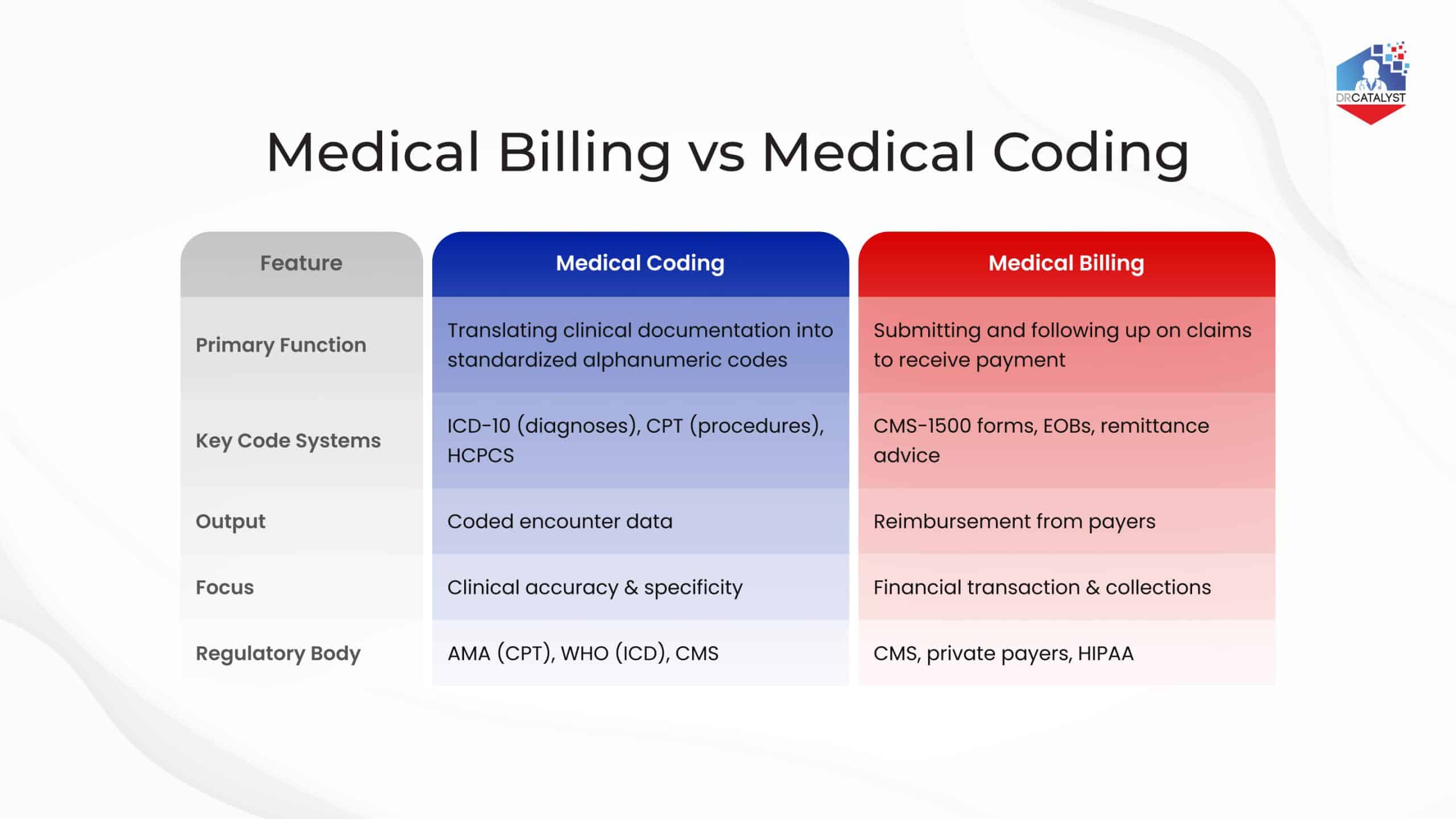
Difference Between: Medical Billing vs Medical Coding
Medical billing and coding are two distinct pillars of the healthcare revenue cycle. Understanding the differences between them is crucial for practice efficiency. Coding requires a deep focus on clinical accuracy and regulatory compliance to ensure every diagnosis is represented correctly. Billing requires mastery of financial follow-up and payer rules to ensure that the diagnoses represented actually result in revenue.
Together, they form a continuous loop: accurate coding prevents denials, and effective billing ensures the practice remains financially viable. Read more about Drcatalyst’s multi-location medical billing and RCM services.
Master Your Revenue Cycle with DrCatalyst
Navigating the pros and cons of medical billing and coding in-house can be a significant burden for growing practices. The high cost of training, the risk of coding errors, and the constant flux of payer rules often lead to revenue leakage. DrCatalyst offers specialized medical coding services with a proven track record of posting $59.5M+ in accurate charges each month. Our end-to-end billing support helps practices save over $25,000 annually with our efficient remote staff.
By leveraging our team of AAPC-certified experts, you ensure your practice achieves peak clinical accuracy and maximum financial reimbursement. Don’t let coding errors or billing delays hold your practice back. Schedule a free consultation with DrCatalyst’s professionals today.
Conclusion
The difference between medical billing and coding lies in their roles, but both are essential for a healthy revenue cycle. Coding ensures accurate documentation, while billing ensures providers are paid for their services. Practices that align these functions effectively see better financial outcomes and smoother operations. With the right expertise and support, healthcare organizations can turn complex processes into a smoothly functioning system that drives growth.