


The complex world of healthcare involves patient encounters and a massive amount of data. From the symptoms discussed to the specific tests performed and the ultimate diagnosis, these clinical details must be translated into a universal language that insurance companies, government agencies, and healthcare researchers can understand. This is the essence of medical coding. The global medical coding market accounts for USD 39.85 billion in 2024 and is projected to reach USD 71.47 billion by 2030.
If you are new to the healthcare industry or a practice owner looking to optimize your revenue, understanding the fundamentals of this process is essential for financial stability and clinical accuracy. In this guide, we break down the fundamentals of the medical coding process with DrCatalyst. In fact, we will also explore the importance of this service, process, challenges, and what the future holds.
What is Medical Coding?
Every time a patient walks out of a clinic, something happens behind the scenes that most people never think about. Yet without it, no one gets paid, no insurance processes correctly, and no health data makes sense at the national level. This is medical coding, and the rising market for it is projected to grow at a CAGR of 10.22% from 2025 to 2030.
Let’s see what it looks like in real life. A physician in Texas and an insurance adjuster in Ohio speak different professional dialects, but the code Z23 (encounter for immunization) means the same thing to both of them. Medical coding is what makes that translation possible.
The Three Core Code Sets
According to the Medical Coding Market, the radiology and imaging specialty takes the cake, with the highest CAGR of 10.4%. The three systems of medical codes that work together are: ICD-10-CM codes describe why a patient was seen; CPT codes describe what was done; HCPCS Level II codes describe what supplies or equipment were used.
| Code Set | Full Name | Purpose | Example |
|---|---|---|---|
| ICD-10-CM | International Classification of Diseases, 10th Revision, Clinical Modification | Diagnosis coding | E11.9 = Type 2 diabetes without complications |
| CPT | Current Procedural Terminology | Procedure/service coding | 99213 = Office visit, established patient |
| HCPCS Level II | Healthcare Common Procedure Coding System | Equipment, supplies, and non-physician services | A4253 = Blood glucose test strips |
Evaluation & Management (E&M) Coding: The Most Common Code Type
The Global Medical Coding Market has noted that CPT and HCPS account for 32.5% of the market in 2025. E&M codes (99202–99215) are the most frequently used CPT codes in outpatient/ambulatory settings and represent the majority of physician billing.
Key E&M Code Ranges
| Code Range | Patient Type | Setting |
|---|---|---|
| 99202–99205 | New patients | Office/outpatient |
| 99211–99215 | Established patients | Office/outpatient |
| 99221–99223 | New admissions | Inpatient hospital |
| 99231–99233 | Subsequent visits | Inpatient hospital |
Why Medical Coding is Important
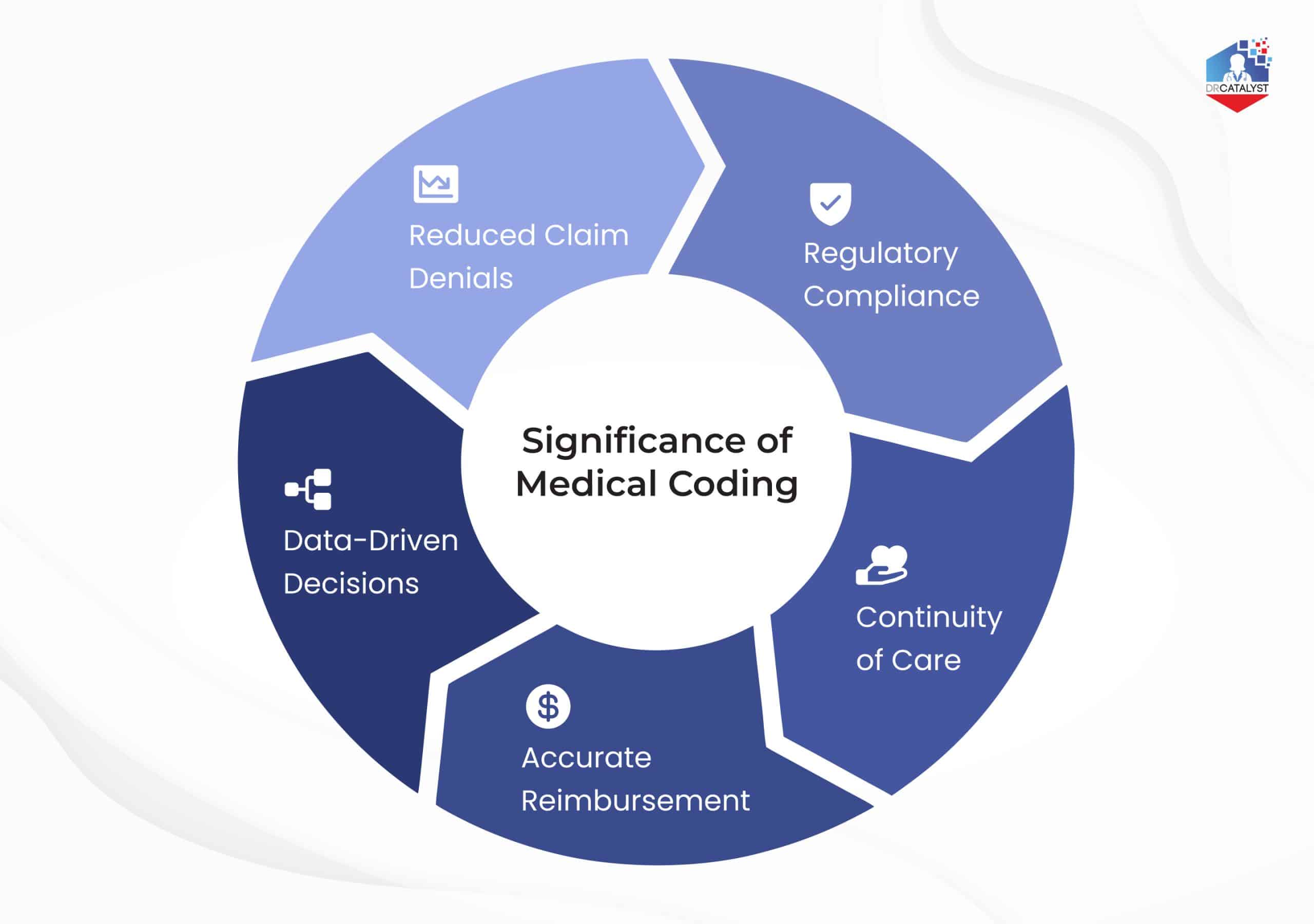
Medical coding is important because it directly impacts the revenue, compliance, and patient care. Here’s why it has a lot of weightage:
- Accurate Reimbursement:
Proper coding ensures healthcare providers are paid correctly for the services they render.
- Regulatory Compliance:
Coding supports adherence to payer guidelines and government regulations.
- Reduced Claim Denials:
Clean and accurate codes minimize rejections and delays.
- Data-Driven Decisions:
Coded data helps in analytics, reporting, and population health management.
- Continuity of Care:
Standardized records ensure consistent patient information across providers.
Without effective medical coding, even high-quality care can lead to revenue loss and compliance risks. Read more about how to avoid medical coding errors and improve billing accuracy.
The Medical Coding Process
The medical coding process is systematic and requires attention to detail. Here’s how it works:
Clinical Documentation Review
Coders analyze physician notes, lab reports, and patient records to determine the correct codes.
Code Selection
Appropriate ICD, CPT, and HCPCS codes are assigned based on the documentation.
Compliance Check
Codes are verified against payer guidelines and regulatory standards.
Claim Submission
The coded data is forwarded for billing and claim submission.
Audit & Review
Regular audits ensure accuracy and reduce compliance risks.
A well-structured coding process ensures fewer denials, faster reimbursements, and smoother revenue cycle operations. Understand how coding fits into the bigger picture of your revenue cycle in our guide on Medical Billing vs Revenue Cycle Management.
Medical Coding Challenges
Medical coding is not a simple functionality. Here are the major challenges that practices and coding teams face:
- Frequent code set updates:
ICD-10, CPT, and HCPCS codes are updated annually (and quarterly for some HCPCS codes), requiring continuous staff training and system updates to stay compliant
- Documentation quality gaps:
Vague or incomplete provider notes may not always trigger an immediate rejection. However, they become a critical liability when payers request medical records. If documentation doesn’t clearly support the selected codes, practices face significant risks of post-payment audits and “takebacks,” in which insurers recoup previously paid reimbursements.
- Coding errors leading to denials:
Incorrect codes, missing modifiers, unbundling, and upcoding contribute to denial rates of 15–20% on average in many practices
- Specialty-specific complexity:
Different specialties have different coding requirements, payer rules, and modifier conventions; a coder proficient in cardiology billing may struggle with orthopedic procedures. Here’s a blog on the common diagnostic codes for allergy clinics.
- Staffing shortages:
The U.S. faces a growing shortage of certified medical coders, leading to backlogs, errors, and increased administrative burden on understaffed teams
- Payer-specific rules:
Each payer has its own coverage policies, prior authorization requirements, and coding preferences that differ from the standard code set guidelines
- Compliance risk:
Upcoding, undercoding, and unbundling all carry serious legal and financial consequences under federal law
- Technology integration:
Connecting coding workflows with EHR systems, billing platforms, and payer portals introduces technical complexity and interoperability challenges
- Value-based care complexity:
As payment models shift toward quality and outcomes rather than volume, coding must capture increasingly nuanced clinical information to support accurate risk adjustment and quality reporting
The Future of Medical Coding
The future of medical coding is evolving with advancements in technology and healthcare delivery models. Key trends to keep in mind for the future include:
- AI and Automation:
Reducing manual effort and improving coding accuracy, but would still require human supervision before claim submission.
- Computer-Assisted Coding (CAC):
Enhancing coder productivity
- Value-Based Care Models:
Increasing focus on accurate documentation and outcomes
- Real-Time Coding Integration:
Swift workflows within EHR systems
- Stronger Compliance Requirements:
Greater emphasis on audit readiness
As the healthcare landscape evolves, practices that adopt modern coding solutions will gain a competitive edge in efficiency and revenue performance. Read more about Automatic Downcoding Threatening Independent Physician Practices.
How DrCatalyst Supports Your Medical Coding Needs
Industry Trends report that outsourced Coding dominates the segment, with 56.33% market share in 2023. Here’s the truth about medical coding in a busy practice: it’s complex, it changes constantly, and the consequences of getting it wrong compound quickly in denials, in compliance exposure, and in revenue that never gets collected or worse, taken back. Most practices can’t maintain a fully staffed, continuously trained, specialty-specific medical coding team in-house.
DrCatalyst’s Medical Coding Services offer AAPC-certified coders to your practice. These remote specialists are trained in your specialty’s payer rules, documentation requirements, and coding conventions. They work directly inside your existing EHR and billing system from day one. We review documentation quality, flag undercoding and potential compliance issues, and provide coder feedback to providers. Our team keeps you updated on code changes that could affect your specialty.
This results in cleaner claims, lower denial rates, faster reimbursements, and a coding function that supports your revenue cycle. Medical coding isn’t just a back-office function. It’s the foundation of your entire billing operation. It should thus be backed by the expertise it requires.
Final Thoughts
Whether you’re a practice owner, a new coder, or simply curious, this article should have helped you understand the nuances of medical coding and how it is the silent engine of healthcare revenue. Accurate coding means faster payment, fewer denials, and more time for patient care. DrCatalyst connects you with experienced, AAPC-certified medical coding professionals who work remotely, follow your protocols, and help you clean up messy claims.