

Provider credentialing is a crucial part of the administrative process in healthcare. It ensures that physicians and healthcare professionals meet the necessary qualifications, certifications, and experience requirements to deliver patient care and receive reimbursements from insurance payers. According to Research and Markets, the credentialing and enrollment services segment held the highest market share at 55.31% in 2023. This can be attributed to the growing use of credentialing & enrollment in healthcare settings, and for insurance payers collecting & providing insurance information.
However, even small errors in credentialing can lead to delayed approvals, denied claims, and lost revenue for healthcare organizations. When the process breaks down, you risk unpaid claims, legal liabilities, and lost patients. Understanding common mistakes in healthcare credentialing is the first step toward a more efficient, profitable practice.
Don’t Let Rookie Errors Delay Your Revenue and Risk Your Reputation
Healthcare Credentialing Errors That Are Costing Your Practice
Healthcare credentialing is an essential safeguard that verifies practitioners’ competence, qualifications, and fitness to practice. Industry reports indicate that there are over 1 million physicians in the USA, and thousands more are joining each year. As a result, healthcare facilities must manage an intricate web of regulations and stringent standards. However, significant defects throughout the credentialing process continue to undermine patient safety and institutional integrity.
For administrators, the stakes are even higher. Credentialing isn’t just a compliance box to check; its primary purpose is to allow providers to see patients and get paid at in-network, contracted rates. Any delay or error directly translates to lost revenue, claim denials, and thousands of dollars in unreimbursed care. Therefore, here we have listed down the key mistakes and prevention strategies:
1. Submitting Incomplete or Inaccurate Applications
Missing documents such as licenses, certifications, malpractice insurance details, or education records are among the most frequent credentialing mistakes. Even minor inconsistencies in dates or provider details can slow down verification. And sometimes it’s not even a missing document; it’s the wrong one entirely. Then, three months later, when you followed up on the application status, you discovered the entire process had to restart from scratch. This would mean three months of lost billing time, all due to a single form error that a second set of eyes would have caught in 60 seconds.
How to Prevent It
Maintain a centralized system, such as CAQH, to track all provider documents and ensure information is updated regularly. Providers upload their documents once, and payers retrieve the information directly from there, eliminating the need to upload the same documents to multiple payer systems. Be sure to reattest your CAQH profile quarterly to keep all information current and compliant.
2. Starting Too Late
Credentialing can take anywhere from 90 to 120 days. It can sometimes also take longer if the payer has a backlog. If you start the process just the week before a new doctor starts, that will lead to empty exam rooms.
How to Prevent It
Build credentialing into your onboarding timeline, and do it at least 4 months in advance.
3. Allowing Providers to Start Before Credentialing is Complete
This is one of the most common and costly errors made by practice, causing credentialing issues in healthcare. The pressure to have a new provider see patients is immense, but letting them practice before they are fully credentialed with payers is a major risk. Any services they provide during this period will likely be non-reimbursable, resulting in a financial loss for the practice.
How to Prevent It
Establish a strict policy requiring completion of the credentialing process before seeing patients. Build a buffer into your onboarding timeline that accounts for the full credentialing cycle. Treat the credentialing start date as the true start date for revenue generation. A clear checklist and project plan for new providers can help prevent jumping the gun.
4. Ignoring Expiration Dates Until It’s Too Late
Provider licenses, board certifications, and insurance policies have expiration dates. If these are not monitored properly, credentialing can lapse, causing major reimbursement issues.
How to Prevent It
Use automated reminders or credentialing management systems to track renewals and maintain compliance.
5. Poor Primary Source Verification
A provider’s CV cannot be taken at face value without verifying their education, training, and peer references through sources. This can lead to serious risks to practice compliance. Skip it, rush it, or rely on photocopies instead of the sources, and your applications will hit a wall. Worse, submitting unverified credentials can expose your practice to compliance violations and, in serious cases, liability. This is one of those common credentialing mistakes that practices don’t realize they’re making until a payer rejects an application or an audit surfaces a gap, and it affects their entire billing cycle.
How to Prevent It
Verify directly from the issuing source about licensing boards, medical schools, and certification bodies. Don’t rely on what a provider hands you. Confirm it yourself, document it, and keep a record to avoid credentialing issues in healthcare.
6. Poor Communication with Providers
One of the most common mistakes in healthcare credentialing is failing to obtain the necessary documents from busy providers. This back-and-forth creates massive delays if providers don’t understand what’s needed or why it’s urgent, and credentialing stalls.
How to Prevent It
Create a clear, simple “provider packet” that lists all required documents for the credentialing process up front. Use a provider portal so they can upload documents directly without a lot of back-and-forth. Send friendly, automated reminders to providers so the whole process is easy for them to see what’s still missing. Only when providers understand that incomplete files lead to delayed paychecks do they become more motivated to cooperate and improve the overall billing lifecycle.
7. Inconsistent Provider Information
Discrepancies in provider names, NPIs, addresses, or practice locations across different applications can raise red flags during verification. Similarly, unexplained gaps in work history or unfavorable National Practitioner Data Bank (NPDB) reports, such as settled malpractice claims or disciplinary actions, can trigger intensive audits and significantly delay the credentialing process.
How to Prevent It
At DrCatalyst, we ensure that all provider data remains consistent across credentialing applications, payer enrollments, and internal systems to minimize falling for common credentialing mistakes.
8. Outdated CAQH Profiles
If you work with commercial payers, you already know that most of them rely on CAQH to verify provider information. What surprises many practices is just how often those profiles are outdated due to incorrect addresses, expired documents, and outdated malpractice information, and how much that slows things down. An outdated CAQH profile doesn’t just delay one application. It creates a ripple effect across every payer that pulls from it, which is most of them.
How to Prevent It
Build a quarterly CAQH profile audit into your credentialing workflow. Every three months, log in, verify that all information is current, and re-attest. It takes less time than chasing down a denied enrollment.
9. Overlapping Committee Responsibilities
A primary challenge in credentialing implementation is the overlapping of duties by credentials committees, leading to unclear accountability and inconsistent application of standards. This confusion results in gaps that allow misconduct or incompetence to slip through undetected.
How to Prevent It
Define distinct roles and responsibilities for credentials committees to eliminate overlapping duties and ensure accountability at each stage of the process.
10. Not Staying Updated on Payer Requirements
Payer rules, enrollment forms, and coverage policies change constantly. What was acceptable for Cigna last year might be different today. Relying on outdated knowledge is a surefire way to have applications returned or denied, making it one of the trickier credentialing issues in healthcare to manage alone.
How to Prevent It
Designate someone on your team to monitor payer communications and update your internal checklists regularly. Better yet, partner with DrCatalyst. We’re a specialist in staying current on every single payer’s nuances across multiple states for an effective credentialing process.
11. Lack of Process Standardization
Ask any credentialing specialist what slows them down most, and “I can’t find the right document” is usually somewhere near the top of the list. When provider files are scattered across email threads, shared drives, physical folders, and someone’s desktop, errors happen. Documents go missing. Expired certificates get submitted. Applications go out incomplete.
Healthcare credentialing errors stemming from disorganization aren’t just dramatic; they’re definitely death by a thousand cuts.
How to Prevent It
Centralize everything. One digital home for every provider’s credentialing documents, organized by provider, with clearly labeled folders for each document type and expiration date visible at a glance. If your current system doesn’t support that, it’s worth upgrading to DrCatalyst and our proven experience in credentialing services.
12. Underestimating the Time and Resources Required
Many practices hand credentialing to an already overworked office manager, expecting it to be a small, additional task. They soon discover it’s a full-time job. The administrative burden leads to burnout, errors, and a massive opportunity cost as other important tasks get neglected.
How to Prevent It
Be realistic. If your practice is growing or has multiple providers, credentialing needs dedicated attention. This might mean hiring a specialist or, for many practices, partnering with experts like DrCatalyst who can handle the entire credentialing lifecycle efficiently. When you work with our dedicated, trained credentialing team, you can focus on patient care while we do the heavy lifting.
13. Not Recredentialing Existing Providers
New provider credentialing gets attention because it’s urgent and visible. However, recredentialing for existing providers often falls through the cracks until a payer sends a termination notice or a compliance audit surfaces a gap. Most payers require recredentialing every two to three years. Missing that cycle can mean losing a provider’s in-network status entirely, which affects both patient access and revenue.
It doesn’t stop at commercial payers either. Missing Medicare and Medicaid revalidation deadlines, which CMS requires every 5 years depending on provider type, can result in termination from those programs. And since many Managed Care Organizations (MCOs) tie the credentialing requirements directly to active Medicare and Medicaid enrollment status, a lapse in federal revalidation can trigger a cascading termination across multiple MCO contracts. One missed deadline can quietly unravel years of payer relationships.
How to Prevent It
At DrCatalyst, our credentialing solutions involve tracking recredentialing deadlines the same way we track initial credentialing — including Medicare and Medicaid revalidation windows. We put them on a shared tracker and assign ownership. We don’t assume someone else is watching it.
14. Credentialing Misalignment and Underpayment
Beyond missing documents, many practices suffer from “ghost denials” caused by incorrect provider enrollment or expired payer-specific credentials. If a provider is not correctly linked to your group NPI or their CAQH profile isn’t re-attested, insurers will deny every claim for that provider, regardless of how accurate the clinical coding is. These errors often remain unnoticed until the A/R aging report reveals a massive spike in unpaid encounters.
How to Prevent It
Partner with DrCatalyst to conduct regular audits of your payer status. DrCatalyst helps you reevaluate your existing contracts to see if you are being underpaid or if your credentialing status is limiting your reimbursement potential. By identifying these gaps, we help you renegotiate your contracts and ensure your practice is positioned to receive the maximum allowable rates for your services.
The Impact on Your Revenue Cycle
Healthcare credentialing errors don’t just increase the administrative workload; they directly impact your bottom line. If a provider isn’t properly credentialed, insurance companies will not recognize them as “in-network,” meaning you cannot bill for their services. This leads to:
- Increased Denials:
Claims for non-credentialed providers are rejected automatically, adding to your medical billing workload.
- Patient Dissatisfaction:
Patients may receive unexpected “out-of-network” bills, which can damage your practice’s reputation.
- Stalled Growth:
You can’t scale your practice or add new specialties if your providers aren’t authorized to bill.
Why Accurate Credentialing Matters for Revenue Cycle Management
The global credentialing market size was estimated at USD 807.8 million in 2023. As of now, it is expected to reach USD 1.42 billion by 2030. This growth is estimated to be between a CAGR of 8.3% from 2024 to 2030. If providers are not properly credentialed, insurance companies may reject or deny claims, resulting in lost revenue. This makes it crystal clear how credentialing is closely tied to healthcare revenue cycle management. It must work easily with other operational processes such as healthcare billing, claims management, and payer enrollment. Practices that maintain strong credentialing workflows typically experience:
Faster payer approvals
Reduced claim denials
Improved compliance
More predictable revenue streams
Let DrCatalyst Take the Credentialing Headache Off Your Plate
Many organizations struggle to manage credentialing issues in healthcare internally due to time constraints and administrative complexity. Deciding between in-house and outsourced credentialing depends on your practice size, available staff, and operational needs. From initial enrollment to ongoing re-credentialing, our professionals ensure your providers stay compliant, and your revenue stays steady. Whether you need to hire remote medical billers or a full RCM overhaul, we deliver speed, clarity, and flexibility.
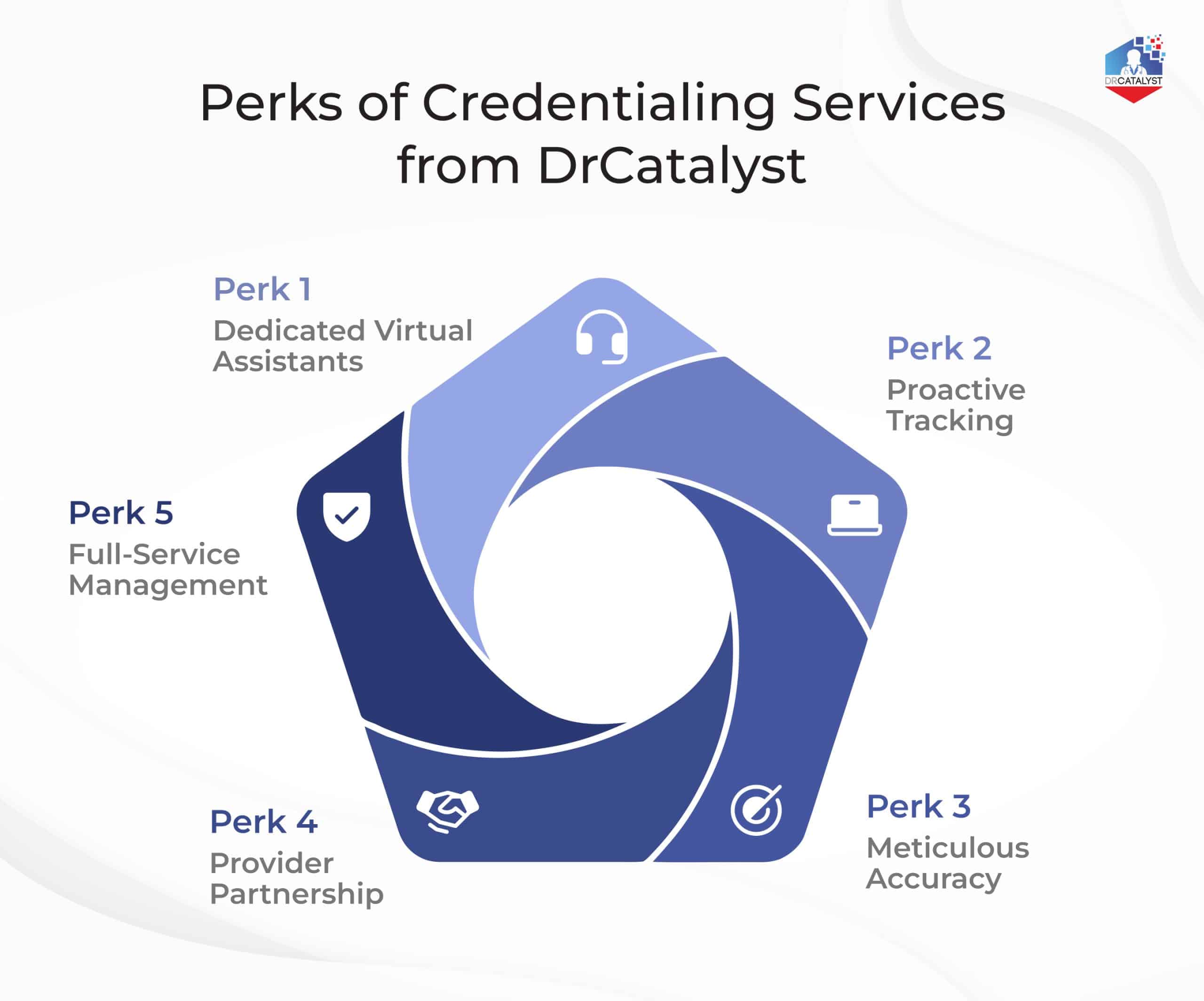
Here’s how we prevent these errors for our clients:
- Dedicated Virtual Assistants:
Your practice is assigned experienced credentialing specialists who live and breathe payer requirements.
- Proactive Tracking:
We monitor expirations and recredentialing deadlines months in advance, so you never miss a beat.
- Meticulous Accuracy:
Every application is reviewed and verified before submission, slashing rejection rates.
- Provider Partnership:
We work directly with your providers to gather documents, making the process smooth for both of them.
- Full-Service Management:
From the very first credentialing of the provider through ongoing maintenance and payer follow-up, and finally recredentialing, we are equipped to handle it all.
TL;DR
Common mistakes in healthcare credentialing often result from strained administrative staff. Firstly, by understanding these common credentialing mistakes and implementing structured processes, healthcare providers can improve efficiency and reduce delays. In fact, even leveraging expertise from reliable credentialing systems ensures that providers remain compliant and fully authorized to deliver care.
If your organization is facing credentialing challenges, consider partnering with DrCatalyst. Don’t just take our word for it, hear it from our happy clients, too. They have repeatedly highlighted that we understand the complexities of the credentialing process and can help keep your practice running smoothly.