

Imagine you hired a surgeon. They’ve been through their first week, and you discover that their medical license expired three years ago. Or submitting insurance claims for months, only to find out your new provider was never properly credentialed with the payer, and now you can’t get paid for any of that work.
Sounds like a nightmare, right? That’s exactly what healthcare provider credentialing prevents.
Medical credentialing is the behind-the-scenes process that verifies every provider’s qualifications, licenses, training, and work history before they can legally practice or bill insurance companies. The global market for credentialing services is expected to reach USD 1.42 billion by 2030. It has been growing at a CAGR of 8.3% from 2024 to 2030. Medical credentialing process is tedious, time-consuming, and absolutely non-negotiable.
If you’re new to credentialing for healthcare providers or just trying to understand why it takes so long, this guide will walk you through everything: what it is, why it matters, how the process works, and how to avoid the biggest pitfalls that slow practices down.
Explore DrCatalyst’s Medical Credentialing Services
What is Provider Credentialing in Healthcare?
Healthcare provider credentialing is the formal process of verifying that medical professionals. doctors, nurse practitioners, physician assistants, therapists, and other clinicians must have the proper qualifications, licenses, certifications, and clean backgrounds to provide patient care and bill insurance companies.
Think of it as a comprehensive background check combined with professional verification. Before a provider can see patients under an insurance plan or work at a hospital, credentialing ensures they are who they claim to be and qualified to do what they say they can do.
Listen to our webinar to understand Provider Credentialing
What gets Verified during Medical Credentialing?
The physician credentialing process typically includes verification of:
Medical education and training – Medical school, residency, fellowships
Active medical licenses – State and DEA licenses
Board certifications – Specialty certifications (e.g., ABIM, ABFM)
Work history – Previous employment and clinical experience
Malpractice insurance – Current coverage and claims history
Background checks – Criminal records, sanctions, disciplinary actions
Hospital privileges – Affiliations and admitting rights
All of this information, and many more credentialing details are reviewed by insurance companies (payers), hospitals, and healthcare networks before they approve a provider to participate in their plans or facilities.
Why does Provider Credentialing matter?
Without proper credentialing:
Providers can’t bill insurance companies
Patients may not receive coverage for services
Practices risk compliance violations and legal issues
Healthcare organizations can’t verify provider competency
In short, no credentialing = no reimbursement = no revenue.
Learn more about the revenue cycle and billing basics
Step-by-Step Healthcare Provider Credentialing Process
The credentialing process for providers is notoriously slow. It can typically take 90 to 180 days or longer. Here’s what happens during that time:
Step 1: Application Submission
The provider (or the practice’s credentialing team) completes detailed applications for each insurance payer, hospital, or healthcare network. These applications require:
Personal information
Education and training details
License numbers and expiration dates
Work history for the past 5-10 years
Malpractice insurance details
References from colleagues
Each payer has its own application format. So, this step alone can take weeks if a provider needs to credential with multiple insurance companies.
Step 2: Primary Source Verification (PSV)
Insurance companies don’t just take your word for it. They verify everything directly with the original sources:
Medical schools confirm degrees
State licensing boards confirm active licenses
Board certification organizations verify specialty credentials
Previous employers confirm work history
The National Practitioner Data Bank (NPDB) is checked for malpractice claims or sanctions
This is the most time-consuming part of the medical credentialing process because it relies on third-party responses, which can take weeks or even months.
Step 3: Committee Review
Once all documents are verified, the payer’s credentialing committee reviews the provider’s entire file. They assess qualifications, check for red flags, and determine whether to approve or deny the application.
Step 4: Approval and Enrollment
If approved, the provider is officially enrolled in the payer’s network and assigned a provider ID number. At this point, they can start seeing patients covered by that insurance plan and the practice can bill for those services.
Step 5: Re-credentialing
Credentialing isn’t a one-time event. Providers must be re-credentialed every 2-3 years to maintain their status with payers and hospitals. This means the entire process repeats periodically throughout a provider’s career.
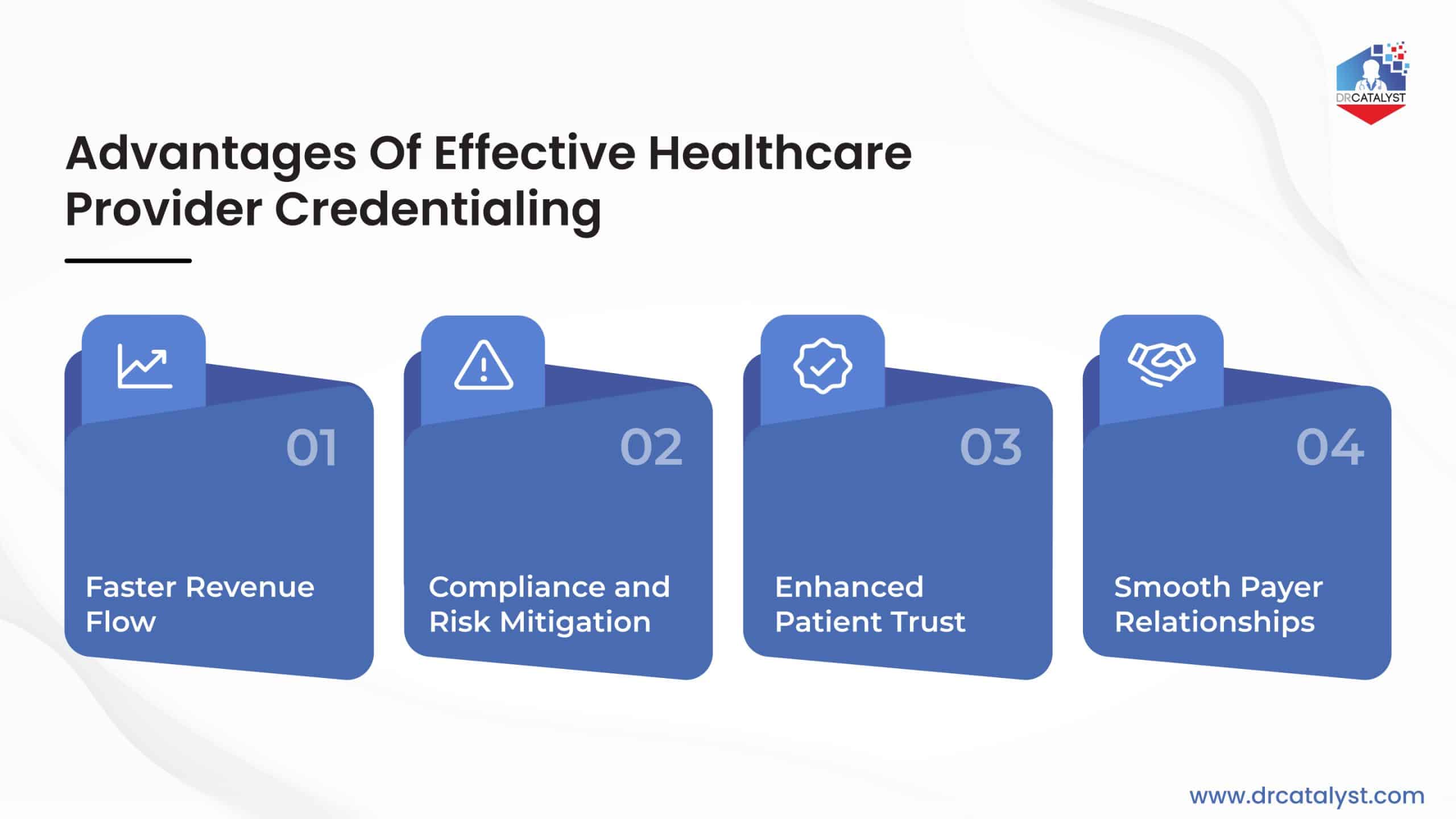
The Benefits of Effective Healthcare Provider Credentialing
When done right, the credentialing process in healthcare delivers measurable benefits that go far beyond just “checking boxes.”
1. Faster Revenue Flow
Properly credentialed providers can bill insurance companies immediately. Delays in credentialing mean delays in revenue, which can last for months. A smooth credentialing process ensures your practice starts getting paid as soon as your provider starts seeing patients.
2. Compliance and Risk Mitigation
Credentialing verifies that providers meet all legal, regulatory, and professional standards. This protects your practice from:
Billing for services by uncredentialed providers (which is fraud)
Employing providers with hidden disciplinary actions or malpractice issues
Violating payer contracts and losing network participation
3. Enhanced Patient Trust
Patients want to know their providers are qualified and trustworthy. Credentialing creates transparency and accountability, ensuring that every provider in your practice meets the highest professional standards.
4. Smooth Payer Relationships
Insurance companies require credentialing before they’ll pay claims. Having organized, accurate credentialing processes builds positive relationships with payers and prevents claim denials due to credentialing issues.
Example: A multi-provider orthopedic practice hired two new surgeons to meet growing patient demand. Due to incomplete paperwork and slow responses from previous employers, credentialing with major insurance payers took 6 months instead of the expected 90 days.
During that time:
The surgeons could only see cash-pay patients
The practice lost an estimated $180,000 in insurance reimbursements
Patient wait times increased, leading to complaints and lost referrals
Once the practice partnered with a specialized credentialing service, they reduced future credentialing timelines to 60-75 days and avoided similar losses.
Discover how efficient credentialing services can speed up insurance approvals
Challenges in Healthcare Provider Credentialing
The physician credentialing process is very complex. Even small mistakes in the process can lead to major delays. Here are the most common challenges that practices face in healthcare provider credentialing:
1. Lengthy Timelines
Even under ideal conditions, credentialing takes 90-180 days. Delays from payers, missing documents, or verification issues can stretch this to 6-9 months. During this time, providers can’t bill insurance, which directly impacts revenue.
2. Complex Documentation Requirements
Each insurance payer has different forms, requirements, and submission processes. Gathering and organizing all necessary documents, especially for providers with long work histories or multiple board certifications, is time-consuming and prone to errors.
3. Primary Source Verification Delays (PSV)
PSV relies on third parties (medical schools, licensing boards, and previous employers) to respond to verification requests. If any of these sources are slow or unresponsive, the entire process stalls.
4. Incomplete or Inaccurate Information
A single missing document or typo on an application can cause rejection and require resubmission, adding weeks or months to the timeline. Common issues include:
Expired licenses or certifications
Gaps in work history without explanation
Missing malpractice insurance details
Inconsistent information across different forms
5. Re-credentialing Requirements
Credentialing isn’t a one-and-done process. Providers must be re-credentialed every 2-3 years, which means practices must continuously track expiration dates, renew licenses, and resubmit applications. Often, they undertake this process while juggling daily operations.
6. Staffing and Expertise Gaps
Medical credentialing requires specialized knowledge of payer requirements, compliance regulations, and document management. Many practices don’t have dedicated credentialing staff. This leaves the task in the hands of already-overwhelmed administrative teams who may lack the exposure to navigate the process efficiently.
How DrCatalyst simplifies Healthcare Provider Credentialing
At DrCatalyst, we know that credentialing delays cost practices abundant money and headaches. That’s why our Medical Credentialing Services are designed to take this burden off your plate entirely.
What we Handle:
- Initial credentialing:
Complete application preparation, 24/7 status tracker, and submission for new providers
- Re-credentialing management:
Proactively tracking the credentials and renewing it before deadlines
- Primary source verification:
Direct follow-up with licensing boards, schools, and employers
- Payer enrollment:
Enrollment with Medicare, Medicaid, and commercial insurance networks
- Council for Affordable Quality Healthcare (CAQH) profile management:
Keeping your CAQH data current and accurate
- Compliance monitoring:
Tracking license expirations, certifications, and payer contract requirements
Why Organizations trust DrCatalyst’s Credentialing for Healthcare Providers?
- Faster timelines:
Our 700+ dedicated credentialing specialists help in reducing average credentialing time.
- Fewer errors:
We’ve successfully completed credentialing for over 350+ providers by ensuring that every application is complete and accurate before submission
- Proactive tracking:
You’ll never miss a re-credentialing deadline or license renewal
- More time for patient care:
We’ve successfully handled the credentialing in 18+ states so that the in-house team can peacefully attend patients.
Whether you’re onboarding new providers, expanding to new locations, or simply tired of credentialing chaos, we provide end-to-end support that keeps your practice compliant, efficient, and revenue-ready.
Explore our Virtual Medical Assistants for additional administrative support
Conclusion
Medical Billing and provider credentialing are one of those necessary evils. It is tedious, time-consuming, and absolutely critical to your practice’s financial health. Without proper credentialing, you can’t bill insurance, your providers can’t practice, and your revenue grinds to a halt. But it doesn’t have to be tricky all the time! With a detailed understanding of the credentialing process in healthcare, recognizing common challenges, and partnering with experienced credentialing professionals, you can avoid costly delays and keep your practice running smoothly.
The question is how to efficiently credential so that it doesn’t hold your practice back. Let’s look at your credentialing process for faster revenue processing!