


Your practice could be doing everything right clinically, and still lose tens of thousands of dollars a year. For most healthcare providers, that’s not a hypothetical. It’s Tuesday. And the stakes couldn’t be higher. The global revenue cycle management market was estimated at USD 343.78 billion in 2024.
The present forecast says that the revenue cycle market will reach USD 894.25 billion by 2033. This means the growth rate will be 11.12% CAGR from 2025 to 2033. An average practice has denied claims piling up, prior authorizations stalling care, and payments delayed, disputed, or, in the worst cases, never collected. The harder truth is that it is a problem that can be fixed with revenue cycle management best practices.
Why RCM is a Critical Challenge for Healthcare Practices
Revenue Cycle Management (RCM) is the process of managing every financial step of the patient journey, from scheduling and insurance verification to claims submission, reimbursement, and payment collection. The obstacles in the revenue cycle are numerous and often interconnected, creating a perfect storm of financial erosion and administrative burnout.
Complex & Changing Payer Rules: Keeping up with thousands of payer policies, medical necessity guidelines, and coding updates is full-time work.
Rising Claim Denial Rates: A significant percentage of denied claims on first submission are a result of minor errors, missing prior authorizations, or incomplete documentation.
Prolonged Prior Authorizations: The time-consuming process of securing approvals for procedures, medications, and referrals creates treatment delays and revenue bottlenecks.
Administrative Burden on Staff: Your clinical and front-desk teams spend long hours on manual data entry, billing follow-up, and insurance phone calls instead of focusing on patients.
Slow Payments & Aging Accounts Receivable (A/R): Without aggressive follow-up, accounts receivable can age quickly, strangle cash flow, and make financial planning a nightmare.
The “Back-and-Forth” of Claims Processing: The revenue cycle is rarely linear. It involves a constant loop of claim scrubbing, submission, tracking, handling rejections, appealing denials, and resubmissions, a cycle that demands relentless attention.
These challenges are often addressable when RCM best practices are adhered to.
Revenue Cycle Management Best Practices for Healthcare Practices
Running a financially healthy practice requires good clinical care as well as a revenue cycle that actually works. From the moment a patient schedules an appointment to the day a claim is paid, every step in the process is an opportunity to capture revenue or lose it. The best RCM habits listed below distinguish high-performing practices from those that are constantly fighting denials and chasing payments.
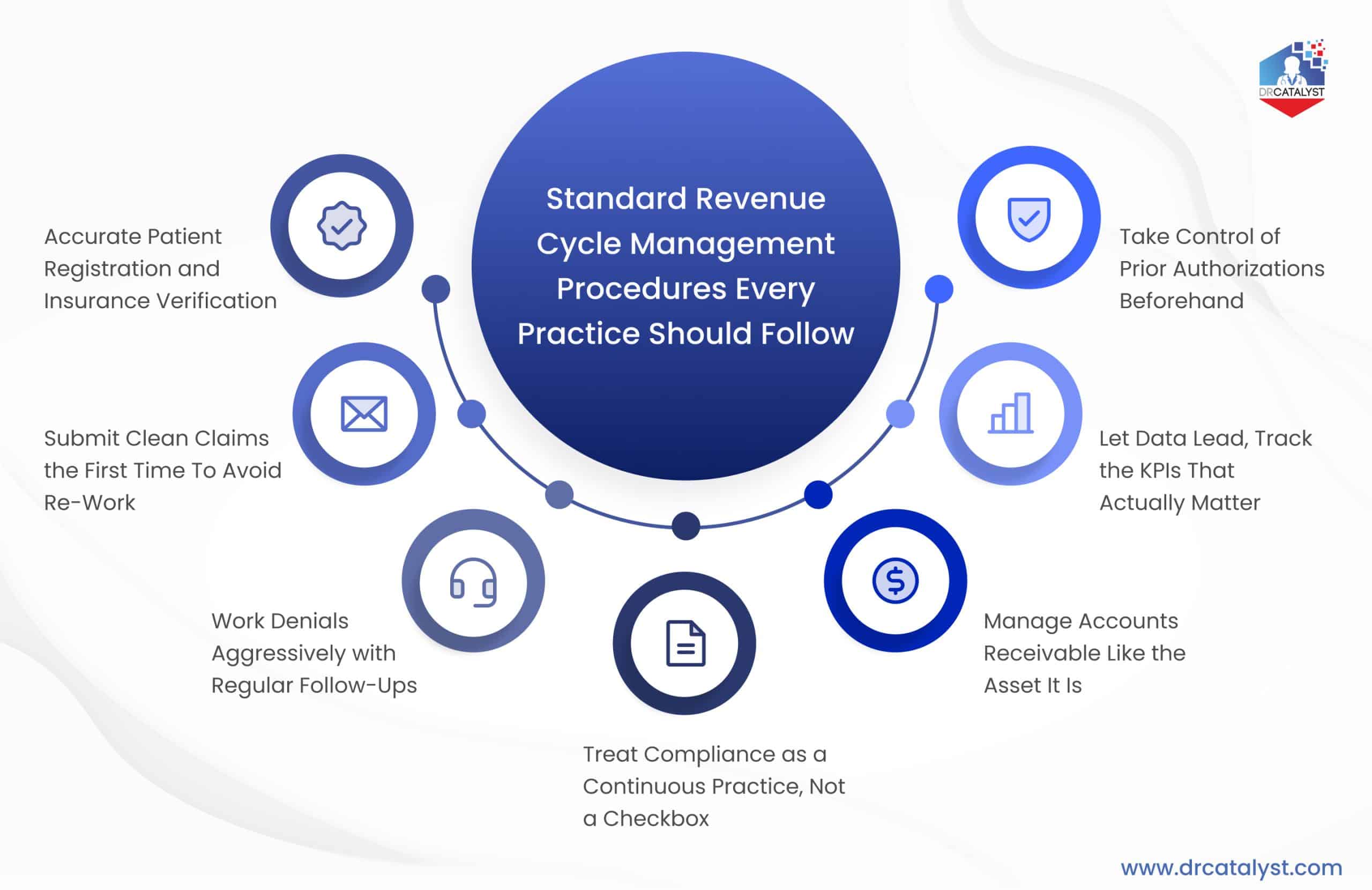
1. Accurate Patient Registration and Insurance Verification
Does the revenue cycle start when a claim is submitted? Think again. The revenue cycle starts when a patient calls to schedule an appointment. Any simple error in the patient name, date of birth, insurance ID, or group policy number creates a cascade of downstream problems, including rejected claims, delayed payments, billing disputes, and frustrated patients.
According to AHIMA research, the cost to rework a denied claim averages $25, before accounting for lost time, delayed cash flow, and the very real possibility that the claim never gets paid at all.
Best practice: Cross-check registration workflows. This, coupled with insurance eligibility verification, helps catch these issues before they become expensive denials. Verifying coverage 48–72 hours before each appointment. A little pre-planning pays off for the team, giving them the window they need to address gaps, confirm prior authorization requirements, and set accurate patient financial expectations.
2. Submit Clean Claims the First Time
A clean claim has no errors or missing information, its supporting documentation is complete, and it gets paid on the first submission. To achieve consistently clean claim submission, precision is required at every step: accurate coding, proper modifiers, matching diagnosis codes, and documentation that supports the level of service billed.
Claims scrubbing tools combined with trained billing specialists catch coding errors, missing modifiers, and documentation gaps before a claim ever reaches a payer.
Best practice: Build a multi-level review process, automated claim scrubbing followed by human review for complex or high-value claims. Every hour invested in healthcare revenue cycle management best practices leads to cleaner claim submissions and saves hours of denial follow-up.
3. Work Denials Aggressively
Claim denials are inevitable. How your practice responds to them is what separates a healthy revenue cycle from a struggling one. Effective denial management goes well beyond simply resubmitting claims.
To manage denials proactively, categorize them by root cause, eligibility issues, coding errors, lack of prior authorization, medical necessity disputes, or duplicate claim submissions. Each category requires a different fix. Tracking these patterns over time reveals systemic gaps that can be corrected upstream, preventing the same denials from recurring.
Best practice: Establish clear timelines for denial turnaround. Work denials and rejections within 48–72 business hours. Prioritize high-value claims and those approaching payer timely filing deadlines.
4. Take Control of Prior Authorizations Before They Take Control of You
If there’s one RCM function that consistently breaks practices, operationally and financially, it’s prior authorizations! The average practice spends 12 hours per week managing prior authorizations, according to the American Medical Association.
Prior authorization requirements have increased by 30% over the last three years. When authorizations are missed, delayed, or incorrectly obtained, the result is denied claims, delayed patient care, and frustrated clinical teams.
The key is a proactive system: track which services require payer authorization, submit requests early enough to receive approvals before the scheduled service date, follow up regularly on pending requests, and document everything meticulously. For high-volume practices, this function demands dedicated focus; it can’t be a side task for already-overloaded front desk staff.
Best practice: Assign dedicated staff or a virtual healthcare assistant specifically to prior authorization management. Specialization in revenue cycle management best practices pays for itself many times over in reduced denials and smoother care delivery.
5. Manage Accounts Receivable Like the Asset It Is
Accounts receivable is where revenue gets lost and where practices often discover just how much they’ve been leaving on the table. Claims that sit unpaid for 30, 60, or 90 days aren’t just a cash-flow problem; they’re a collections problem.
Payer timely-filing limits, write-off policies, and administrative overload mean old AR management rarely gets the attention it deserves. A healthy AR has the majority of outstanding balances under 30 days, with very little aged beyond 90 days. If you’re seeing the opposite, your denial management, follow-up processes, or staffing levels need attention, fast!
Best practice: Review AR aging reports weekly. Prioritize follow-up on claims approaching timely filing deadlines and high-dollar balances. At DrCatalyst, aged insurance claims are worked as standard practice, not as an exception.
6. Let Data Lead, Track the KPIs That Actually Matter
You cannot fix what you do not measure. Healthcare practices operating without consistent revenue cycle reporting are reacting to financial problems rather than preventing them.
The right revenue cycle KPIs give you early warning signs of process breakdowns and a clear picture of where revenue is being gained or lost. The metrics every practice should be tracking include:
Days in Accounts Receivable (AR) measure how long it takes to collect payment after a service
Clean Claim Rate includes the percentage of claims paid on the first submission
Denial Rate by payer and procedure pinpoints exactly where revenue is leaking
Net Collection Rate of what you’re actually collecting vs. what you’re owed
Cost to Collect is all about how much you’re spending to bring in each dollar
First Pass Resolution Rate determines the efficiency of your initial claim submission
According to a 2026 MGMA survey, 37% of medical group leaders said their biggest investment for 2026 is in the workforce, precisely because RCM best practices require people who can interpret these numbers and act on them.
Best Practice:Establish a recurring billing review cadence; weekly for operational KPIs, and monthly for strategic performance reviews. Make it a real conversation with your RCM team, not just a report drop.
7. Treat Compliance as a Continuous Practice, Not a Checkbox
Regulatory compliance in healthcare billing is a moving target. ICD-10, CPT, and HCPCS coding updates, payer policy changes, CMS rule revisions, and state-level regulations all shift regularly. A compliance lapse, intentional or not, can trigger denied claims, audits, recoupments, and serious reputational damage.
Best practice: Conduct internal coding and documentation audits at least quarterly. Flag patterns that could indicate upcoding, undercoding, or documentation gaps, and address them proactively. Train staff on compliance updates as they happen, not annually.
How DrCatalyst Helps Practices Implement Revenue Cycle Management Best Practices
DrCatalyst provides end-to-end RCM solutions designed to eliminate inefficiencies and maximize financial performance. Our services include:
Insurance eligibility verification
Prior authorization management
Accurate coding and documentation review
Clean claim submission and tracking
Denial management and appeals
Payment posting and reconciliation
Revenue analytics and performance dashboards
We combine healthcare expertise, intelligent workflows, and dedicated support to help practices implement proven revenue cycle management best practices. Our team ensures your revenue cycle runs efficiently, so your staff can be relieved of administrative burdens to focus on patient care.
The Bottom Line
In an era of shrinking margins and increasing complexity, a reactive approach to revenue cycle management is a recipe for financial strain. By adopting data-driven best practices and partnering with specialists like DrCatalyst, your practice can move from simply processing claims to actively optimizing revenue. You can reduce the administrative chaos, stabilize cash flow, and, most importantly, reinvest your team’s time and energy where it matters!