


Two claims come back unpaid on the same day. One never reached the payer. The other was opened, reviewed, and refused. If your team handles both the same way, one of them will quietly age past its filing deadline while somebody drafts an appeal letter for the other. That is what’s actually at stake in the claim rejection vs denial question. The two outcomes reach you through different channels and need opposite responses. Confusing them costs real money, and the volume isn’t trivial.
KFF found that insurers on HealthCare.gov denied 19% of in-network claims in 2024, and that fewer than 1% of those denials were ever appealed. A lot of it is preventable. As we’ve covered in our piece on preventing claim denials, most of what ends up in a denial queue started as something catchable before the claim left the building. In this blog, we have explored what each outcome actually is, how to tell them apart in about ten seconds, and what to do with each.
What is a Claim Rejection?
A rejected claim never made it into the payer’s adjudication system. It failed a front-end check, either at your clearinghouse or at the payer’s front door, because something about the file couldn’t be read or matched. Wrong format. Missing required field. A member ID that doesn’t exist.
Watch how it reaches you and the distinction becomes obvious. An accepted claim comes back on a 277 Claim Acknowledgment with a claim number attached, and that number is what you use to track it from then on. A rejected one comes back with error codes and no claim number at all. That absence is the tell. As far as the payer is concerned, you haven’t submitted anything yet.
One consequence matters more than the rest. A rejection can’t be appealed, because nothing was decided. You fix it and send it again. Meanwhile, the timely filing clock has been running since the date of service, and nobody at the payer’s end knows the claim exists. Most rejections never get that far, because claim scrubbing catches them at the door.
What is a Claim Denial?
A denied claim is the reverse. It was accepted, given a claim number, worked all the way through adjudication, and then refused payment. Somebody, or something, looked at it and said no.
Denials show up on the remittance advice or EOB carrying Claim Adjustment Reason Codes, the standardized CARC values that explain why a claim or service line was paid differently than it was billed. A Remittance Advice Remark Code usually sits alongside more detail.
Those codes are the whole story, and each carries a fixed published meaning in the CARC list maintained by X12, the body that sets these standards. Code 50 covers services “not deemed a medical necessity by the payer.” Code 29 means “the time limit for filing has expired.” Code 97 means the benefit is “included in the payment/allowance for another service/procedure that has already been adjudicated.” Code 204 covers a service “not covered under the patient’s current benefit plan.”
The two-letter prefix matters as much as the number. CO marks the amount of a contractual obligation your practice absorbs. PR moves that balance to the patient. So CO-50 and PR-204 send a claim down very different paths, even though both look like a refusal at first glance.
Because a denial is a decision, you can appeal it, and usually that’s the right route. Resubmitting a denied claim as though it were new tends to produce a duplicate denial and burns another cycle for nothing. Our guide to healthcare denial management covers how to build a process around this instead of treating each one as a fresh surprise.
Difference Between Claim Rejection and Claim Denial
The difference between claim rejection and claim denial comes down to a single question. Did the claim get adjudicated? Everything else follows from the answer.
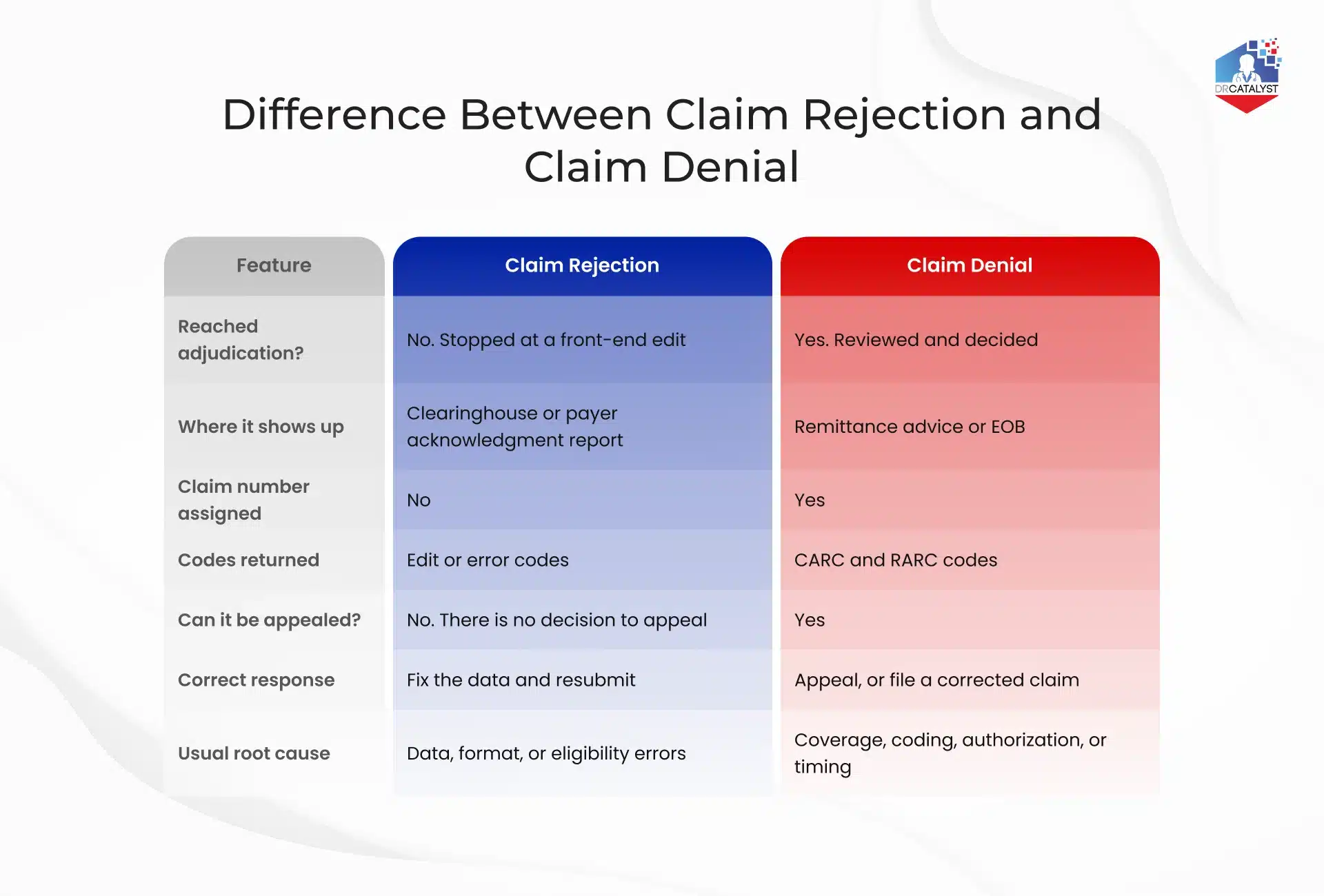
In practice, one habit settles it. If the unpaid claim shows up on your remittance advice with a reason code attached, it’s a denial. If it came back on an acknowledgment report before any remittance existed, it’s a rejection.
Common Causes of Claim Rejections
Rejections are almost always clerical. The care was appropriate. The coding may well have been correct. The claim simply couldn’t be read, or couldn’t be matched to a member.
Patient demographics that don’t match the payer’s record. A misspelled surname, a transposed date of birth, a maiden name nobody updated.
An invalid, expired, or mistyped member ID.
Coverage that had already terminated on the date of service.
Missing or invalid NPI, tax ID, or taxonomy code.
Wrong payer ID, which sends the claim somewhere it was never meant to go.
Codes that don’t exist or aren’t formatted correctly for the submission type.
One cause gets misread constantly. When a provider isn’t yet active with a payer, claims for that provider often get rejected outright rather than paid or denied. Billing sees a data error. The real problem is sitting in enrollment, several weeks upstream. Our breakdown of credentialing errors covers how often this happens and how to catch it before a month of claims goes out.
Common Causes of Claim Denials
Denials are decisions, so their causes sit further upstream, in coverage rules, documentation, authorization, and timing.
The payer judged the service not medically necessary for the diagnosis submitted.
Prior authorization or a referral was required, and nobody obtained it.
The patient’s plan excludes the service outright.
The claim arrived after the filing window had closed.
Coordination of benefits was unresolved, so the wrong payer got billed first.
Bundling or modifier problems, such as an unbundled service or a modifier the payer would not accept.
A duplicate of something already on file.
An underpayment rather than a denial. The claim was processed and paid, but below the contracted rate. These are easy to miss entirely unless somebody is checking remittances against the fee schedule.
The mix surprises most practices. In KFF’s analysis of 2024 marketplace data, administrative reasons accounted for 25% of in-network denials. Missing prior authorization came to 9%. Medical necessity, the argument every team braces for, accounted for just 5%. Another 36% were filed under “other” with no explanation offered at all.
How to Resolve Rejections and Denials
Because claim rejection vs. denial is a difference of stage rather than degree, the two responses diverge, and speed matters far more on one side than the other.
For rejections, correct and resubmit the same day wherever you can. Read the edit code, fix the underlying record rather than patching the claim field, then check whether the same error is sitting on other claims in the batch. Rejections cluster, so one wrong payer ID usually takes a run of claims with it, not just the one in front of you.
For denials, start with the CARC and RARC, because they decide the route. A coding or data error normally needs a corrected claim. A medical necessity or coverage decision needs an appeal with documentation attached. A timely filing denial may need proof of the original submission. Working these one at a time as they land is how backlogs form, and a structured process, or a partner running ,denial management services, is what stops the queue from becoming permanent.
One rule covers both. Record what caused each one. A denial you win on appeal and never diagnose will be back next month, and the month after that.
How to Avoid Claim Rejections and Denials
Prevention costs a fraction of recovery, and most of it happens before the patient is seen. Payers publish their own guidance here. UnitedHealthcare’s provider resources set out the front-end steps that eliminate the most common failures, and the essentials don’t vary much from one payer to the next.
Verify eligibility and benefits before every visit, not once at registration.
Confirm prior authorization requirements for the specific service with that specific payer.
Run every claim through scrubbing edits before it goes out.
Update demographic and insurance details at each encounter.
Track filing deadlines by payer. They vary more than people expect.
Keep provider enrollment and revalidation current with every payer you bill.
That last one carries more weight than its position suggests. A lapsed enrollment stops an otherwise perfect claim, and fixing it takes weeks. Our guide to provider credentialing covers what to maintain and when. If you’re weighing whether that work belongs in-house at all, our comparison of outsourced vs. in-house credentialing is worth reading first.
How DrCatalyst Can Help
Most practices don’t have a rejection problem or a denial problem. They have a visibility problem. Nobody can say which of the two is costing more, or why, because both land in the same pile and get worked in the order they arrive.
We start by separating them. Our strategic denial management covers the eight categories that account for almost everything a practice sees: eligibility and coverage, prior authorization, medical necessity, coding, timely filing, duplicates, administrative and technical errors, and underpayments. Each one has a different fix, and more importantly, a different prevention step.
Two things change the outcome more than anything else. Denials get worked within three business days, while appeal windows are still comfortably open. And every denial gets traced back to a root cause in clinical documentation or the front end, so the same reason stops turning up next month.
We report on denial rate, clean claims rate, net collection rate, days in A/R, denial resolution time, and appeal overturn rate. That set matters because it shows whether the underlying process is improving, not just whether last month’s queue got cleared. Alongside it, you get daily productivity tracking, denial trend reporting, and A/R aging dashboards, so nothing about the work is hidden from you.
All of it runs inside the systems you already use, and sits within our wider RCM solutions, so eligibility, coding, submission, and follow-up move as one process. DrCatalyst is part of the Meditab group of companies, with 28 years in US healthcare and more than 11,000 providers served across 500+ practices. Your assigned staff work to your protocols, with three levels of supervision behind them.
In Brief
A rejection never reached the payer, so it has to be corrected and resent. A denial was decided, so it has to be appealed or corrected. That’s the whole of the claim rejection vs. denial distinction, and every difference in how you handle them follows from it.
The practices that recover the most money are rarely the ones with the best appeal letters. They’re the ones that keep claim rejections vs. denials in separate queues, work rejections within hours instead of weeks, and treat every denial as information about something upstream that needs fixing.
FAQs
A rejection is stopped before adjudication and never becomes a claim in the payer’s system. A denial is adjudicated and then refused. Rejections get corrected and resubmitted. Denials get appealed or corrected and refiled.
No. An appeal challenges a decision, and nothing was decided. Fix it and resubmit quickly, because the timely filing clock has been running since the date of service and none of that time was paused.
Check where it arrived. Rejections come back on a clearinghouse or payer acknowledgment report, with an error code and no claim number. Denials appear on the remittance advice with a CARC, usually a RARC too.
Denials, in total. They take longer to work, and more of them get written off. But rejections are more dangerous per claim, because they are easy to miss completely and can expire in silence while everyone assumes the payer is still processing them.
The underlying claim rejections vs. denials logic holds everywhere, since both follow standard electronic transactions. What changes is the detail. Filing windows, authorization rules, accepted modifiers, and appeal deadlines all vary, which is why tracking denial reasons by payer is worth the effort it takes.