


A physician can be fully licensed, board-certified, and clinically excellent, and still be unable to see a single insured patient. Between the medical degree and the first paid claim sits a set of verification processes that most practices only learn about when one of them stalls. Those processes are not interchangeable. Enrolling with Medicare is not the same as joining a hospital’s medical staff, and neither one gets a provider onto a commercial payer’s panel. The Centers for Medicare & Medicaid Services sets out its own enrollment requirements.
Credentialing requirements include obtaining an NPI, filing through PECOS, coordinating with a Medicare Administrative Contractor, and reporting significant changes within 30 days. That is only one payer among many. This guide explains the types of credentialing in healthcare, what each one accomplishes, how they connect to one another, and where practices most often lose time.
What is Provider Credentialing?
Provider credentialing is the process of verifying that a clinician is who they say they are and qualified to do what they intend to do. It means confirming education, training, licensure, board certification, work history, malpractice coverage, and claims history, and checking for any sanctions or exclusions. The defining feature is that verification happens at the source.
A credentialing team does not accept a copy of a diploma. It contacts the medical school. It does not take a license number on trust. It checks the state board directly. That requirement is what makes provider credentialing slow, and it is also what makes it meaningful. Our guide to healthcare provider credentialing walks through the full document set a practice needs to assemble before anything can be submitted.
Practices sometimes hear the term used loosely, as though credentialing were a single form. It is not. It is a family of related processes, each answering a different question for a different authority.
The Types of Credentialing in Healthcare
Most practices encounter five or six of these, often at once and often for the same provider. Understanding which is which is the difference between a coordinated onboarding and a series of surprises.
1. Individual Provider Credentialing
This is the foundational process, and it involves verification of one clinician’s qualifications: degree, residency, fellowship, state license, DEA registration, board certification, malpractice history, and professional references. Every other form of credentialing builds on this record, which is why an incomplete or inconsistent provider file delays everything downstream.
2. Payer Credentialing
Payer credentialing, also called insurance credentialing, is the process of getting a provider approved to participate in a health plan’s network. It is the step that determines whether the practice can bill that payer as in-network, and it is where most revenue delays originate. Each plan has its own application, its own committee schedule, and its own turnaround, and many draw from a provider’s CAQH profile, which has to be completed and re-attested regularly.
This is also the piece most often meant when practices ask about types of credentialing in medical billing. Until payer credentialing is complete, claims for that provider either go out of network or do not go out at all.
3. Facility Credentialing
Facility credentialing applies to the organization rather than the individual. A clinic, ambulatory surgery center, imaging center, laboratory, or home health agency is credentialed as an entity, with its own NPI, tax identification, licenses, accreditation, and insurance. A group practice needs this before its individual providers can be linked to it under a payer contract.
4. Medical Staff Credentialing
Medical staff credentialing is the hospital’s own review of a practitioner applying for appointment to its medical staff. It covers the same primary source verification as individual credentialing, and adds peer references, a review of clinical competence and, typically, approval by a credentials committee and the governing board. Appointment is usually granted for a defined term rather than indefinitely.
5. Hospital Privileging
Privileging is frequently confused with credentialing, and the distinction matters. A US Government Accountability Office reviewUS Government Accountability Office review of physician credentialing describes credentialing as collecting and reviewing a physician’s professional background to determine suitability for appointment, and privileging as determining which clinical services that physician should be allowed to provide.
In short, credentialing establishes who a clinician is. Hospital privileging establishes what they are permitted to do inside that facility. A surgeon may be credentialed at a hospital and privileged for some procedures but not others, based on documented training and volume.
6. Telehealth Provider Credentialing
Telehealth provider credentialing has become its own category as virtual care has expanded. A clinician delivering care across state lines needs licensure in the state where the patient is located, and originating-site facilities may credential distant-site practitioners through recognized arrangements rather than duplicating the full process. Our overview of how virtual credentialing services work covers how practices manage this at scale. If you are adding a provider in the next quarter, map which of these six applies before the start date.
How These Types of Credentialing Fit Together
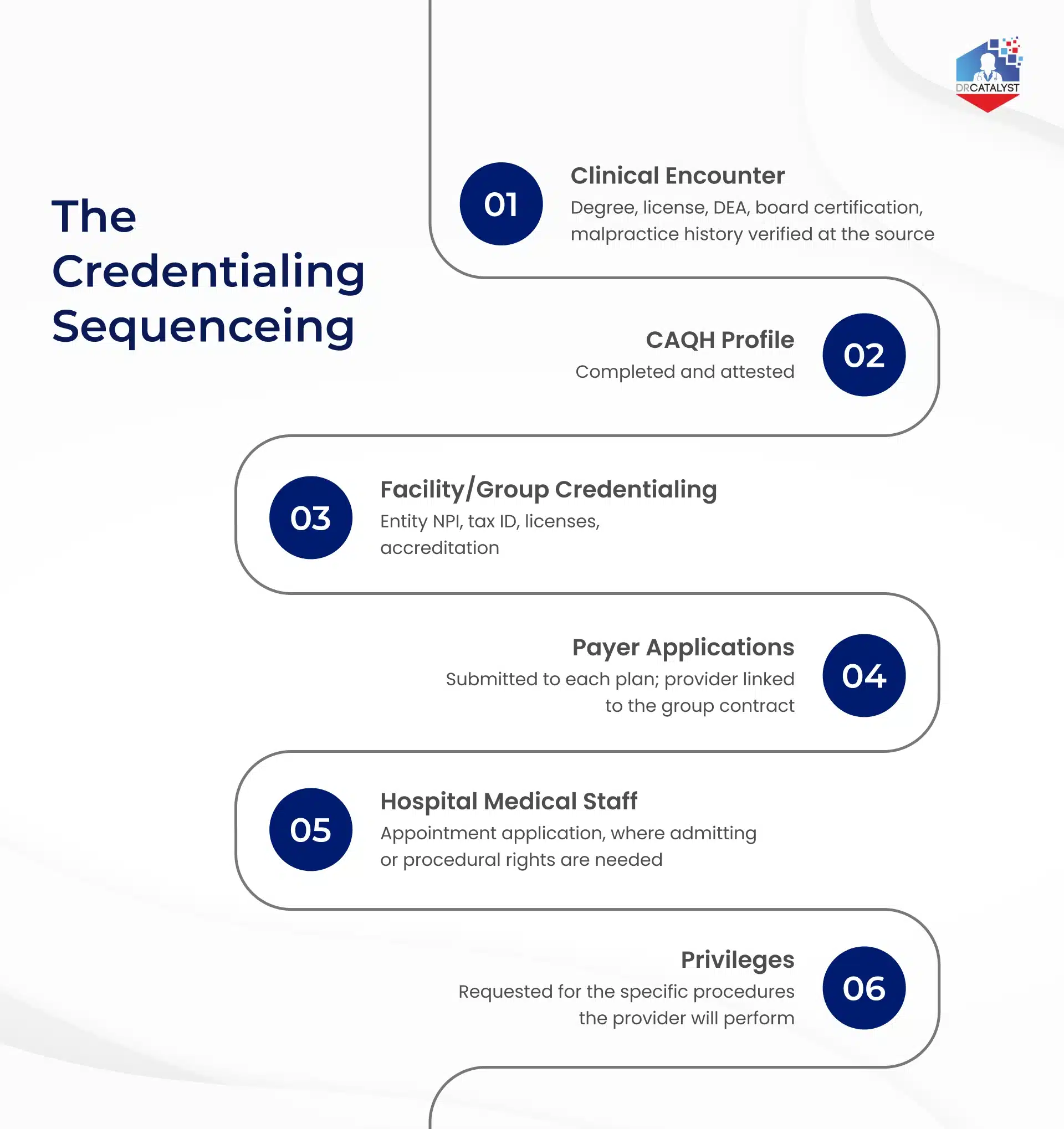
The reason practices lose time is that the types of credentialing run in sequence and depend on each other. The practices tend to treat them as parallel tasks that can be started whenever someone gets to them.
A typical order for a new provider joining a group:
Individual credentials verified and the provider file assembled
CAQH profile completed and attested
Facility or group credentialing confirmed, if the entity is new
Payer applications submitted, and the provider linked to the group contract
Hospital medical staff application filed, where admitting or procedural rights are needed
Privileges requested for the specific procedures the provider will perform
A gap anywhere in that chain stops the ones after it. A provider whose license verification is still pending cannot be submitted to payers. A group whose facility credentialing is incomplete cannot link new providers to its contracts. This is why credentialing timelines are so often quoted as ranges. These variables determine how cleanly each step feeds the next.
Why Verification Takes So Long
Every step above depends on evidence obtained from an original source, and those sources answer at their own pace. State boards, schools, previous employers, malpractice carriers, and certification bodies all respond on their own timelines, and none of them prioritize your onboarding date.
Screening adds another layer. Organizations are expected to check practitioners against the Office of Inspector General’s List of Excluded Individuals and Entities, which identifies parties excluded from federal healthcare programs. Employing an excluded individual can expose an organization to civil monetary penalties, so the check has to be documented.
The workload is administrative, which is why many practices reach a point where it no longer belongs on the office manager’s desk. Our comparison of in-house vs outsourced credentialing sets out where the crossover usually happens.
Re-Credentialing Is an Ongoing Step
The most expensive assumption in credentialing is that finishing it means it is finished. Re-credentialing runs on fixed cycles, and missing one is more damaging than a slow initial application, because the provider is already seeing patients when it lapses.
Medicare makes the consequences explicit. CMS states that providers and suppliers generally revalidate every five years, with DMEPOS suppliers revalidating every three. Failing to revalidate on time can place a hold on reimbursement or deactivate billing privileges entirely, and Medicare will not reimburse for services provided during a deactivated period. CMS grants no exemptions and no extensions.
What has to be maintained continuously:
Payer re-credentialing, typically every two to three years per plan
Medicare revalidation on the CMS cycle
CAQH re-attestation, required at regular intervals
Hospital medical staff reappointment and renewal of privileges
License, DEA, and board certification expirations
Malpractice coverage renewals
For a practice with a dozen providers across several payers, that is a rolling calendar of dozens of dated obligations, none of which announce themselves in advance. If nobody in your practice can name the next credentialing deadline, it is a problem worth solving first.
How DrCatalyst Supports Credentialing
DrCatalyst has credentialed more than 350 providers across 18+ states and 60+ specialties, spanning medical, dental, mental health, and vision practices. Our medical credentialing services cover provider enrollment and payer setup, group linking, payer contract negotiation, demographic updates, ERA and EFT setup, CAQH management, directory verification, hospital affiliation renewals, and annual re-credentialing.
The number worth noting is turnaround time. Credentialing commonly takes 90 to 120 days. With active management, applications are chased rather than filed and forgotten. We complete most in 60 to 90 days. That difference is a month of billable time per provider.
Every account runs with specialized staff for your practice, daily productivity reports, and three or more levels of supervision, so you can see where each application stands. We also build a credentialing tracker in a format matched to your practice’s requirements, which can be loaded directly into your EHR. Whether you are opening a practice, adding locations, or handing over a single stalled application, the work is scoped to what you actually need.
Schedule a 15-minute call to review your provider roster and renewal calendar.
In a Nutshell
The types of credentialing in healthcare answer different questions for different authorities. Individual credentialing verifies the clinician. Facility credentialing verifies the organization. Payer credentialing gets you in network. Medical staff credentialing gets a practitioner appointed to a hospital. Privileging defines what they may do there. Telehealth credentialing extends all of it across state lines.
They run in sequence; they depend on one another, and every one of them expires. Practices that treat credentialing as a project finish it once and are surprised a few years later. Practices that treat it as a calendar rarely are.
FAQs
Provider credentialing verifies that a clinician is qualified to practice and to be paid for it. The most common types are individual provider credentialing, payer credentialing, facility credentialing, medical staff credentialing, hospital privileging, and telehealth provider credentialing. Each verifies something different, and most practices deal with several of them for the same provider.
Credentialing verifies a practitioner’s qualifications and background. Hospital privileging determines which specific clinical services that practitioner is authorized to perform at a given facility. A physician can be credentialed at a hospital and still not hold privileges for a particular procedure.
Payer credentialing commonly takes 90 to 120 days, and longer where applications are incomplete or a payer’s committee meets infrequently. Actively managed, it can be completed in 60 to 90 days. The variable is usually how quickly primary sources respond and how consistently applications are followed up.
Of the types of credentialing in medical billing, this is the one with the most direct revenue impact. It is the process of getting a provider approved into a health plan’s network so the practice can bill as in-network. Until it is complete, claims for that provider are out of network or cannot be submitted at all.
Commercial payers typically re-credential every two to three years. CMS requires Medicare providers and suppliers to revalidate every five years, and DMEPOS suppliers every three. Hospital medical staff appointments and privileges are also granted for defined terms and must be renewed.
Sometimes, but the practice usually cannot bill for those visits as in-network. Some payers permit retroactive effective dates, and some do not, so this needs to be confirmed plan by plan before a provider’s start date.
Smaller practices with stable rosters often manage in-house. The workload becomes a distinct role once you are tracking multiple providers across multiple payers with staggered renewal dates. The usual sign that a missed deadline nobody saw coming is when practices decide to outsource their credentialing process.