


Healthcare organizations work hard to deliver quality care, but receiving payment for those services is not always straightforward. One of the biggest challenges in revenue cycle operations is healthcare claim denials. Year-on-year, they lose $262 Billion to denials. When insurance companies deny claims, it can significantly impact cash flow, increase administrative workload, and delay reimbursements. According to Healthcare Finance reports, 15% of claims submitted to private payers are initially denied. Some of these claims were actually approved via the prior authorization process.
The MGMA Stat Poll laid out a crucial observation. In their analysis, 60% of medical groups reported higher claim denials in 2024 than in 2023. Understanding what denial management is and implementing an efficient denial management process can help practices reduce revenue loss and improve financial performance. This guide covers everything you need to know, from what denials management actually is, how the process works, the types of denials you’ll encounter, and the strategies that turn a reactive headache into a proactive system.
What Is Denial Management?
The healthcare revenue cycle management (RCM) is complex in its own way. In that, denial management plays a major role as the systematic process of preventing, identifying, investigating, and resolving denied claims. It’s more than just fixing errors after they happen; a robust denial management strategy helps you recover revenue that’s rightfully yours. This lays down the path to prevent future denials from occurring in the first place. According to Healthcare Finance News, 54% of initially denied denials were later paid.
Imagine a common scenario where your clinical team provided great care. The documentation was clean. The codes were correct, mostly. You submitted the claim, waited, and then got a letter back from the payer that essentially says,” No.” Effective denials management goes beyond just resubmitting paperwork; it involves investigating the root cause of every “No” to ensure you eventually get to a “Yes.”
The Scope of the Denial Problem
Healthcare claim denials have become a growing challenge for providers across the United States, affecting both financial performance and operational efficiency. As denial rates continue to rise, healthcare organizations are experiencing significant revenue losses along with increased administrative pressure on their revenue cycle teams. Managing denied claims requires time, specialized resources, and continuous coordination between billing staff, providers, and payers.
Prevalence and Financial Impact
The denial landscape in US healthcare is substantially growing:
One out of seven health insurance claims is rejected in the United States.
The average denial rate has been steadily increasing year over year, with the COVID-19 pandemic further accelerating this trend.
Healthcare providers often experience revenue loss of 5-10% annually due to claim denials.
Continued increases in payer clinical claim denial rates place heightened stress on healthcare organizations’ revenue cycles and financial health.
Administrative Burden
Beyond direct financial losses, denials create substantial administrative costs:
Physicians lose 18% of Medicaid revenue to billing problems, compared with 4.7% for Medicare and 2.4% for commercial insurers.
The complexity of healthcare billing requires significant staff time and resources to manage the back-and-forth sequences of claim denials and resubmissions.
Healthcare providers must increasingly hire dedicated staff to handle denials, prior authorizations, and appeals, driving up payroll costs.
What Is the Denial Management Process
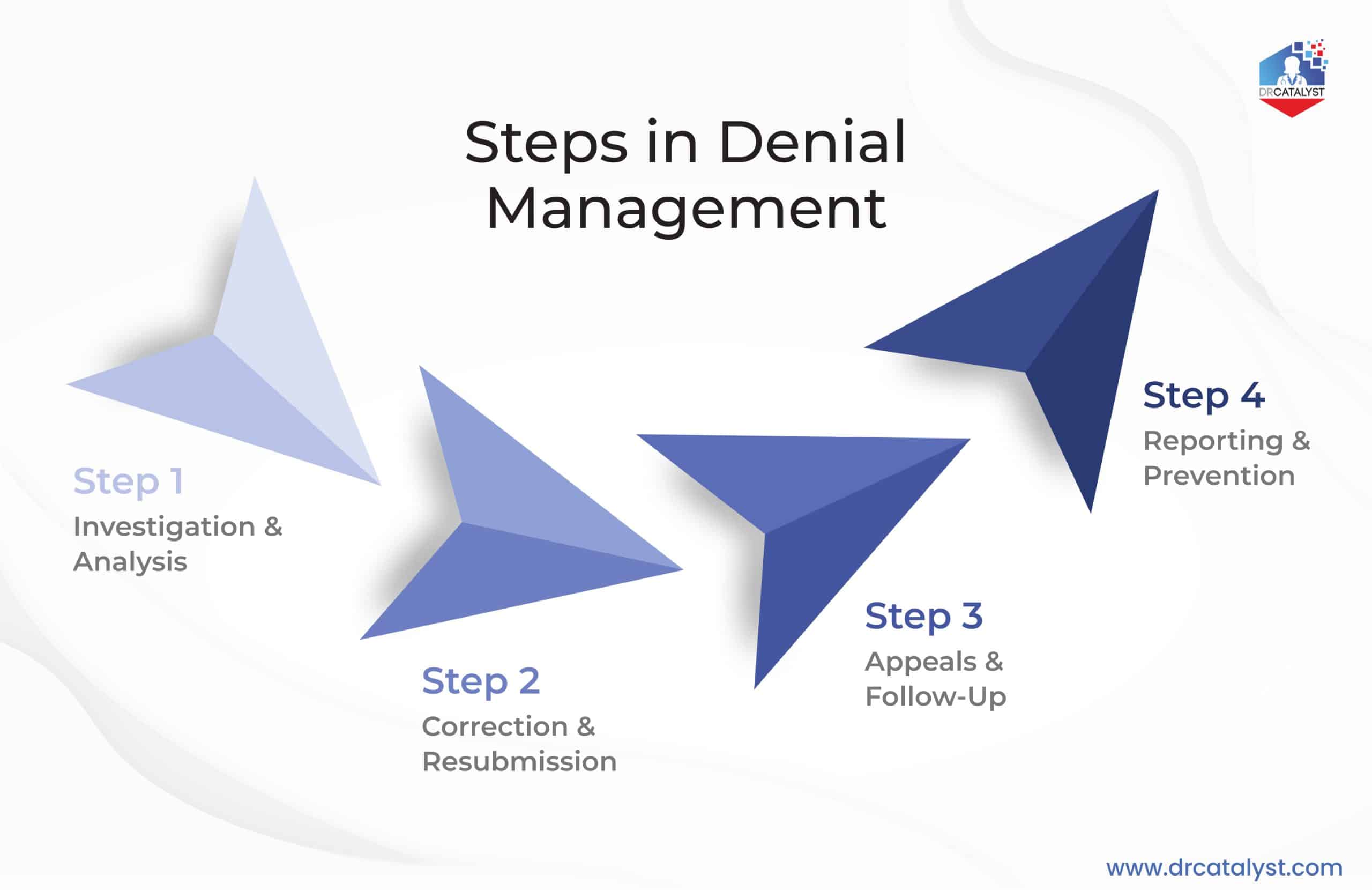
The denial management process is a continuous cycle designed to stop revenue loss. While it can be broken down into several steps, it typically follows this path:
Identification & Categorization: The first step is to log all denied claims and categorize them by type, reason, and payer. Is it a duplicate claim? A lack of prior authorization? An issue with medical necessity?
Investigation & Analysis: Each denial is investigated till its root cause is discovered. This analysis goes beyond surface-level errors to uncover systemic issues in your workflow.
Correction & Resubmission: Once the cause is identified, the claim is corrected and promptly resubmitted to the payer.
Appeals & Follow-Up: For more complex denials, a formal appeal letter must be crafted and submitted. Persistent follow-up is critical here, as many payers require multiple touches.
Reporting & Prevention: This is the most crucial step. By analyzing denial trends, you can pinpoint weak spots in your front-end processes, such as patient registration or eligibility verification, and implement changes to prevent the same denials from recurring.
Varieties of Healthcare Claim Denials
Not all denials are created equal. They generally fall into the following categories:
- Clinical Denials:
These occur when a payer determines that a service wasn’t medically necessary or doesn’t meet coverage criteria. These are often more complex to appeal, requiring detailed clinical documentation to prove the patient’s condition warranted the procedure.
- Administrative Denials:
These are the most common and often the easiest to fix. They result from errors like incorrect patient or insurance information, missing prior authorizations, duplicate claims, or timely filing limits.
- Hard denials are final:
The payer has rejected the claim and will not pay it ever unless a formal appeal is filed and won. Hard denials require immediate attention and strong documentation to prove them otherwise.
- Soft denials are conditional:
The payer is withholding payment pending additional information or a correction. Resubmit correctly and quickly, and the claim gets paid. Miss the window, and it turns into a hard denial.
Master Healthcare Claim Denials Management
It is essential to question the “why” behind the rejection of claims. This helps master the claim denials efficiently. However, most of these denials fall into these categories listed below:
- Registration/Eligibility Errors:
The patient’s insurance was inactive, or the service isn’t covered under their specific plan.
- Missing or Invalid Data:
Simple slips, like a missing social security number or a misspelled name.
- Medical Necessity:
The payer doesn’t believe the procedure was required based on the diagnosis provided.
- Coding Errors:
Using outdated ICD-10 or CPT codes, or failing to use appropriate modifiers.
- Prior Authorization Issues:
The service was performed before the payer’s approval was obtained. Many denials are preventable with strong front-end checks.
Impact of Healthcare Claim Denials on Stakeholders
As per HFMA’s 2024 Health System CFO Pain Points report, 82% of CFOs believe payer denials have increased significantly since pre-pandemic levels. In fact, 90% of health systems cite denials as their top revenue cycle challenge.
Providers
- Financial load:
Lost revenue and increased costs for appeals and rework.
- Administrative burden:
Time diverted from patient care to billing issues.
- Staff morale:
Frustration from dealing with complex denial processes.
Patients
- Financial burden:
Unexpected out-of-pocket costs when claims are denied.
- Delayed care:
Treatment is postponed while authorization or appeal issues are solved.
- Confusion and stressors:
Difficulty navigating insurance complexities.
- Disparities:
Patients from historically disadvantaged racial and ethnic groups or with low household incomes experience the largest burdens from claim denials.
Disparities in Denial Burden
Recent research reveals significant inequities in how claim denials affect different populations:
Low-income patients (household income <$50,000 annually) are least likely to have denied claims contested and, when contested, achieve lower success rates.
Racial minority patients are more likely than non-Hispanic White patients to have cost-sharing obligations reduced but achieve lower mean savings per successfully contested denial.
Contesting denied claims requires considerable investment in institutional knowledge, time, and resources, which disadvantaged populations may lack.
Contesting denied claims requires considerable investment in institutional knowledge, time, and resources, which disadvantaged populations may lack.
How Do Healthcare Claim Denials Affect Medical Practices?
The impact of poor healthcare denial management is felt across the entire organization:
- Stalled Cash Flow:
Money that should be in your pocket is stuck in “pending” or “denied” status for weeks or months.
- Increased Overhead:
It costs significantly more to work a denied claim than to submit a “clean” one the first time.
- Staff Burnout:
Your team spends its days caught in an administrative backlog rather than focusing on patient care.
- Patient Dissatisfaction:
If a claim is denied, the financial burden often shifts to the patient, leading to confusion and frustration.
Strong healthcare claims denial management strategies help reduce operational costs by preventing denials before they occur.
Strategies for Effective Denial Prevention
Reactive denial management in RCM will always be necessary. But the practices that win at revenue cycle management are the ones that prevent denials in the first place. Here are the strategies that make the biggest difference:
Verify patient eligibility and benefits at registration.
Secure prior authorizations early.
Use accurate, up-to-date coding and scrubbing tools.
Train staff regularly on payer rules and common errors.
Leverage analytics to spot trends and automate workflows.
Implement cross-departmental teams for root-cause analysis.
Avoiding top medical billing mistakes, such as incomplete documentation or untimely submissions, can dramatically reduce denials.
Turn Denial Management into a Revenue Driver with DrCatalyst
Properly managing denial management in healthcare takes dedicated expertise, consistent processes, and tools that most practices don’t have! It requires substantial time to build and maintain on its own, especially when patient care is the priority. Our team of remote medical billing experts can be a complete replacement of your in-house staff or even work as an extension of your practice to:
- Recapture Lost Revenue:
We work on denials within 48-72 hours, analyzing every rejection and filing appeals before deadlines creep up.
- Fix Root Problems:
We don’t just resubmit claims; we track denial patterns to identify and correct underlying issues in your front-end processes.
- Provide Total Visibility:
You get detailed reporting on denial trends, recovery rates, and the financial health of your revenue cycle.
Here’s the Final Takeaway
In today’s complex healthcare environment, managing insurance claim denials is critical for maintaining financial stability. Although denials pose a consistent burden on health systems, Becker’s Hospital Review estimates that 86% of denials are avoidable. Understanding denial management and implementing a structured process helps healthcare organizations reduce revenue loss and improve reimbursement outcomes.
Resolving Questions About Denial Management in Healthcare
1. What is denial management in healthcare environment?
Denial management in healthcare is the process of identifying, reviewing, appealing, and preventing claim denials flagged by insurance payers. When a payer refuses to reimburse a submitted claim in full or in part, denial management is the structured system a practice uses to recover that revenue and prevent the same denial from happening again. It covers everything from root cause analysis and appeals to upstream process improvements in coding, documentation, and eligibility verification.
2. What is the denial management process?
The denial management process involves several steps that help healthcare organizations address denied claims effectively. These steps typically include:
Identifying denied claims from the responses of the payer
Reviewing denial codes and explanations
Categorizing denials based on root causes
Correcting errors in documentation or coding
Resubmitting claims or filing appeals
Tracking denial trends to prevent future issues
This structured approach strengthens denial management in RCM and improves reimbursement outcomes.
3. What is the difference between a rejection and a denial?
A claim rejection occurs before the payer processes the claim. The claim is returned due to formatting errors, missing data, or invalid codes. Rejections are corrected and resubmitted immediately. A claim denial occurs after the payer has processed the claim and determined it cannot be paid. Denials require investigation, correction, and formal appeal or resubmission.
4. How does healthcare denial management affect a practice’s revenue?
Healthcare claim denials can significantly impact practices by delaying or reducing revenue, often costing $25–$181 per reworked claim and contributing to billions in annual losses industry-wide. The American Hospital Association reports that providers spent an estimated $19.7 billion in 2022 solely on appeals and overturning denied claims. This has significantly increased administrative burden, strained staff, delayed patient care, and contributed to cash-flow issues and provider burnout.
5. Why is denial management important in revenue cycle management?
Denial management in RCM is the ultimate safety net for your practice’s financial health. Without a dedicated approach to claims denial management, your practice essentially gives away its services for free, leading to a direct hit on your bottom line and clinical sustainability.
6. Why is denial management important for medical practices?
Denials management is critical because:
The average cost of reworking a denied claim falls from $25 to $117
Denied claims tie up staff time that could be spent on proactive billing
Delayed payments disrupt cash flow and create budget uncertainty
Without proper management, 65% of denied claims are never reworked
Recurring denials often indicate systemic issues that need fixing
7. Which categories can you classify healthcare claim denials into?
Healthcare claim denials generally fall into several recurring categories.
Eligibility denials occur when a patient’s coverage is inactive or incorrect on the date of service.
Prior authorization denials occur when a required approval is missing, expired, or obtained wrongly.
Coding denials result from incorrect CPT or ICD-10 codes, missing modifiers, or mismatched diagnosis and procedure codes.
Multiple submissions for the same service trigger duplicate claim denials.
Medical necessity denials arise when documentation does not adequately support the level of care billed.
Timely filing denials occur when a claim is submitted outside the payer’s filing window, and these are almost always unrecoverable.
Understanding which types of healthcare claim denials your practice encounters most frequently is the starting point for reducing them.