


Billing is the engine that keeps a practice running, and it costs more than most people realize. A study published in JAMA found that billing and insurance-related work costs anywhere from 3% to 25% of professional revenue, depending on the type of visit. With numbers like that, it’s worth asking whether your current setup is the right one, and that’s where the in-house medical billing vs outsourcing decision comes in.
Some practices swear by their in-house team. Others can’t imagine going back after switching to an outside partner. So who’s right? The truth is, it depends on your size, your payer mix, and how much time you want to spend managing billing instead of patient care. Let’s break down in-house billing vs. outsourcing in plain terms, so you can decide what actually fits your practice.
What is In-House Medical Billing?
In-house billing means you hire, train, and manage your own billing staff. They sit in your office (or work for you directly), use your software, and handle everything from charge entry and claim submission to denials and patient statements. If you want a refresher on each stage, our guide to the medical billing process walks through it step by step.
The biggest draw is control. Your billers are right down the hall, so they answer questions quickly. In many smaller offices, those same staff members also cover the front desk or answer phones when things get busy.
What is Outsourced Medical Billing?
Outsourced medical billing simply means handing some or all of your billing work to an outside team. That could be a full-service billing company, a revenue cycle partner, or dedicated remote billers who work inside your own EHR. Because they handle patient information, any outside billing partner counts as a business associate under HIPAA and must sign an agreement to protect that data.
Outsourced medical billing isn’t one-size-fits-all. It usually comes in two flavors: professional remote billers who work your AR, eligibility, and denials under your direction, or a full revenue cycle team that runs everything from charge entry to patient statements. Some practices outsource just one piece, while others hand over the entire revenue cycle. If you’re new to the idea, our complete guide to outsourced medical billing covers how it works in more detail.
The Key Differences: In-House Billing vs Outsourcing
Here’s a quick side-by-side look at how in-house medical billing vs outsourcing compares across the factors practices care about most.
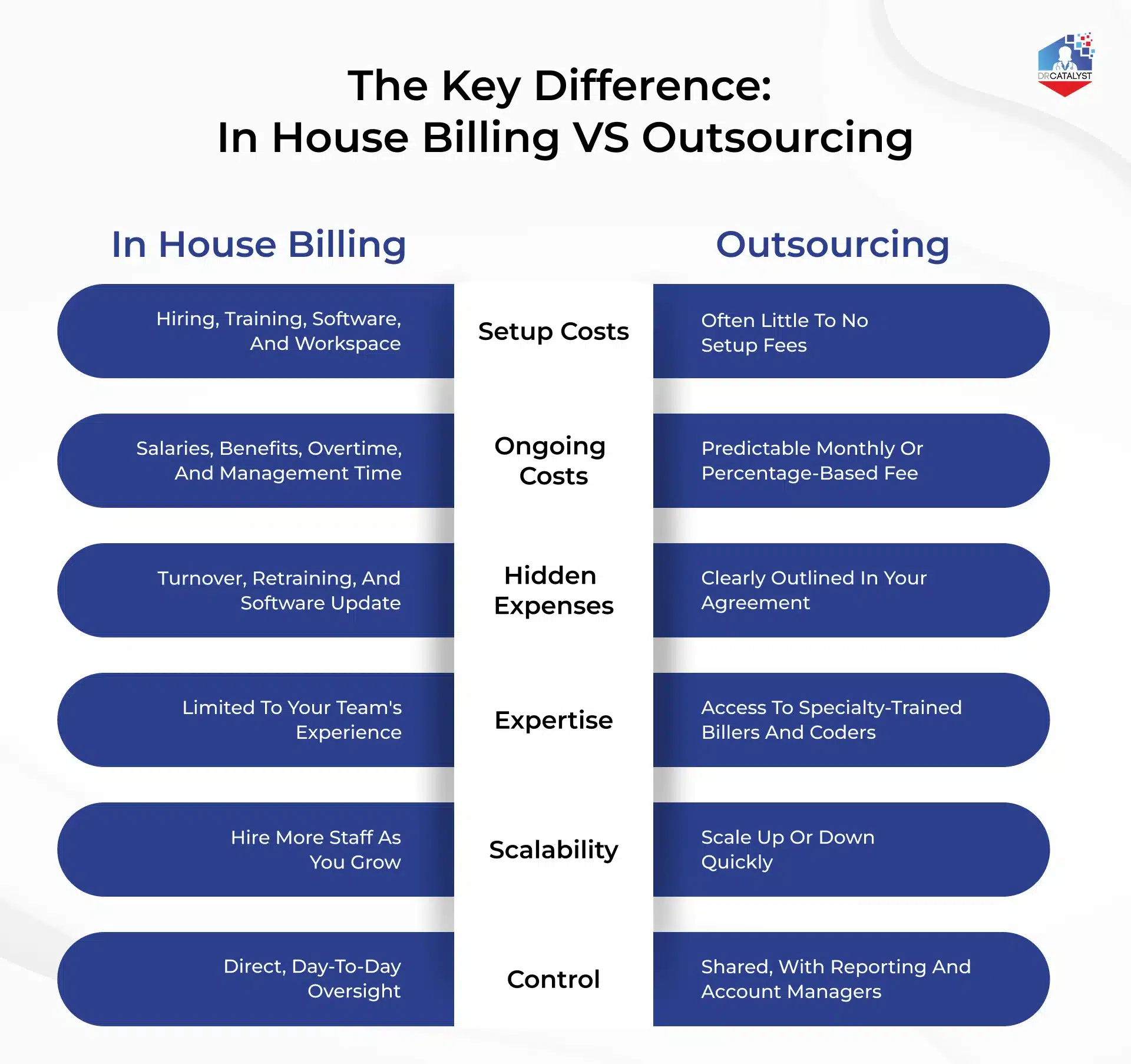
The Actual Cost of an In-House Team
Cost is usually where the medical billing outsourcing vs. in-house debate gets real. According to the U.S. Bureau of Labor Statistics, the median annual wage for medical records specialists was $51,140 in May 2025. That’s before benefits, payroll taxes, training, software licenses, and the cost of replacing someone when they leave.
And turnover hurts more than people expect. When a biller walks out the door, they often take your payer knowledge, your workarounds, and your AR history with them. Your remaining staff scramble to cover, claims slow down, and cash flow takes a hit. Then you start the hiring and retraining cycle all over again, often for the same position. It’s a big reason more practices are bringing in remote medical billers instead.
Pros and Cons of In-House Medical Billing
In-house billing isn’t wrong. For some practices, it works really well. Just remember that billing rules never sit still. CMS releases new ICD-10 codes every October 1, and your team has to keep up. Here’s the fair picture before we flip to the outsourcing side of the medical billing outsourcing vs. in-house comparison.
Pros
Full, day-to-day control over every claim
Quick answers when billing questions come up
Staff who know your providers, patients, and workflows
Flexibility to cover other front-office tasks
Cons
High fixed costs for salaries, benefits, and software
Constant training as codes and payer rules change
Coverage gaps during vacations, sick days, and turnover
Billing knowledge concentrated in just one or two people
Pros and Cons of Outsourcing Medical Billing
Now let’s look at the other side. Understanding the pros and cons of outsourcing medical billing helps you go in with realistic expectations.
Pros
Lower overhead, with no extra office space, equipment, or on-site staff
Billers and coders who stay current on regulations and specialty rules
Easy to scale with growth or seasonal changes
Detailed reporting and financial analytics
More time for your team to focus on patients
Cons
Less hands-on control over daily billing tasks
Quality varies widely between vendors
Some practices worry about data security and communication
Contracts and fees need careful review
Most of those cons come down to choosing the right partner, which we’ll cover in a minute. That’s really the heart of outsource medical billing vs. in-house pros and cons: the downsides of outsourcing are often fixable, while the downsides of in-house billing tend to grow as your practice does.
When Should a Practice Consider Outsourcing?
Here are a few signs it’s time to take a serious look:
Your AR over 90 days keeps growing
Denials are climbing, and nobody has time to work them
You’ve lost a biller and can’t find a qualified replacement
Your practice is adding providers, locations, or specialties
Collections feel lower than they should be, but you’re not sure why
If two or three of these sound familiar, it may be time to rethink in-house medical billing vs. outsourcing for your practice. Many practices start small, outsourcing just AR follow-up or denials, then expand once they see results. Others go further and look at outsourcing RCM as a whole, from eligibility checks all the way through patient payments.
How to Choose the Right Medical Billing Partner
Once you’ve weighed outsourcing medical billing vs. in-house for your practice, the next step is picking the right partner. Not all medical billing outsourcing is created equal, so before you sign anything, ask these questions:
Do they know your specialty? Billing for allergy, cardiology, or behavioral health is very different from primary care.
Can they work in your EHR? Switching systems adds cost and disruption you don’t need.
How do they report results? You should see clear monthly reporting on collections, denials, and AR.
Who checks their work? Ask about supervision and quality assurance, not just headcount.
What does the contract look like? Watch for long lock-in periods and fees that aren’t spelled out. A trial period is a great sign that a partner is confident in its work.
How fast do they work? Ask for turnaround times on charge entry, payment posting, and denials.
How do they protect your data? Look for a signed HIPAA BAA, third-party HIPAA certification, and safeguards that meet the HIPAA Security Rule.
Who’s your point of contact? A dedicated account manager makes communication much easier.
The right partner should feel like an extension of your team, not a black box you send claims into.
How DrCatalyst Can Help
At DrCatalyst, we’ve been helping practices find the right balance in the in-house billing vs. outsourcing decision since 2010. As part of the Meditab group of companies, we bring nearly three decades of healthcare experience, a team of 600+ billers, and support for 84+ EHR and practice management systems, so we work right inside the software you already use.
Our medical billing services cover charge entry, claims scrubbing, claim submission, payment posting, denial management, and AR follow-up. Charge entry and payment posting are completed within 24 to 48 hours, and denials are worked within 48 to 72 hours. Every account includes 3+ levels of supervision, daily productivity reports, and a dedicated account manager, so you always know how your numbers are trending.
Our remote billers work as a dedicated part of your team, on your systems and your schedule. Nationally, an onsite medical biller costs about $55,101 on average in a year with taxes and benefits. A DrCatalyst biller costs about $29,064, saving you roughly $26,037, or 47%, per biller. And because our supervisors step in when someone is out, you get built-in business continuity and never have to retrain for the same role again.
And if you’re ready to hand over the full revenue cycle, our RCM team gives you specialty-specific billing teams, certified coders, a separate quality assurance team, and regular KPI reports. Our RCM clients see an average 18% revenue increase after being onboarded on DrCatalyst.
In A Nutshell
There’s no universal winner in the medical billing outsourcing vs. in-house debate. In-house billing can work well for small, stable practices with experienced staff and a simple payer mix. But as costs rise, staff turns over, and denials pile up, more practices find that outsourced medical billing gives them better results with less stress. Research in JAMA Internal Medicine estimates that 18% of insured US adults reported a health insurance denial in 2023, so getting claims right the first time matters more than ever.
The best way to settle in-house billing vs. outsourcing for your practice is to look honestly at your numbers: your costs, your denial rate, your AR, and how much time your team spends on billing. Once you see the full picture, the answer usually becomes clear, and if outsourcing wins, our RCM solutions are ready to take it from there.
FAQs
Medical billing outsourcing means hiring an outside team to handle some or all of your billing tasks, such as claim submission, payment posting, denial management, and AR follow-up.
For many practices, yes. Outsourced medical billing removes the costs of salaries, benefits, training, software, and turnover, and replaces them with a predictable fee.
The main pros are lower overhead, specialty expertise, scalability, and better reporting. The main cons are less hands-on control and the need to carefully vet vendors. Most of the cons come down to choosing the right partner.
Consider outsourcing when denials and AR are growing, you’re struggling to hire or keep billing staff, or your practice is expanding faster than your billing team can handle.
It depends on the model. Remote billers are usually billed hourly, while full revenue cycle management is typically priced as a percentage of your monthly collections. At DrCatalyst, a remote biller costs about $29,064 a year, compared with roughly $55,101 for an onsite biller nationally.