


Every patient visit becomes a string of letters and numbers on a claim. A sore throat, a strep test, a quick injection before the patient heads home, each piece gets translated into a code before a payer will even look at it. When those codes are off, the claim stalls, a denial shows up a few weeks later, and someone on your team spends an afternoon fixing what should have been right the first time. That’s why it pays to understand the three main types of medical coding used in the United States. ICD codes describe the diagnosis, CPT codes describe the service, and HCPCS codes cover supplies, equipment, drugs, and a few services that CPT doesn’t.
The ICD system comes from the World Health Organization’s International Classification of Diseases, which countries worldwide use to record and report health conditions. In this guide, we’ll walk through each system, show how they work together on a single claim, and highlight the coding mistakes we most often see in practices.
What Are Medical Coding Systems?
Medical coding systems are standardized code sets that turn clinical notes into data that insurers, government agencies, and health systems all read the same way. If you’re new to the field, our guide on what is medical coding covers the basics of the job and why it matters to your revenue. Under HIPAA, providers who bill electronically have to use approved code sets. For physician practices, that means three main medical coding types: ICD-10-CM for diagnoses, CPT for procedures and services, and HCPCS Level II for items and services outside CPT. A clean claim usually needs all three to agree with each other and with the chart.
An ICD-10-CM Overview
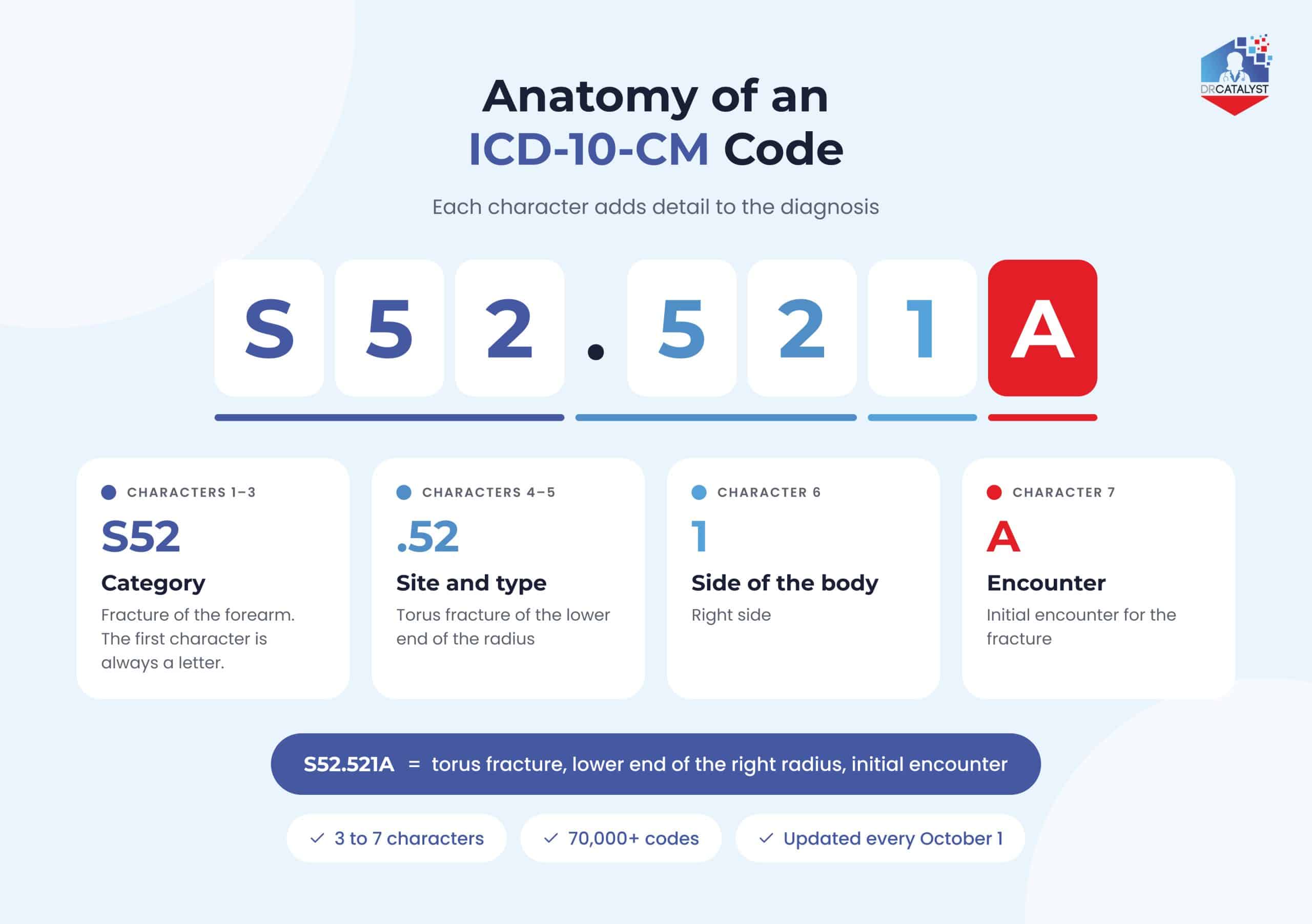
ICD stands for International Classification of Diseases. In the US, providers use ICD-10-CM (Clinical Modification) to report diagnoses, symptoms, injuries, and the reasons a patient came in. The code set is maintained by the CDC’s National Center for Health Statistics along with CMS, and it’s updated every year on October 1. ICD-10-CM codes are alphanumeric and run from three to seven characters. The first character is always a letter, and each subsequent character adds detail, such as the body site, side of the body, severity, or whether it is the first visit for an injury.
For example, E11.9 reports type 2 diabetes without complications, while S52.521A points to a torus fracture of the lower end of the right radius at the initial encounter. In total, the code set holds more than 70,000 codes. There’s also ICD-10-PCS, a separate system hospitals use for inpatient procedures. Most outpatient practices will never use it, but it’s worth knowing it exists so the two don’t get mixed up. Here’s why ICD codes matter so much: the diagnosis tells the payer why a service was needed. If the diagnosis code doesn’t support the procedure billed, the claim can be denied for medical necessity, even when the care was completely appropriate.
Explore DrCatalyst’s medical coding services and see how we help practices get claims right on the first submission.
What is CPT Coding?
If ICD explains why the patient was seen, CPT explains what the provider did. CPT, short for Current Procedural Terminology, is the code set owned and maintained by the American Medical Association for reporting medical, surgical, and diagnostic services. The AMA’s CPT Editorial Panel reviews it every year, and the new code set takes effect each January 1. CPT codes fall into three categories, and each one serves a different purpose.
Category I
These are five-digit numeric codes for the services providers bill every day, including office visits, surgeries, lab tests, and imaging. For example, 99213 is an established patient office visit, and 93000 is a routine ECG with interpretation and report. Category I codes drive most of a practice’s reimbursement.
Category II
Category II codes have four digits followed by the letter F, such as 3074F for a recent systolic blood pressure under 130. They’re supplemental tracking codes for quality and performance reporting. They usually don’t carry payment on their own, but they can affect your scores in quality programs like MIPS.
Category III
Category III codes have four digits followed by the letter T. They’re temporary codes for emerging technologies and new procedures that haven’t yet met the requirements for Category I. They generally expire after five years unless they’re renewed or moved into Category I, and coverage varies widely by payer.
CPT codes can also carry two-digit modifiers, such as 25 or 59, that tell the payer something specific about how a service was performed. Modifiers are useful, but they’re also one of the most common reasons claims get flagged for review when the documentation doesn’t support them. Coders assign these codes, while the billing team turns them into a claim and follows it through to payment. If those roles feel blurry at your practice, our post on the difference between medical billing and medical coding lays it out clearly.
What is HCPCS Coding?
HCPCS stands for the Healthcare Common Procedure Coding System, and most people in billing offices pronounce it “hick-picks.” It was created so Medicare, Medicaid, and other payers could process claims for items and services consistently. The system is maintained by the Centers for Medicare & Medicaid Services, and it’s split into two levels.
HCPCS Level I
Level I is simply the CPT code set described above. So when people talk about “HCPCS codes” in day-to-day work, they almost always mean Level II.
HCPCS Level II
Level II codes are one letter followed by four digits. They cover the products, supplies, and services that CPT leaves out. They include ambulance transport, durable medical equipment like wheelchairs and walkers, prosthetics, orthotics, and many injectable drugs. J-codes report drugs (J1100 is dexamethasone sodium phosphate, 1 mg), E-codes report durable medical equipment, and G-codes report certain professional services Medicare tracks separately.
Level II has its own set of modifiers, made up of letters or a letter and a number, such as LT and RT for the left and right side of the body. CMS updates Level II codes every quarter, so a code that was valid in March may be gone by July. A third level of local codes once existed, but it was phased out in 2003.
Key Differences in ICD vs CPT vs HCPCS
The simplest way to keep these straight is to ask three questions. Why was the patient seen? That’s ICD. What did the provider do? That’s CPT. What supplies, drugs, or equipment were used that CPT doesn’t describe? That’s HCPCS Level II. Here’s a side-by-side look:
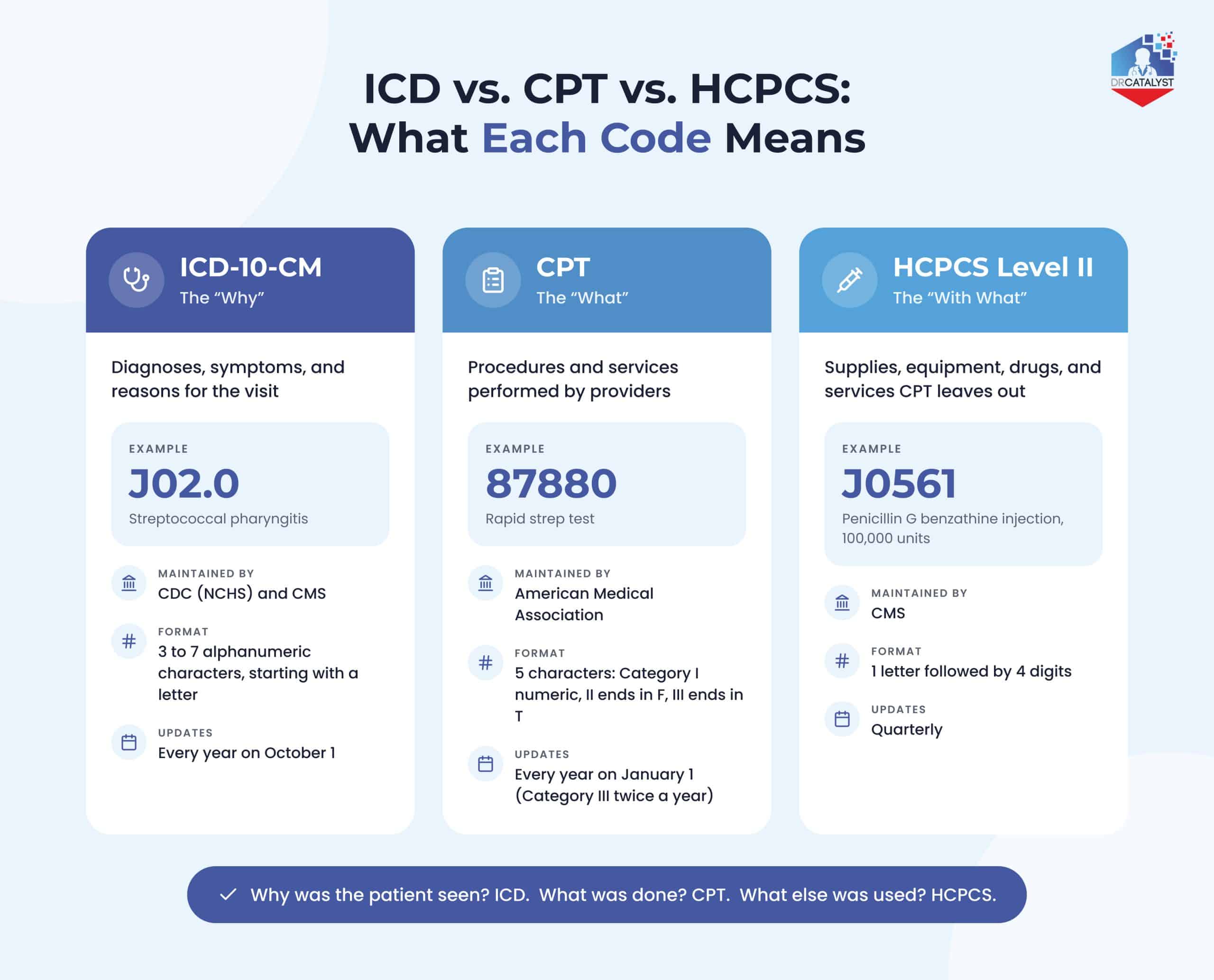
| Feature | ICD-10-CM | CPT | HCPCS Level II |
|---|---|---|---|
| What it describes | Diagnoses, symptoms, and reasons for the visit | Procedures and services performed by providers | Supplies, equipment, drugs, and services CPT leaves out |
| Maintained by | CDC (NCHS) and CMS | American Medical Association | CMS |
| Format | 3 to 7 alphanumeric characters, starting with a letter | 5 characters (Category I numeric, II ends in F, III ends in T) | 1 letter followed by 4 digits |
| Example | J02.0 (streptococcal pharyngitis) | 87880 (rapid strep test) | J0561 (penicillin G benzathine injection, 100,000 units) |
| Update cycle | Every year on October 1 | Every year on January 1 (Category III twice a year) | Quarterly |
To see how CPT, HCPCS, and ICD-10 work together, picture one visit. A patient comes in with a sore throat. The provider bills an established patient visit (99213), runs a rapid strep test (87880), diagnoses strep throat (J02.0), and gives a penicillin injection (J0561, plus 96372 for the administration). Every code supports the others. If the diagnosis didn’t justify the test, or the drug units didn’t match what was given, the claim would bounce back. Accurate codes are only half the job. DrCatalyst’s medical billing solutions handle claim submission, denial follow-up, and payment posting, so your coded claims turn into payments faster.
Common Coding Errors and How to Avoid Them
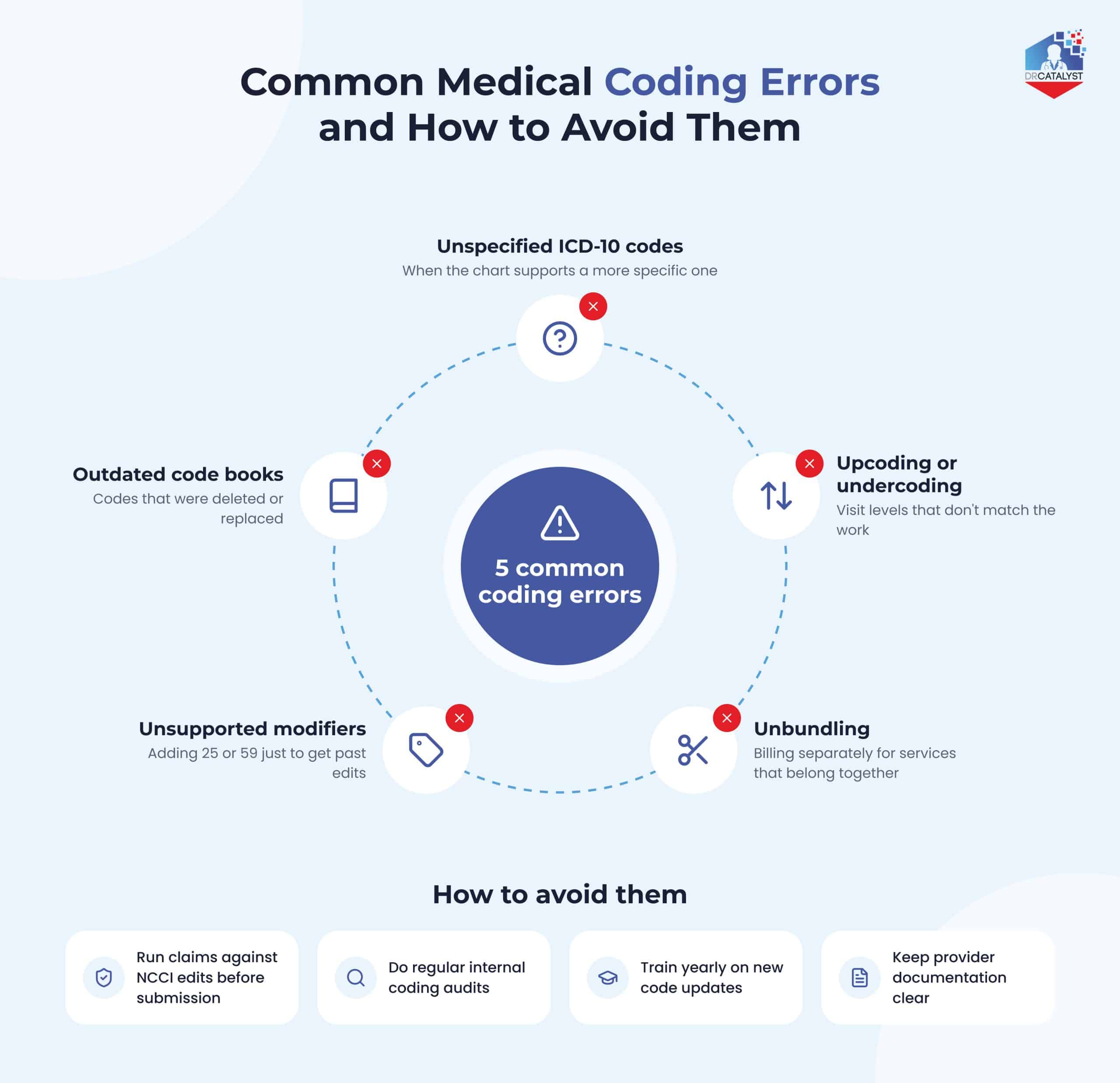
Most common coding errors stem from a handful of habits such as choosing unspecified ICD-10 codes when the chart supports a more specific one, upcoding or undercoding visit levels, unbundling services that should be billed together, adding modifier 25 or 59 to get past edits, and using outdated code books. Running claims against the CMS National Correct Coding Initiative (NCCI) edits before submission catches many bundling problems early.
Regular internal audits, yearly training when new codes come out, and clear provider documentation prevent most of the rest. For a fuller list with practical fixes, read our post on medical coding mistakes.
How DrCatalyst Can Help
Keeping up with three code sets that change on three different schedules is a lot to ask of a front office that’s also checking patients in, verifying insurance, and answering phones. DrCatalyst works as an extension of your team. Our certified coders review documentation, assign the right ICD-10-CM, CPT, and HCPCS Level II codes and modifiers, and flag gaps before claims go out. Here’s what that looks like day to day:
Coders who know the documentation requirements of your specialty
Claim scrubbing against payer rules and NCCI edits before submission
New ICD, CPT, and HCPCS updates applied as soon as they take effect
Routine coding audits with feedback your providers can use
Denial reviews that trace each rejection back to its cause
Seeing the same denials month after month? Reach out to the DrCatalyst team, and we’ll help you find out where your claims are getting stuck.
In a Nutshell
Each type of medical coding has its own job. ICD-10-CM explains the diagnosis, CPT records the service, and HCPCS Level II covers the supplies, drugs, and equipment that go with it. When all three match the documentation, claims move through without a fight. When they don’t, revenue sits in limbo while your staff chases corrections. Knowing how these medical coding types differ is a good start. Having a team that applies them correctly on every claim is what keeps your cash flow steady, month after month.
Frequently Asked Questions
The three main types of medical coding are ICD-10-CM, CPT, and HCPCS Level II. ICD-10-CM codes describe a patient’s diagnosis, CPT codes identify the procedures and services performed, and HCPCS Level II codes cover supplies, medical equipment, drugs, and services not included in CPT.
ICD coding uses the International Classification of Diseases system to document diagnoses, symptoms, injuries, and reasons for patient visits. ICD-10-CM codes help insurers understand why a service was medically necessary and determine whether the billed procedure is supported by the patient’s diagnosis.
CPT coding stands for Current Procedural Terminology. It describes medical, surgical, and diagnostic services performed by healthcare providers. CPT has three categories: Category I for commonly performed services, Category II for quality and performance tracking, and Category III for emerging technologies and procedures.
HCPCS coding (Healthcare Common Procedure Coding System) covers medical products, supplies, equipment, and certain services. HCPCS Level I consists of CPT codes, while Level II covers items such as wheelchairs, prosthetics, orthotics, ambulance services, and injectable drugs that CPT does not describe.
Common coding errors include using unspecified diagnosis codes when more detail is available, upcoding or undercoding services, unbundling procedures, applying unsupported modifiers, and using outdated codes. Practices can prevent these errors through regular coding audits, updated code references, accurate clinical documentation, and claim reviews against CMS National Correct Coding Initiative (NCCI) edits.