


You run a psychiatric clinic, therapy group, or solo counseling practice to sit with people, guide them through trauma, unpack anxiety, and help them rebuild their lives. Yet by Friday afternoon, your desk is likely covered in unpaid claim notices, confusing pre-authorization letters, and perplexing clearinghouse rejections. Behavioral health billing follows a completely different set of rules than standard physical medicine.
Psychotherapy, diagnostic interviews, and ongoing psychiatric evaluations, however, deal with the unpredictable clock of human emotion, highly nuanced time-based documentation, and restrictive insurance carve-outs.
According to clinical prevalence studies published by the National Institute of Mental Health, more than one in five U.S. adults live with a mental health condition. While patient demand is at an all-time high, getting paid for that care while navigating administrative barriers remains an uphill battle.
Navigating the administrative maze of mental health billing requires clear systems, accurate clinical documentation, and an agile revenue cycle. Let’s take a deep dive into why these claims face so many obstacles and review the everyday coding rules that dictate your payouts.
Why Mental Health Billing and RCM Is Complex
Many clinical directors assume billing is simply about submitting a diagnostic code and an office visit code. If you have ever compared medical billing vs. medical coding, you already know the two workflows require distinct operational guardrails. Behavioral health medical billing introduces layers of administrative friction rarely seen in general healthcare settings:
Carve-Out Networks: A patient might carry insurance with a major commercial health plan for physical illness, but a third-party administrator manages their psychiatric benefits, with separate submission portals, credentialing requirements, and fee schedules.
The Clock Dictates the Code: Physical medicine often bills based on medical decision-making complexity alone. In contrast, mental health medical billing relies heavily on precise face-to-face duration. Under-documenting your session by a single minute can trigger an automatic audit flag or complete denial.
Pre-Authorization Roadblocks: After a patient’s first intake session, many insurers will only pay for a limited number of visits. Once you hit that cap, they won’t reimburse further care until you submit detailed medical-necessity forms proving the patient still needs treatment.
Non-Standard Provider Credentials: Large health systems usually bill under physicians. A behavioral health practice might employ licensed clinical social workers, licensed professional counselors, marriage and family therapists, and psychiatric nurse practitioners. Each payer has distinct rules on which provider types can bill independently versus incident-to.
Understanding these structural hurdles is the first step toward reclaiming your time and eliminating revenue cycle bottlenecks.
Most Common Mental Health CPT Codes
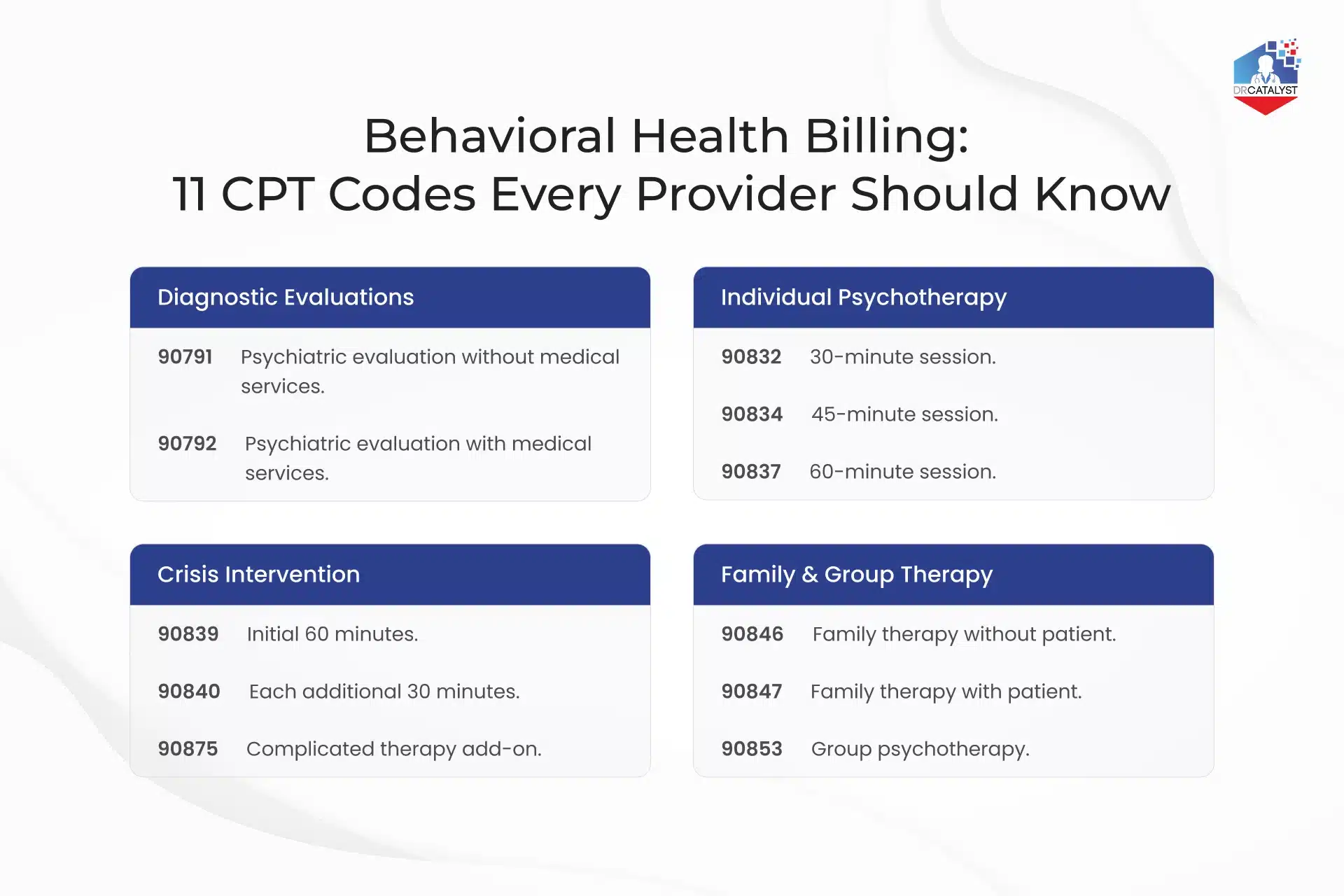
Accurate coding serves as the baseline for every clean claim. The American Medical Association maintains standard Current Procedural Terminology (CPT) guidelines that govern mental health CPT codes, with detailed time thresholds outlined in the APA psychotherapy coding guidelines. Choosing the right code demands strict alignment between your session notes and payer rules. Below are the core codes behavioral health providers submit every week:
Diagnostic Evaluations
CPT 90791: Integrated psychiatric diagnostic evaluation without medical services. Used by licensed therapists and psychologists for standard clinical intakes.
CPT 90792: Integrated psychiatric diagnostic evaluation with medical services. Psychiatrists and psychiatric nurse practitioners typically bill this code when they evaluate medical histories, order labs, or assess medication regimens during intake.
Individual Psychotherapy
Routine outpatient talk therapy is governed by the time spent in face-to-face contact with the client:
CPT 90832: Psychotherapy, 30 minutes (session duration must sit between 16 and 37 minutes).
CPT 90834: Psychotherapy, 45 minutes (session duration must sit between 38 and 52 minutes).
CPT 90837: Psychotherapy, 60 minutes (session duration must reach at least 53 minutes).
Crisis Intervention and Interactive Complexity
CPT 90839: Psychotherapy for crisis, first 60 minutes. Applies when a patient presents with an acute, life-threatening, or severe emotional emergency that requires immediate intervention.
CPT 90840: Add-on code for each additional 30 minutes of crisis intervention beyond the initial hour.
CPT 90875: Interactive complexity add-on. Bill alongside routine therapy when specific environmental or interpersonal factors complicate care delivery, such as communication barriers, third-party involvement, or intense parental conflict.
Family and Group Therapy
CPT 90846: Family psychotherapy delivered without the patient present.
CPT 90847: Family psychotherapy delivered with the patient present.
CPT 90853: Group psychotherapy (billed per participant in non-family group treatment).
Familiarity with these numbers is vital, but following the principles in professional medical coding guides helps your clinical charting support your claims when payers conduct retrospective audits.
Mental Health Billing Guidelines for Timely Claim Submission
Knowing which codes exist is only half the battle; submitting them accurately is what keeps your bank account healthy. Payers follow rigorous mental health billing guidelines that determine whether they process a claim immediately or shunt it into a pending review queue. To ensure reliable reimbursement, every submitted claim should satisfy four fundamental standards:
The Time Rule: Because individual therapy is time-sensitive, your documentation must clearly specify start and stop times. Simply writing “session conducted for forty-five minutes” does not suffice during a formal payer inquiry. Document exact timestamps (e.g., 2:03 PM to 2:55 PM).
Clear Separation of E/M and Therapy: When psychiatrists provide both pharmacologic management and therapy during one visit, submit an Evaluation and Management (E/M) code alongside an add-on therapy code (such as +90833 or +90836). Never bundle these into a single therapy code.
Diagnostic Precision: Payers demand clinical continuity between the DSM-5 criteria in your notes and the ICD-10 code on the CMS-1500 form. Avoid broad, non-specific codes (like unspecified depressive disorder) when detailed clinical histories support a definitive diagnosis.
Telehealth Modifiers: With widespread adoption of remote teletherapy, monitor regional payer rules on modifiers such as 95, GT, or FQ, alongside accurate place-of-service (POS) markers like POS 02 or POS 10.
A breakdown of billing practices shared by the Substance Abuse and Mental Health Services Administration highlights that administrative standardization directly protects patient access. Use clean billing workflows to minimize surprise out-of-pocket bills and benefit everyone.
Overcoming Challenges in Mental Health Billing
Even conscientious clinicians hit roadblocks. The most frequent mental health billing and coding challenges stem from small, overlooked clerical discrepancies that ripple through the revenue cycle:
1. Incomplete Eligibility and Benefit Verification
Assuming a patient’s insurance status is active on January 1st doesn’t guarantee their mental health deductible hasn’t reset, or their plan hasn’t carved out behavioral benefits to another vendor. Failing to re-verify benefits monthly is among the most expensive medical billing mistakes a practice can make.
2. Time Threshold Mismatches
Billing CPT 90837 for a 48-minute session is one of the most common reasons commercial carriers claw back funds. Payers follow midpoint coding principles. If your session ran 48 minutes, it falls squarely under CPT 90834. Over-coding, even by accident, paints a target on your practice for comprehensive billing audits.
3. Missing Prior Authorizations
Certain specialized services, intensive outpatient programs, and extended psychotherapy blocks require pre-approval. Submitting a claim without an authorization tracking number in box 23 of the CMS-1500 guarantees an immediate denial that takes weeks to appeal.
4. Delayed Claim Filing
Every insurer enforces a strict timely filing window, varying from 90 days to one calendar year. When claims sit in an unworked clearinghouse error queue, that clock keeps ticking. Once the window closes, you permanently lose the revenue.
The Right Strategy For Outsourcing Mental Health Billing
When administrative duties start eroding your evenings and weekends, it is usually time to reconsider your operational structure. For private groups and expanding clinics, outsourcing mental health billing has shifted from an emergency fix to a long-term strategic advantage. Rather than tasking front-desk personnel with chasing payer call centers, handing claims management over to dedicated specialists offers immediate benefits:
Consistent Claim Tracking: Denials are flagged, corrected, and resubmitted within 48 hours instead of lingering for weeks.
Rigorous Verification: Dedicated billing teams confirm coverage, deductibles, co-pays, and prior authorizations before the patient sits on your couch.
Specialized Industry Knowledge: Specialized billers understand state-specific telehealth rules, behavioral carve-outs, and modifier requirements.
Lower Administrative Overhead: You eliminate the cost of hiring, training, and retaining internal billing staff.
Choosing a partner that provides reliable medical billing services lets your clinical team reclaim their time, expand capacity, and build an environment where patient care comes first.
How DrCatalyst Helps Mental Health Practices
Managing behavioral revenue requires specialized support beyond claims processing. DrCatalyst team, with specialized mental health billing and RCM services, handles the operational friction unique to behavioral care settings:
Advanced Treatment Authorizations: Dedicated support for high-documentation modalities including Transcranial Magnetic Stimulation (TMS), Intensive Outpatient Programs (IOP), and Medication-Assisted Treatment (MAT) like Suboxone.
Multi-Disciplinary Credentialing: Full enrollment and re-credentialing management for teams spanning psychiatrists, NPs, and licensed clinical social workers to prevent reimbursement gaps.
Telemedicine Expansion: End-to-end multi-state credentialing and state-specific compliance for clinics scaling virtual counseling across state lines.
Payer Contract Renegotiation: Targeted advocacy to review and renegotiate low behavioral reimbursement rates directly with primary health plans.
Integrated Behavioral Health & FQHC Billing: Specialized expertise supporting Federally Qualified Health Centers with complex PPS capture and UDS reporting guidelines.
Our team pairs these clinical interventions with comprehensive RCM services to ensure predictable cash flow and full compliance.
Building a Sustainable Financial Foundation
Healthcare providers should never compromise on compassionate care just to keep their practice doors open. When your practice pairs accurate clinical documentation with disciplined coding protocols, revenue cycle management becomes a smooth background operation instead of a daily headache. Review your current claims turnaround times, unworked accounts receivable, and denial rates. Transparent systems today protect your practice from future policy shifts, ensure compliance, and give you the peace of mind to focus on guiding your patients toward healing.
FAQs
The leading causes of behavioral health denials are expired eligibility, missing prior authorization numbers, and inaccurate time-based coding. In many instances, a patient’s mental health benefits are administered by a third-party carve-out plan rather than their primary medical carrier, resulting in claims sent to the incorrect claims address.
Generally, no. Payers do not reimburse for both an initial diagnostic interview (such as CPT 90791) and an individual psychotherapy session (such as CPT 90834) for the same patient on the same service date. The intake interview includes the initial diagnostic assessment.
Telehealth requires specific location markers and modifiers depending on the payer’s rules. Most insurers require Place of Service (POS) 02 (telehealth provided outside the patient’s home) or POS 10 (telehealth provided in the patient’s home), often paired with modifier 95, GT, or FQ to confirm synchronous audio and video interaction. Always review specific payer guidelines annually, as policies change regularly.
If your accounts receivable older than ninety days keeps growing, your staff is overwhelmed by claim denials, or your clinicians spend significant non-clinical hours managing billing forms, outsourcing makes sense. It gives you access to experienced billers who stay on top of payer updates and help stabilize your monthly practice collections.