


IVF gives families hope, but for the clinics delivering that care, billing errors can quietly undo every bit of progress made in the treatment room. A single coding mismatch, a missed prior authorization, or an incomplete document can mean thousands of dollars in denials or delays. Additionally, compliance with payer policies is non-negotiable.
As the rise of fertility clinics in America continues, so does the complexity of the billing landscape around them. IVF treatment billing is not a single-claim process, but it spans multiple procedures, cycles, and payer rules, all of which must work together for a clean submission. This guide breaks down how DrCatalyst simplifies Fertility Billing Services.
IVF Billing Workflow
A strong IVF billing workflow starts before the first claim is ever submitted. The goal is to ensure that every step of IVF treatment billing is documented, authorized, and aligned with the correct payer requirements. A simple IVF billing workflow usually includes:
Insurance verification before treatment begins.
Prior authorization for covered services.
Clear patient consent and financial counseling.
Accurate coding for each IVF-related service.
Charge capture for every visit, test, and procedure.
Claim submission with supporting documentation.
Follow up on denials, underpayments, and missing information.
When fertility clinics treat IVF billing as a structured workflow rather than a one-time task, they reduce errors and improve cash flow. Good IVF billing depends on communication between front office staff, clinical teams, and billing teams. If one department misses a detail, the claim can stall. This is also where a specialized partner like Drcatalyst can help. Clinics that want to simplify IVF treatment billing often look for services built specifically for reproductive medicine, such as Fertility Billing Services.
Common IVF Billing Mistakes and How to Avoid Them
Even seasoned medical billers can stumble over the intricate nuances of reproductive endocrinology claims. To keep your revenue cycle flowing smoothly, watch closely for these frequent industry pitfalls:
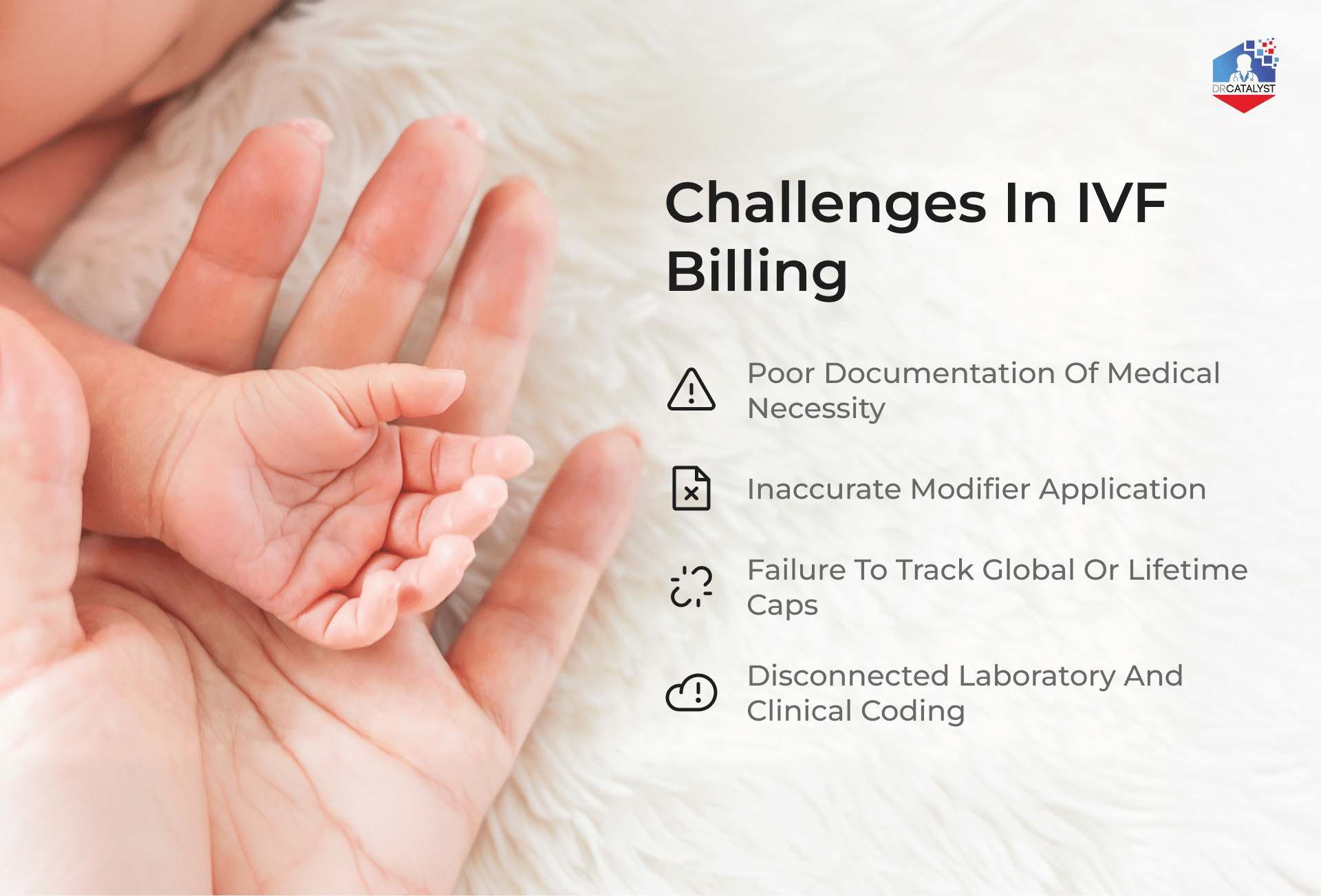
1. Inaccurate Modifier Application
Multi-service claims frequently trigger automatic bundling rejections if modifiers are omitted or misused. For example, if a patient requires a separate, unrelated evaluation and management (E/M) service on the same day as a surgical procedure, failing to append Modifier -25 will result in an immediate denial of the office visit.
2. Failure to Track Global or Lifetime Caps
Many insurance policies place a strict lifetime dollar limit or a maximum number of allowable cycles on fertility benefits. If your team fails to track these caps in real time, you risk billing the insurance provider for a cycle that must legally be paid out of pocket by the patient, creating unexpected financial strain.
3. Disconnected Laboratory and Clinical Coding
The embryology lab operates under highly specific technical rules. A common point of failure is a mismatch between the number of oocytes retrieved, inseminated, or cryopreserved in the embryologist’s log and the final insurance claim form.
4. Poor Documentation of Medical Necessity
Certain advanced lab techniques, such as assisted hatching or preimplantation genetic testing (PGT), require explicit, documented clinical justification to clear insurance hurdles. If the physician’s encounter note fails to establish medical necessity, the accompanying lab claims will be rejected.
IVF Billing CPT Codes
Accurate IVF treatment billing depends on selecting the right code for every service performed. Here are the core CPT codes used in a standard IVF cycle:
| CPT Code | Service Description |
|---|---|
| 58970 | Follicle puncture for oocyte retrieval |
| 58974 | Intrauterine embryo transfer |
| 89250 | Culture of oocyte(s)/embryo(s) |
| 89253 | Assisted embryo hatching |
| 89255 | Preparation of the embryo for transfer |
| 76830 | Transvaginal ultrasound (monitoring) |
| 80053 | Comprehensive metabolic panel (blood work) |
| 58321 | Artificial insemination (IUI) |
| 89268 | Insemination of oocytes |
In addition to CPT codes, ICD-10 codes for infertility diagnoses, such as N97.0-N97.9, must be accurately paired with each claim. Upcoding, downcoding, or mismatched pairings all result in denials that require time-consuming appeals. Billing staff and practice managers in fertility clinics need to ensure accurate and compliant billing at all times.
Tips to Optimize Your IVF Billing Revenue Cycle Management
To improve IVF treatment billing, fertility clinics should focus on consistency, visibility, and follow-up. Revenue cycle management works best when every step is connected, from patient intake to final payment. Here are a few practical ways to improve IVF treatment billing:
Verify benefits early and confirm coverage details.
Use a standardized checklist for every fertility case.
Track authorizations and expiration dates carefully.
Review claims before submission to catch errors.
Follow up quickly on denied or pending claims.
Monitor aging accounts and unpaid balances.
Train staff on payer rules and documentation updates.
Use reporting to track denial trends and payment delays.
A strong IVF billing process should also include regular performance reviews. If denials are increasing or reimbursements are slowing, the issue may lie in coding, documentation, or workflow design. Fertility clinics that make data-driven changes to IVF treatment billing often see better results over time. For clinics seeking deeper support, DrCatalyst offers specialty-focused billing expertise tailored for fertility practices. You can learn more about Fertility Billing Services and how the right specialists can simplify IVF treatment billing across the entire revenue cycle.
Transform Your IVF Billing with DrCatalyst
Managing high-volume fertility cycles alongside intricate laboratory rules leaves very little time to track shifting payer policies, regional mandates, and strict modifier compliance protocols. Trying to recruit, train, and maintain an expert in-house team of specialized fertility billers can drastically increase your operational overhead and pull your clinical focus away from what matters most, such as helping patients achieve successful pregnancies.
At DrCatalyst, we take the administrative stress out of reproductive medicine. Our remote Fertility Billing Services are designed explicitly to navigate the unique challenges of ART and embryology workflows. From proactive eligibility verification and accurate modifier checking to relentless accounts receivable (A/R) aging management, we function as a highly efficient extension of your office. Contact our specialized team today to discover how our custom end-to-end RCM workflows can support your clinical mission!
Conclusion
IVF treatment billing will never be simple. But with the right workflow, the right codes, and the right team of DrCatalyst behind your practice, it does not have to be a constant source of revenue loss. From front-end verification to final collections, every step in the billing cycle matters, and every step can be improved. Fertility clinics that invest in billing accuracy protect their financial health and, ultimately, their ability to keep delivering the care their patients depend on. Schedule a consultation with DrCatalyst to see how we can improve your IVF billing outcomes.