


A fax machine is coughing up a referral somewhere right now that three different people will forget about before lunch. That referral is a patient, sitting at home, waiting for a call that may never come. Multiply that by a few thousand, and you’ve got the quietly chaotic reality most practices live in every single day. The fix has a name, and it’s less exciting than it deserves to be: referral management. Stick with us, though, because done well, it’s the difference between “we’ll get you scheduled” and a patient who actually walks through the specialist’s door.
The primary care physicians (PCPs) alone initiate more than 51 million referrals annually in the US. The referral process is described as one of the most fragmented aspects of US care delivery, with substantial variation in how PCPs manage referrals compared to evidence-based prescribing decisions. Let’s break the whole thing down as the DrCatalyst team would do.
What Is Referral Management in Healthcare?
At its core, healthcare referral management is the structured process of tracking and handling a patient’s care journey as they move from one provider to another. It bridges the operational gap between primary care physicians, specialists, insurance payers, and community health networks.
A high-performing system ensures that when a referral is generated, the appropriate clinical documentation accompanies the patient, insurance authorizations are secured upfront, and the loop is closed once specialist care is complete. Rather than viewing a referral as a single piece of paper, leading practices treat it as a continuous lifecycle that requires active oversight.
Why Referral Management Matters for Behavioral Health Organizations
Behavioral health practices deal with unique challenges. Patients often face stigma, anxiety, or complex emotional barriers when seeking care. A poorly managed referral can mean a patient never shows up, resulting in missed care opportunities and lost revenue. A frequently cited framework describes referral failures across the US system as “dropping the baton” between referring and receiving clinicians due to communication gaps.
Strong referral management helps close that loophole. It ensures the right information gets to the right provider at the right time, reduces no-shows, and creates a smoother experience for both patients and providers. For behavioral health organizations, improving referral processes is about enhancing core operations and better patient care.
Types of Referral Management Systems
There are different ways practices handle referrals today:
1. Manual Systems
Spreadsheets, phone calls, and paper forms. These are prone to errors and delays.
2. In-House Digital Systems
EHR-integrated tools that track referrals internally.
3. Outsourced Referral Management
Practices partner with virtual staff from DrCatalyst to manage referrals end-to-end.
4. Hybrid Models
A mix of internal staff and external support, often using virtual teams.
Many practices today are shifting toward outsourced or hybrid models that use dedicated virtual medical assistants to reduce workload and improve efficiency.
The Referral Lifecycle
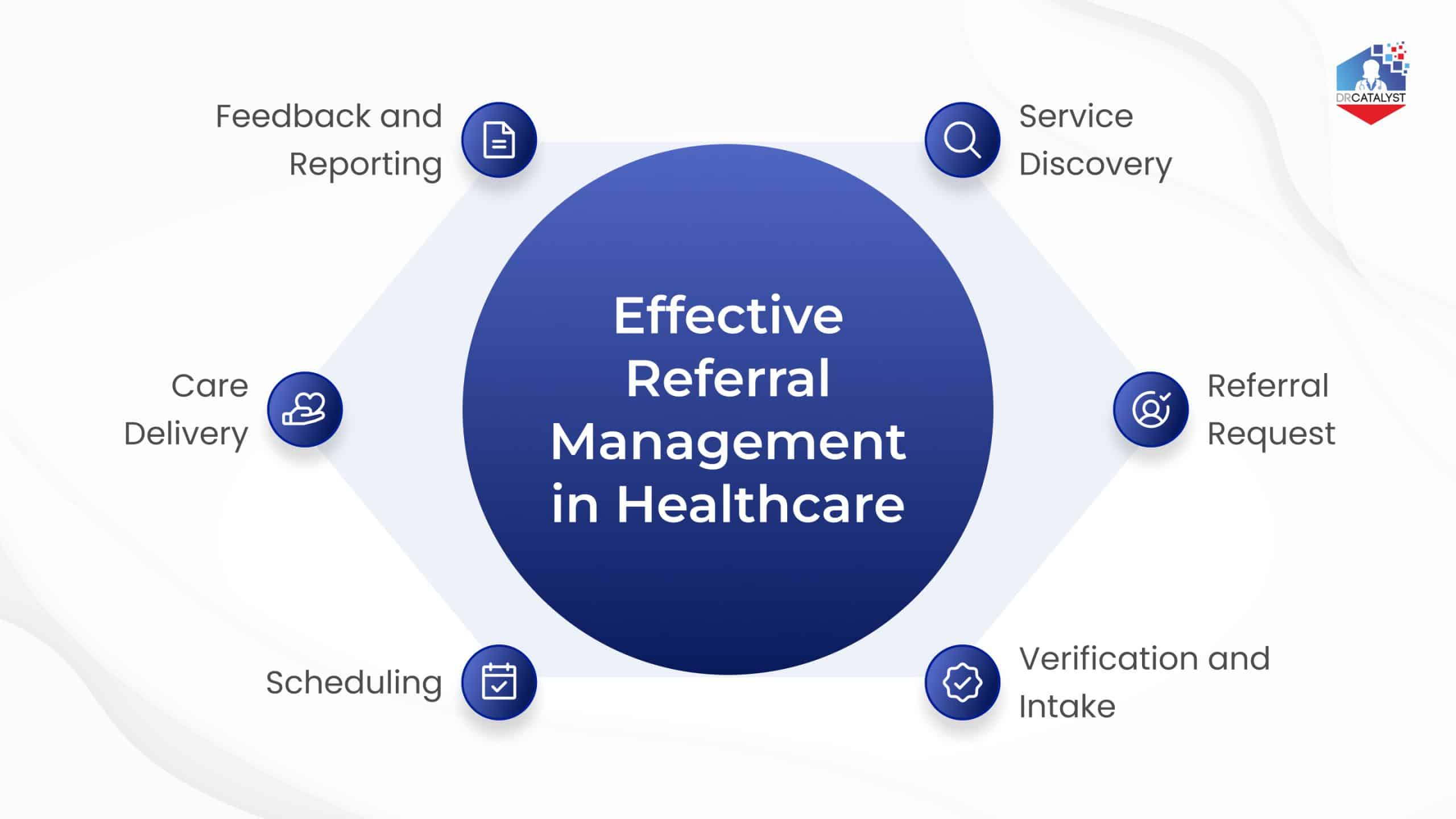
The referral lifecycle follows a consistent pattern regardless of the healthcare setting :
- Service Discovery:
The referring provider identifies an appropriate care provider to receive the referral. This may involve searching service directories by specialty, geography, and availability.
- Referral Request:
The referring provider sends a referral request package containing patient identification, clinical information, relevant medical history, and the reason for referral. This may be accompanied by related health information to help the receiving provider understand the patient’s needs.
- Verification and Intake:
The receiving provider reviews the referral for completeness and accuracy. This step often includes insurance verification and prior authorization. The provider may accept or decline the referral based on capacity, specialization, or other factors.
- Scheduling:
If accepted, the patient is scheduled for an appointment with the specialist or receiving provider. This may be done immediately or within a defined timeframe.
- Care Delivery:
The patient receives care from the specialist or receiving provider.
- Feedback and Reporting:
The receiving provider communicates the results of the consultation back to the referring provider. This “closing the loop” is essential for continuity of care and for strengthening referral relationships.
How Does Referral Management in Healthcare Take Place?
In a day-to-day scenario, healthcare referral management requires coordination between front-office staff, clinical staff, referral coordinators, and outside providers. A referral manager usually monitors the workflow daily, making sure requests are processed, records are attached, and appointments are confirmed.
For example, a primary care practice may send a behavioral health referral for a patient who needs therapy or psychiatric evaluation. The referral coordinator verifies the specialist’s availability, checks required documents, contacts the patient, and ensures the appointment is scheduled. If anything is missing, the coordinator follows up quickly.
This kind of process becomes much easier when supported by the right staffing structure. Practices can improve efficiency by using dedicated virtual medical assistants for routine coordination and medical records assistants for documentation support. If your team struggles with scheduling delays or follow-up gaps, the issue is often not care quality but workflow design.
Key Challenges in Referral Management
Despite its importance, many practices face significant challenges in the healthcare referral management process, such as:
Communication gaps between providers
Incomplete patient information
Delayed authorizations
High no-show rates
Lack of tracking systems
These challenges often lead to revenue loss and poor patient experiences.
What Good Referral Management Looks Like
High-performing organizations share several characteristics in their referral management approach :
1. Rapid Response
Initial callback or response within 15 minutes during business hours, verification of benefits completed within 30 minutes of receiving insurance information, and intake offered within 24 hours for residential referrals.
2. Systematic Tracking
A referral source database captures contact information, referral history, conversion rates, preferred communication methods, and relationship owner assignments.
3. Tiered Source Management
Top-tier sources receive regular in-person visits and dedicated communication channels; mid-tier sources benefit from quarterly check-ins; emerging sources require cultivation through education and consistent responsiveness.
4. Closed-Loop Communication
Referring providers receive feedback about their patients’ progress and outcomes. This demonstrates professionalism and encourages continued referrals.
5. Data-Driven Decisions
Organizations track referral volume by source, inquiry-to-admission conversion rates, average response times, and referral source retention to continuously improve performance.
The Role of Technology in Modern Referral Management
Technology plays a major role in modern referral management by improving speed, accuracy, and visibility. Many organizations now use integrated tools, dashboards, and automated notifications to support healthcare referral management. These technology solutions for referral management in healthcare help reduce manual work and make it easier to track each referral in real time.
Technology can also help with document sharing, status updates, patient reminders, and reporting. For a referral management team, this means fewer lost tasks and follow-up gaps. For patients, it means faster access to care and a clearer experience.
Still, technology works best when paired with the right people. A system may automate part of the process, but human oversight is still needed to make sure referrals are completed correctly. That is why many organizations combine software with staffing support.
Common Referral Management Mistakes
Many practices unknowingly make mistakes that disrupt their referral workflows:
Not tracking referrals after initiation
Relying on manual processes
Poor communication with patients
Ignoring follow-ups
Overloading front-desk staff
These can cost healthcare teams revenue and patient trust and can impact operations.
Benefits of Effective Referral Management
The benefits of effective referral management in healthcare extend across clinical, operational, and financial dimensions:
- Improved Patient Outcomes:
Patients receive timely access to necessary specialist care, reducing delays that can worsen conditions. Research shows that proactive referral management helps ensure that patients complete their recommended care faster.
- Enhanced Patient Experience:
A swift referral experience builds patient trust and loyalty. Patients who feel supported during the referral process are far more likely to stay in-network and trust the system for future needs.
- Reduced Administrative Burden:
Automated referral tracking and communication systems substantially reduce staff time spent on manual follow-ups.
- Revenue Retention:
Preventing referral loss keeps patients in-network and has a significant financial impact.
- Strengthened Referral Relationships:
Systematic follow-up and communication with referring providers build trust and encourage repeat referrals. Organizations that consistently provide timely updates see higher retention of referral sources.
- Better Resource Allocation:
Referral attribution data drives strategic resource allocation. Organizations can invest in the channels that deliver results and develop channels where gaps exist.
DrCatalyst Closes the Referral Management Loop
At DrCatalyst, we understand that referral management is an administrative task, a core part of patient access and care coordination for the practice’s efficiency. Our patient referral management services are designed to help healthcare organizations keep them moving, documentation organized, and patients connected to the next step in care.
We support practices with staffing and workflow solutions to make healthcare referral management more manageable. Whether your organization needs help with follow-up, records, coordination, or communication, DrCatalyst can help create a more reliable process. If your team is exploring ways to improve referral flow, now is a good time to assess where support is needed most.
Conclusion
Mastering referral management in healthcare is no longer just about moving paperwork from Office A to Office B. In today’s highly competitive, fast-paced environment, it is a foundational pillar of practice growth, patient safety, and clinical staff retention. By eliminating manual blind spots, embracing secure technology solutions, and leveraging specialized virtual support teams, you can ensure that your patients always receive the continuous, high-quality care they deserve. Take it one step at a time, rely on structured data, and watch your clinic’s operational health thrive. Schedule a free consultation with DrCatalyst today and discover how easily our virtual assistants can work as an extension of your team!
FAQs
Referral management is the process of coordinating a patient’s journey from the provider who recommends a specialist or service to the point at which that care is delivered — including authorization, information transfer, scheduling, follow-up, and documentation.
It improves patient care, reduces delays, and ensures referrals are completed successfully.
A referral manager (a person, a software platform, or both) owns each referral end-to-end: securing approvals, transferring records, booking appointments, sending reminders, closing the loop with the referring provider, and tracking the whole thing so nothing slips through.
The biggest challenges include incomplete documentation, poor tracking, staffing shortages, and fragmented communication.
Manual management relies on paper logs, faxes, and basic spreadsheets, which are prone to data loss and communication gaps. Automated tracking uses cloud-based digital dashboards that monitor every step of the patient lifecycle in real time, automatically flagging uncompleted appointments and missing prior authorizations.