


The orthopedic landscape in 2026 is moving faster than ever. Independent orthopedic practices, sports medicine clinics, and musculoskeletal specialists are balancing high patient volumes with increasingly complex administrative demands. Between navigating major updates to evaluation and management (E&M) guidelines, stricter payer rules, and a shifting regulatory environment, managing your practice’s financial health requires exceptional precision.
From 2000 to 2015, the average Medicare reimbursement declined by 29% across all orthopedic subspecialties, making it critical for practices to capture every dollar. Yet, a busy orthopedic surgeon wraps up a complex knee reconstruction. The clinical work is flawless. The patient is recovering well. But three weeks later, the practice received a denial due for an incorrect modifier, insufficient documentation, and a bundling error. Revenue that was earned walks right out the door. This guide by DrCatalyst is for practices tired of leaving money on the table.
Orthopedic Billing Workflow
A smooth billing workflow is the backbone of a financially successful practice. It’s a series of interconnected steps, and if any one of them fails, the entire system can break down. Let’s walk through the key stages for an orthopedic practice.
- Pre-Visit:
Insurance eligibility and benefits verification (don’t skip this!)
- During the Visit:
Accurate documentation of procedures, diagnoses, and medical necessity
- Charge Capture:
Entering the right CPT codes, modifiers, and units
- Claim Scrubbing:
Catching errors before submission
- Submission & Follow-up:
Sending clean claims and chasing payments
- Denial Management:
Appealing with proper documentation
- Patient Billing:
Collecting what insurance doesn’t cover
Miss a step and the whole chain breaks. That’s why smart practices treat orthopedic billing as a system, not a side task. A specialty-focused team knows how to handle procedure-heavy claims, post-op care, imaging, injections, and global periods without letting revenue slip through the cracks. If your practice is still managing these steps manually, it may be time to rethink the process.
Common Orthopedic Billing Mistakes and How to Avoid Them
Even highly experienced medical groups face revenue drops due to recurring administrative oversights. Identifying these systemic medical billing mistakes is the first step toward achieving an industry-leading first-pass acceptance rate.
1. Incorrect Modifier Usage
Orthopedics is highly modifier-dependent. Frequent errors include:
- Missing Laterality:
Failing to append -RT (Right) or -LT (Left). This is the single highest-volume cause of automatic denials.
- Global Period Misapplication:
Accurate documentation of procedures, diagnoses, and medical necessity
- Improper Use of -59:
Using modifier -59 to bypass NCCI edits without the clear documentation to support a “distinct procedural service.” Payers are increasingly scrutinizing this and prefer the more specific X-modifiers (e.g., XS, separate structure).
To prevent them, invest in continuous coder education on the latest CPT and modifier changes. Implement a claim-scrubbing system that checks for these errors before submission. For a deeper understanding of general billing mistakes, our blog on the top medical billing errors and how to avoid them provides comprehensive insights.
2. NCCI Bundling Violations
The National Correct Coding Initiative (NCCI) prevents unbundling of procedures that should be billed together. Common orthopedic violations include:
Billing hardware removal (CPT 20680) with a revision arthroplasty (e.g., 27134, 27486).
Billing an arthroscopy (e.g., 29881) with an open arthroplasty (e.g., 27447) on the same joint.
Reporting fluoroscopic guidance (77002) as a separate service during an arthroplasty.
To prevent them, keep an updated NCCI edit manual or use billing software that runs claims through an NCCI scrubber. A separate QA team, as part of a structured billing process, can also help catch these errors before they result in denials.
3. Diagnosis-to-Procedure Mismatches
Even if the CPT code is correct, the claim will be denied if the ICD-10 diagnosis code doesn’t support medical necessity. For example, reporting a TKA with a pain diagnosis (M25.561) instead of the specific osteoarthritis diagnosis (M17.11).
To prevent them, ensure your clinical documentation is robust and specifically states the condition, its location, and laterality. Build a crosswalk that maps the most common diagnoses to the correct ICD-10 codes for your most frequent procedures.
Orthopedic Billing CPT Codes You Need to Know in 2026
Accurate code assignment requires an intimate knowledge of the active CPT library. Below is a cheat sheet outlining the core high-frequency code ranges utilized within independent musculoskeletal clinics:
Joint Replacement & Reconstruction
- [CPT 27447] Total Knee Arthroplasty (TKA):
Reimburses for removal of damaged knee joint surfaces and placement of prosthetic components. Requires a 90-day global period.
- [CPT 27130] Total Hip Arthroplasty (THA):
Describes total hip replacement surgery for advanced joint degeneration.
- [CPT 29881] Knee Arthroscopy with Meniscectomy:
One of the most commonly reported knee procedures. Be aware of bundling rules; it cannot be billed with a TKA on the same knee in the same session.
Fracture Care
- CPT 25607:
Open treatment of a distal radius fracture with internal fixation.
- CPT 28485:
Treatment of a calcaneus (heel bone) fracture.
2026 Code Updates
Staying current is crucial. The AMA has updated codes for 2026, including:
- SI Joint Arthrodesis:
Codes 27278 and 27279 have revised descriptors to clarify the distinction between intra-articular and transarticular device placement.
- New Osteotomy Codes:
Code 27458 for femoral osteotomy with an intramedullary lengthening device and 27713 for tibial osteotomy were added.
- Knee Arthroplasty:
Code 27445 (hinge prosthesis) was deleted.
- Spine:
Code 62287 was revised, and new codes 62330 and 62331 were added for percutaneous lumbar decompression with partial removal of the ligamentum flavum.
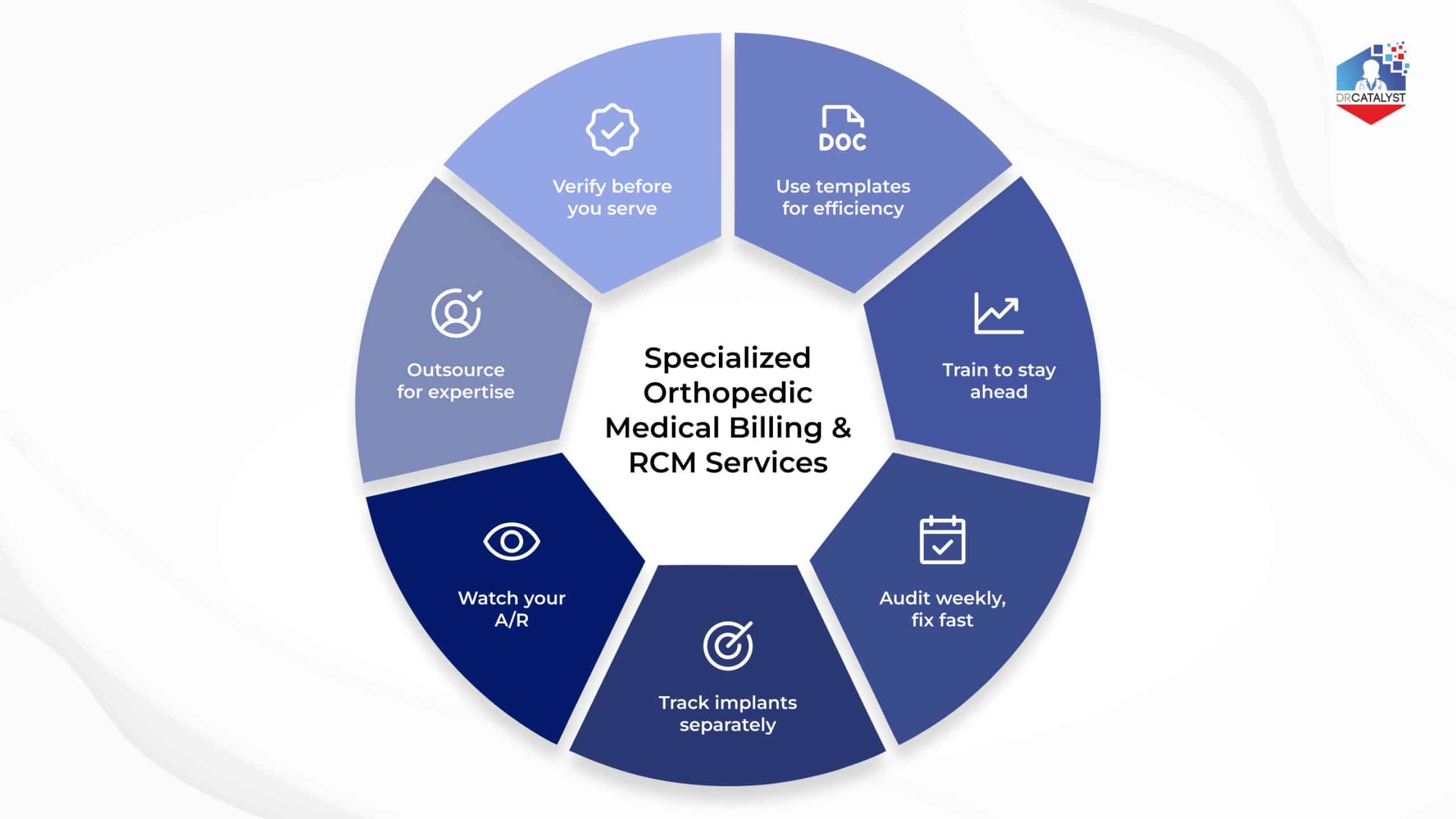
Tips to Optimize Your Orthopedic Billing Revenue Cycle Management
Strong orthopedic medical billing services are built on consistency, visibility, and specialty-specific expertise. Here is what high-performing orthopedic practices do differently:
Verify insurance and obtain prior authorizations before every scheduled procedure, not after
Use orthopedic-specific coding templates and code sets to reduce reliance on memory
Train billing staff continuously on NCCI edits, global period rules, and modifier updates
Audit denied claims weekly to identify patterns and fix upstream process issues
Track implant costs and reimbursements separately to catch discrepancies early
Monitor aging accounts receivable by payer to identify who is paying slowly and why
Consider outsourcing to a specialty-focused team that understands the orthopedic revenue cycle end-to-end
Schedule a free consultation with the DrCatalyst team to know how we reduce denials and recover lost orthopedic revenue.
Why DrCatalyst is the Smart Choice for Orthopedic Practices
Navigating the complexities of orthopedic billing is a significant challenge, but you don’t have to do it alone. At DrCatalyst, we bring over 15 years of expertise to the table, offering specialized orthopedic medical billing services that act as an extension of your practice. We understand the unique nuances of your specialty from complex CPT codes and NCCI edits to global period management and payer-specific rules.
Our skilled coders and billers work with your team, following your protocols and leveraging our expertise to ensure clean claims, faster reimbursements, and a healthier revenue cycle. Don’t let billing challenges hold your practice back. Discover how the DrCatalyst team can be advantageous for your practice’s growth. Let’s start a conversation.
TL;DR
Orthopedic billing and coding in 2026 demand precision, expertise, and a structured approach. With complex procedures, evolving payer requirements, and strict documentation standards, practices must adopt efficient workflows and specialized billing strategies. By minimizing errors, leveraging technology, and partnering with experts in orthopedic medical billing, practices can reduce denials, improve cash flow, and focus more on patient care. A well-optimized billing system is not just an operational necessity; it’s also a growth driver for your practice.