

Documentation is one of the heaviest burdens in healthcare. An AMA study measured that for every hour of direct patient care, doctors spend nearly two more hours on the electronic health record (EHR) and desk work. Research from the National Institutes of Health ties that load to burnout. A remote medical scribe helps flip the ratio back.
The strongest setups pair live scribing with medical transcription. That covers real-time visits and dictated notes alike. This guide covers what a remote medical scribe is, what they do, the benefits, the skills to look for, and the best practices that make virtual medical scribing work.
Who Is a Virtual Medical Scribe?
A virtual medical scribe is a trained documentation professional. They capture a patient encounter and enter it into the EHR in real time. They do it from an off-site location. A remote medical scribe does the same job as an in-person scribe. They join the visit securely by phone or video and document the conversation as it happens.
Think of a behind-the-scenes partner. They listen to the provider-patient conversation. They shape it into a clean clinical note. Then they hand the provider a finished chart to review and sign. The provider stays present with the patient. The note is ready when the visit ends. Because the scribe works remotely, you get skilled help without adding a desk to a crowded office.
What Does a Virtual Medical Scribe Do: Key Roles and Responsibilities
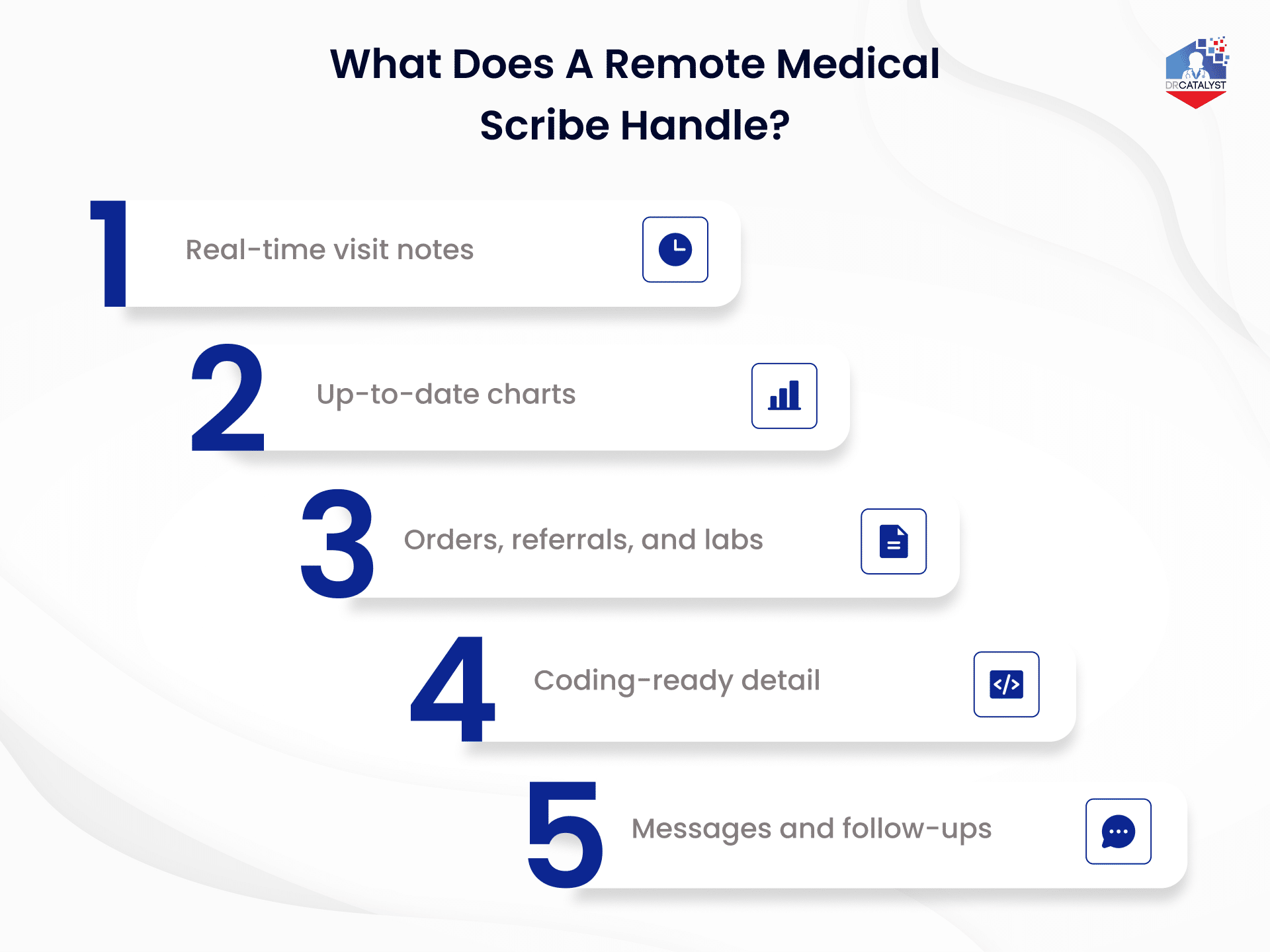
A virtual medical scribe records clinical documentation so the provider does not have to. Here is what a remote medical scribe does on a typical day:
Documents the visit in real time. This covers the history, review of systems, exam findings, and the assessment and plan.
Updates the chart in the EHR. Problem lists, medications, and allergies stay current.
Prepares orders, referrals, and lab and imaging requests for the provider’s authorization.
Records the details needed for accurate coding and clean claims.
Helps manage the provider’s in-basket, messages, and follow-up tasks.
Not every encounter is documented the same way. A remote medical scribe captures many visits live, in real time. Others are handled through medical transcription, which turns a provider’s dictation or recording into a clean note. A complete service delivers both.
Does AI make this role obsolete? No. AI is a powerful assist, not a replacement. Our article on why medical transcriptionists remain essential despite AI advances explains how human judgment keeps a note accurate, in context, and compliant.
Benefits of Hiring Remote Medical Scribes
The benefits of hiring remote medical scribes go beyond tidier notes.
- Less burnout:
Providers stop taking charts home at night.
- More face time:
Full attention improves care and the patient experience.
- Cleaner claims:
Complete notes support correct coding and fewer denials.
- Higher throughput:
Providers see more patients when they are not typing all day.
- Lower cost:
A remote model removes on-site overhead, and you can scale up or down with volume.
- Flexible coverage:
Live scribing handles real-time visits, and medical transcription captures dictated notes.
Scribing is one piece of a bigger staffing strategy. Our article on how remote staffing helps healthcare practices scale faster shows how the pieces fit. Our list of ways a virtual staff can elevate your clinic backs up the numbers.
Want to see this in your practice? Explore DrCatalyst’s remote medical scribe services and book a quick consultation.
Skills and Qualifications for Remote Medical Scribes
The best virtual medical scribe is fast and precise. Look for these qualities in a candidate or vendor:
A strong grasp of medical terminology and common specialty workflows.
Fluency across major EHR platforms, plus the ability to learn new ones fast.
Quick typing paired with real attention to detail.
A working knowledge of documentation and coding rules.
Clear communication and careful handling of patient information.
Full HIPAA training and a privacy-first mindset.
Specialty experience helps too. A scribe who already knows cardiology, allergy, or orthopedic charting ramps up faster and makes fewer errors.
Best Practices for Effective Remote Medical Scribing
A few habits get the most from a remote scribe.
- Invest in onboarding:
Share your templates, macros, and preferences up front.
- Set up the tech:
Clear audio and a secure connection are non-negotiable.
- Give cues during the visit:
Simple prompts help the scribe capture what you want.
- Build a feedback loop:
Quick corrections early lead to clean notes later.
- Keep compliance front and center:
Every tool and connection should meet HIPAA standards.
Common Challenges and How to Overcome Them
Remote scribing works well. Still, a few challenges are worth planning for.
- Audio and connectivity:
Use good microphones, a stable connection, and a backup plan.
- EHR integration:
Pick a scribe or service already fluent with your system.
- Communication gaps:
A short daily rhythm keeps the provider and scribe in sync.
- Trust and quality:
Supervision and regular quality checks build confidence fast.
The same principles apply to the roles around the scribe. A remote patient care coordinator keeps follow-ups on track. Strong referral management in healthcare keeps patients moving through the system.
How Remote Medical Scribes Improve Provider Efficiency and Patient Care
Handle documentation, and everything downstream improves. Providers move through the schedule with less friction. Notes get finished and signed the same day. After-hours charting shrinks or disappears. The documentation burden is a national priority, and the Agency for Healthcare Research and Quality publishes guidance to ease it. Patients feel the difference too. The provider is looking at them, not a screen.
A scribe also works best on a connected team. Pair scribes with remote medical assistants who handle authorizations and refills. Add a virtual new patient coordinator who keeps the schedule full. One efficiency gain becomes practice-wide.
Why DrCatalyst is Best for Remote Medical Scribe Services
DrCatalyst provides trained, HIPAA-compliant remote medical scribes. Our service covers live scribing and medical transcription together. That gives you one partner for real-time documentation and for dictation. They integrate directly into your EHR and workflows. You do not just get one person. You get a supported team with multiple levels of supervision, built-in business continuity, and specialty experience across primary care and beyond. Your documentation keeps running even when someone is out. Your providers get their time back.
Talk to DrCatalyst about a remote medical scribe service built around your practice.
In A Nutshell
A remote medical scribe is a direct way to cut documentation burden. It protects providers from burnout. It gives patients the attention they deserve. The right skills, technology, and a few best practices deliver cleaner notes, healthier providers, and a better experience. Book a free consultation with DrCatalyst and see the difference for yourself.
FAQs
A remote medical scribe is a trained professional who documents patient visits in the EHR in real time. They work off-site, so you get accurate notes without adding office staff.
A remote medical scribe records the history, exam, assessment, and plan during the visit. They update the chart and prepare orders and referrals. The provider simply reviews and signs.
Yes. Reputable virtual medical scribe services are fully HIPAA compliant. They use secure connections, trained staff, and documented privacy safeguards.
For most practices, yes. The time saved, lower burnout, cleaner claims, and added patient volume usually outweigh the cost. A remote model keeps overhead low.
The best virtual medical scribe combines medical knowledge, EHR fluency, speed, accuracy, and clear communication. Specialty experience is a plus.
Yes. DrCatalyst’s remote medical scribe service combines live scribing and medical transcription. Real-time visits and dictated notes are both covered by one team.