

Federally Qualified Health Centers (FQHCs) serve as a critical safety net for the American healthcare system, providing essential medical care to underserved areas and vulnerable populations, regardless of their ability to pay. However, the administrative back-end required to keep these safety nets funded is incredibly complex. Unlike traditional private practices that bill under a standard fee-for-service model, FQHCs operate under a specialized, highly regulated framework.
Shifting regulations from the Centers for Medicare & Medicaid Services (CMS) and complex bundling rules mean that even minor mistakes can result in major revenue leaks. Reports suggest that FQHC billing and operational efficiency directly affect financial sustainability. To protect your health center’s bottom line, master the core elements of FQHC billing guidelines, optimize your coding workflows, and learn the strategic tips needed with DrCatalyst to prevent costly claim denials.
What Is FQHC Medical Billing?
At its core, FQHC medical billing centers around a bundled, all-inclusive reimbursement methodology rather than itemized, service-by-service claims. Under the Medicare Prospective Payment System (PPS) and state-specific Medicaid rules, FQHCs receive a flat, pre-determined reimbursement rate per patient encounter, regardless of how many individual tests or procedures are performed during that specific visit.
FQHC expansion has increased by more than 80% over the past decade, creating new billing environments and requiring adaptations to billing practices. To stay compliant and receive proper reimbursement, FQHCs must follow a distinct set of operational standards:
1. Sliding Fee Scales
Health centers are required to establish a sliding-fee discount schedule based solely on the patient’s family size and income level.
2. Medicare Coinsurance
Clinics must systematically calculate and collect the standard 20% Medicare coinsurance rate from the patient or their supplemental insurer.
3. Enhanced Access
FQHCs must guarantee after-hours access to care, ensuring round-the-clock clinical support for their designated patient base. Because your entire payment is tied to a single, bundled encounter, your staff must carefully follow federal and state-level guidelines to avoid systemic claim rejections.
Understand the Billing and Coding Guidelines for FQHCs
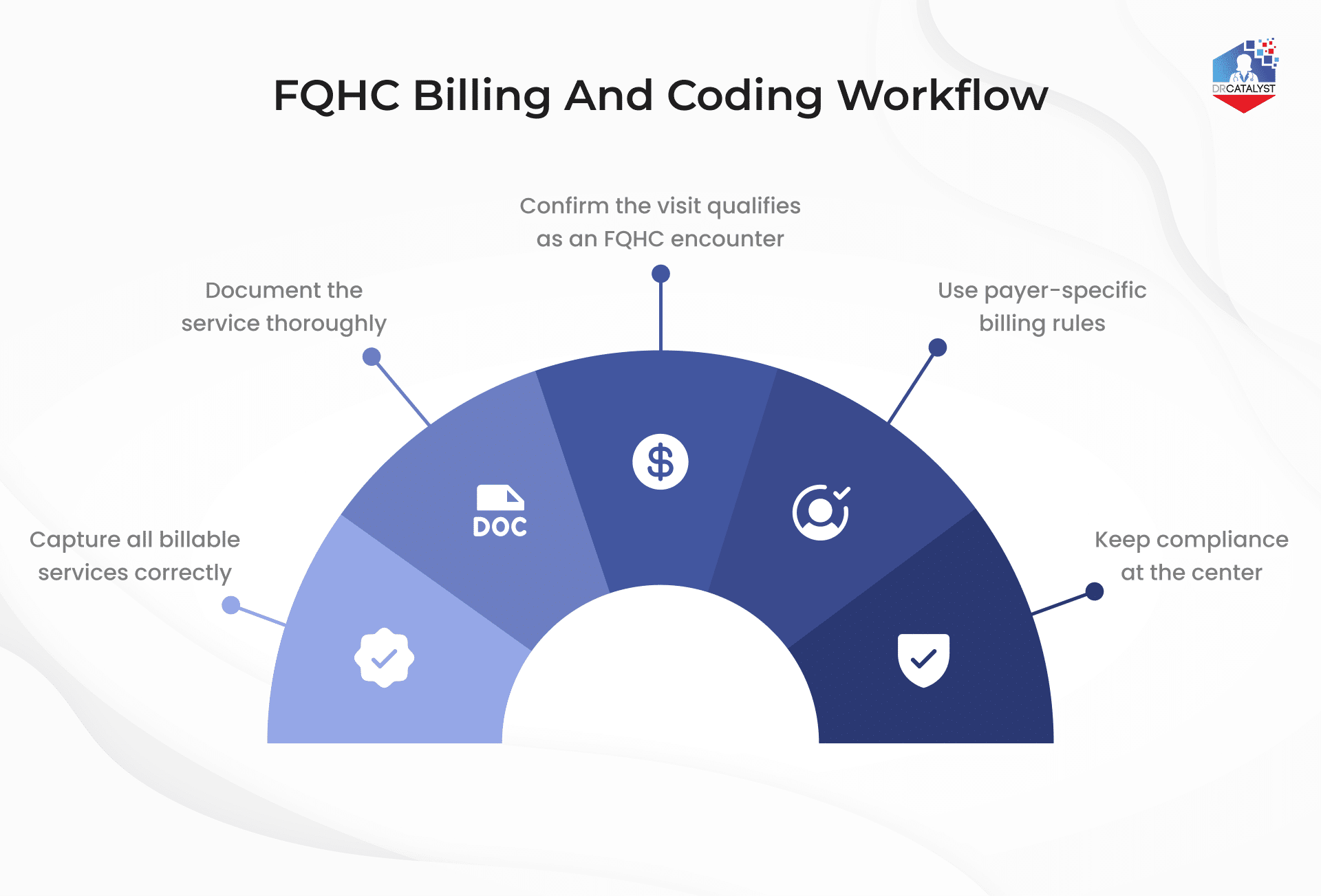
The best way to simplify FQHC medical billing is to break it into clear steps. A strong billing workflow helps your team stay compliant while keeping claims moving.
1. Confirm the visit qualifies as an FQHC encounter
Not every service billed in the clinic counts as an FQHC encounter. Your team should confirm that the visit meets payer and program criteria before submitting the claim.
2. Document the service thoroughly
Accurate documentation is essential. The medical record should clearly support the reason for the visit, the service provided, and the medical necessity of the encounter. This is one of the most important parts of the billing guidelines for FQHC.
3. Capture all billable services correctly
Some services may be bundled, while others may qualify separately depending on payer rules. Proper charge capture supports cleaner claims and fewer reimbursement delays.
4. Use payer-specific billing rules
Different payers may apply different requirements for modifiers, frequency limits, or bundled services. Your billing team should review the payer’s rules before submitting the claim.
5. Keep compliance at the center
Strong FQHC billing and coding practices should always support compliance. That means staying current with Medicare, Medicaid, and managed care requirements while ensuring that documentation and coding align.
Common Challenges in FQHC Billing
Even with clear FQHC billing guidelines, organizations often face operational hurdles that impact revenue.
- Frequent Claim Denials:
Coding errors, documentation gaps, or incorrect payer rules can lead to high denial rates.
- Complex Payer Requirements:
Each payer has unique billing rules, making standardization difficult.
- Staffing and Training Gaps:
Billing teams often lack specialized training in FQHC billing and coding, leading to inconsistencies.
- Regulatory Changes:
Keeping up with evolving compliance requirements is a constant challenge.
- Inefficient RCM Processes:
Manual workflows and disconnected systems slow down billing operations and increase errors.
You can reduce denials and improve efficiency with DrCatalyst. Discover how outsourcing RCM can help small practices.
Use the Correct FQHC Billing Codes to Ensure Timely Reimbursements
This is the part where many FQHC administrators quietly cry into their coffee. Key things to get right:
Use the correct G-codes for preventive services, behavioral health, dental, and wrap-around visits
Bill Medicare and Medicaid using the FQHC-specific payment methodology
Properly document medical necessity for each encounter
Understand how to bill for multiple services on the same day without triggering bundling denials
Get these FQHC billing codes right, and you’ll see cleaner claims and faster payments. Get them wrong, and you’ll spend your life chasing denials.
Turn Your Billing Challenges into Financial Stability
Managing FQHC billing guidelines in-house often stretches small teams to the breaking point. Staff turnover, training gaps, and ever-changing payer rules lead to mounting denials and cash flow interruptions. This is where a dedicated RCM partner becomes essential. At DrCatalyst, our FQHC Billing and RCM Services are designed specifically for the complexities of health centers. We solve the challenges that keep FQHC leaders up at night:
Complex Billing Rules Across Programs
Our FQHC billing experts ensure compliance with Medicare, Medicaid, and commercial payer rules, accurately handle wrap claims, and prevent underpayments.
High Staff Turnover & Training Gaps
We provide fully trained, supervised virtual assistants with no turnover issues. These specialists live and breathe FQHC RCM.
Rising Denials
We apply strict eligibility checks and error-free coding to prevent aggressive denials, ensuring your claims are right the first time.
Slow Collections
Our structured workflows strengthen your revenue cycle so claims go out correctly, and A/R follow-up is relentless. Contact DrCatalyst today to stop chasing denials and start maximizing your PPS capture.
Beyond FQHC-specific expertise, a strong RCM partnership also requires knowing how to choose the right fit. For guidance on evaluating potential partners, read our guide on how to choose the right revenue cycle management partner.
Conclusion
Mastering FQHC billing guidelines doesn’t have to feel like solving a Rubik’s Cube blindfolded. With the right knowledge, correct FQHC billing codes, and a strong partner by your side, you can turn billing from a constant headache into a reliable revenue engine. Your patients deserve great care. You deserve billing processes that actually support your mission. Start optimizing your revenue cycle the smart way today!