


What if a simple coding mistake could delay your payments by weeks, or even cost your practice thousands in lost revenue? In today’s complex healthcare environment, even small medical coding errors can have serious financial consequences.
Whether it’s a surge in claim rejections or heightened regulatory risks, these coding slips disrupt your cash flow and compromise your administrative stability. As payer rules evolve and coding requirements become more specific, practices must proactively identify risks and implement strategies to prevent errors.
According to Grand View Research, the global medical coding market size was approximately USD 39.85 billion in 2024 and is forecasted to reach USD 71.47 billion by 2030. This growth has been estimated at a CAGR of 10.22% from 2025 to 2030.
Without proper coding processes, even high-performing practices can struggle to maintain consistent cash flow. In this blog, we’ll explore the most common medical coding errors, why they occur, and proven strategies for avoiding them.
The High Cost of Common Medical Coding Mistakes
In healthcare, a single digit can cost thousands. According to recent data from MGMA, medical coding mistakes alone account for 13% of revenue cycle loss. These mistakes account for overhead costs and aren’t just clerical slips. The most frequent coding errors in medical billing are listed below:
Upcoding & Downcoding
Reporting a more complex service than performed (upcoding) or under-reporting to “play it safe” (downcoding). Whether intentional or accidental, it is considered fraudulent billing and can trigger serious legal and financial consequences. Both are common medical coding errors that can trigger audits.
The Unbundling Trap
Coding components of a procedure separately instead of using a single comprehensive code. This is a red flag for payers and a frequent error in medical billing and coding. Coders should be familiar with the National Correct Coding Initiative (NCCI) edits, which define which codes can and cannot be billed together.
Using Outdated or Incorrect Codes
ICD-10 codes are updated every October. CPT codes are revised annually. HCPCS codes change throughout the year. Practices that don’t stay current with these updates will inevitably submit claims with outdated codes, which will be rejected.
Incorrect Modifiers
Modifiers provide additional context to a procedure code, indicating that a service was performed differently than usual, that multiple procedures were performed, or that more than one provider performed a service. Missing or misusing modifiers like -25 or -59 is a leading cause of common medical coding mistakes that result in immediate claim rejections.
Diagnosis and Procedure Code Mismatches
Every procedure code submitted on a claim must be supported by a diagnosis code that justifies the medical necessity of that procedure. When these two don’t align, even if both codes are individually correct, the claim will be denied for lack of medical necessity. Coders and clinical staff need to work in alignment. Providers should document not only what they did, but also why, clearly establishing the clinical rationale connecting the diagnosis to each procedure billed.
Specificity Gaps
ICD-10 was designed to capture clinical specificity at a granular level. Payers expect that specificity. Using “unspecified” codes when the clinical notes provide enough detail for a higher level of ICD-10 specificity.
Duplicate Billing
Submitting the same claim twice for the same encounter is often due to a lack of clear “back-and-forth” communication between the clinical and billing teams. Sometimes it’s accidental, caused by a system glitch or a manual data-entry error. Regardless of the cause, payers treat duplicate billing seriously, and repeated instances can trigger fraud investigations.
Strategies to Avoid These Medical Coding Errors
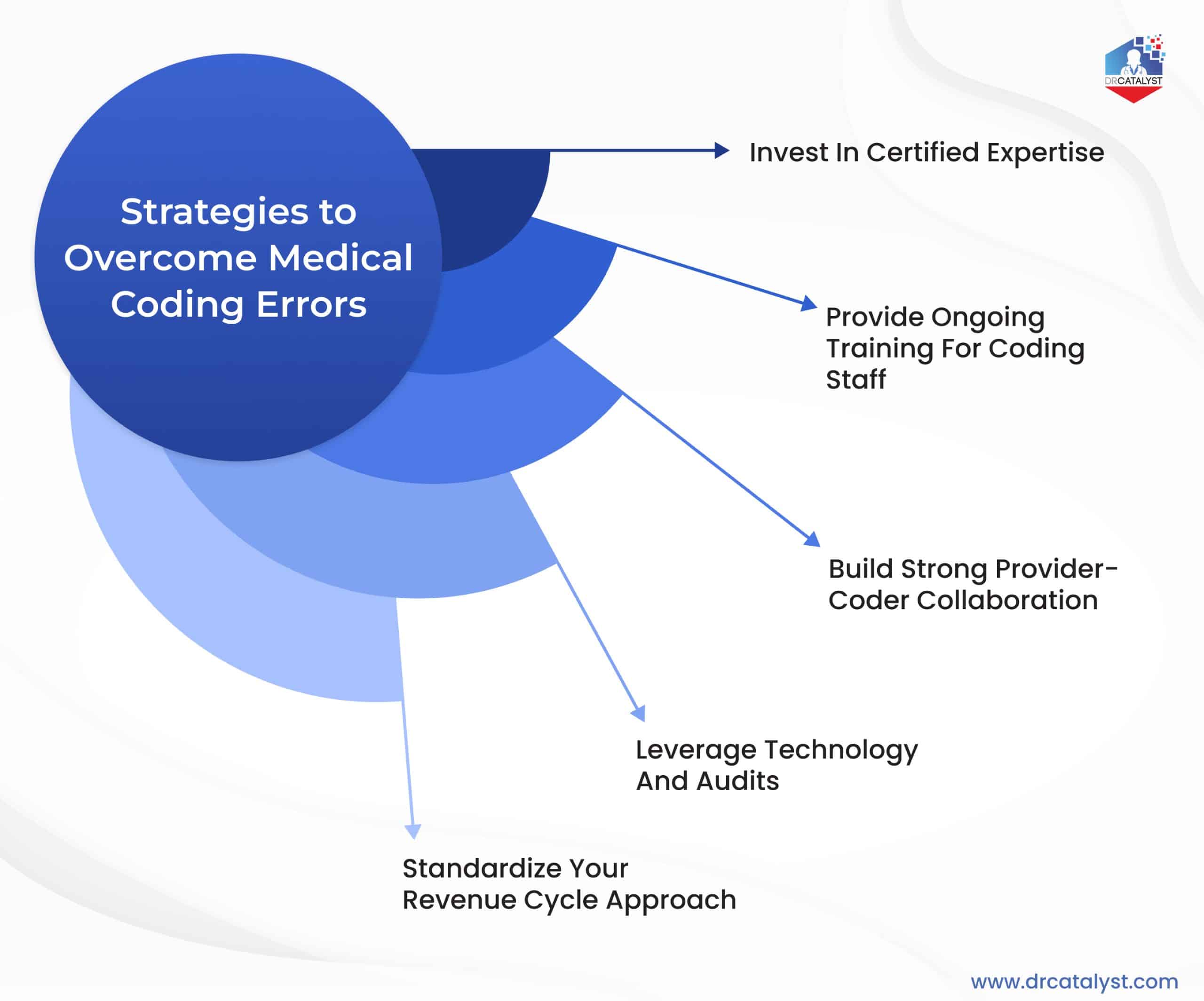
Medical coding errors can significantly impact your practice’s revenue, but they’re preventable with the right approach. From investing in certified specialists and ongoing staff training to fostering provider-coder collaboration and leveraging technology, a multi-layered strategy is essential. By standardizing your revenue cycle and conducting regular internal audits, you can catch discrepancies early, reduce denials, and ensure every service is accurately captured and reimbursed.
Invest in Certified Expertise
The most effective way to reduce medical coding errors is to work with certified professionals who live and breathe coding accuracy. AAPC-certified coders (CPCs and CRCs) bring deep knowledge of coding guidelines, payer policies, and compliance requirements across multiple specialties.
At DrCatalyst, our team of certified medical coding professionals turns messy claims into clean, compliant coding. With 600+ remote medical billers and coders handling billing with unmatched precision, we help over 250 healthcare organizations across 60+ specialties maintain accuracy and maximize revenue.
Provide Ongoing Training for Coding Staff
According to published reports, the ICD series alone accounted for 66.88% medical coding market share in 2025. It has been forecasted to record a 9.88% CAGR to 2031. These expansive medical codes require training to ensure that the coders stay updated with:
ICD-10 updates
CPT code revisions
Compliance requirements
Well-trained coders are more likely to avoid medical billing and coding errors. At DrCatalyst, our coding staff undergoes continuous training as part of their upskilling and keep up with additions, deletions, and revisions to the codes.
Build Strong Provider-Coder Collaboration
Coding quality isn’t just the responsibility of the coding team. When coders and providers collaborate effectively, documentation improves, queries get answered, and claims get paid faster.
Practical advice from certified coding experts, flagging errors, offering documentation tips, and improving claim accuracy, creates a culture of continuous improvement. For practices with multiple locations, this collaboration becomes even more critical.
Leverage Technology and Audits
Computer-assisted coding tools can highlight discrepancies and suggest appropriate codes, but they require human oversight. Regular internal audits focused on high-risk areas help identify patterns before they trigger payer scrutiny. The goal isn’t just to catch medical coding errors; it’s to prevent them from happening in the first place.
Standardize Your Revenue Cycle Approach
Many practices don’t have one revenue drain; they have numerous points of erosion that create missed revenue. A shaky front end triggers denials. Late charges distort A/R. Conservative coding masks revenue erosion. The solution is a unified approach to revenue cycle management that addresses every touchpoint.
DrCatalyst’s comprehensive RCM solutions combine expert billing teams with three levels of supervision and professional QA to ensure accuracy across every aspect of medical billing. From eligibility verification to denial management and payer follow-up, we handle the complex back-and-forth so you can improve your work-life balance.
Why DrCatalyst
With 16+ years of experience and over $59.5 million in monthly charges, DrCatalyst delivers dependable medical coding and billing solutions with speed, clarity, and flexibility. Our innovative hybrid approach combines US-based account management with skilled administrative teams to ensure expert assistance for every client.
We offer:
A team of AAPC-certified CPCs and CRCs with years of experience
Precision-driven quality measure reporting for programs like MIPS
Adaptability to any EHR or billing software
Clear and consistent communication with scheduled recurring meetings and meaningful billing reports
In a Nutshell
Medical billing in healthcare is evolving rapidly, with payers, auditors, and automation tools all tuned to catch even small errors. The practices that thrive treat coding accuracy not as a back-office task but as a strategic enabler of financial and operational excellence. By understanding common medical coding mistakes and implementing strategies to avoid them, whether through certified expertise, stronger collaboration, or a comprehensive RCM partnership, you can protect your revenue, reduce compliance risk, and provide exceptional patient care.
Remember, every denial or correction is a data point, not just a headache. With the right partner, those data points become opportunities for improvement. The financial health of your clinic is built on accurate data. While medical coding mistakes are common in our complex system, they don’t have to be your reality.