


The U.S. healthcare industry loses $262 billion annually to claim denials alone. This number should wake you up on its own. But, here is something even worse, 60% of those denied claims are never resubmitted, meaning practices are simply walking away from money they already earned.
If your practice is struggling with delayed reimbursements, mounting denials, overwhelmed billing staff, and compliance headaches that never seem to end, you’re not alone. Revenue cycle management challenges have hit an all-time high in 2025, and the practices that figure out how to navigate them in 2026 are the ones that thrive financially.
The State of Healthcare Revenue Cycle Management
Before we dig into specific challenges in revenue cycle management, let’s evaluate the present scene. The U.S. RCM market will increase to USD 14.52 billion, at a CAGR of 10.81% from 2023 to 2028. This upcoming explosive growth isn’t just an opportunity; it’s a signal of how complex and resource-intensive revenue cycle management has become.
In Q1 of 2021, 47% of hospitals’ operating margins were reported to be negative. Meanwhile, Medicare physician reimbursement has declined 29% since 2001 (adjusted for inflation), and commercial payers are tightening documentation and prior authorization requirements across the board. This translates to the fact that practices are being squeezed from every direction: lower reimbursements, higher denial rates, tighter compliance requirements, and a staffing market that makes hiring qualified billing professionals feel like searching for a unicorn.
And this trend is not slowing down. So what are the specific RCM challenges in healthcare that practices face every day? Let’s break them down.
Common Healthcare Revenue Cycle Management Challenges
To navigate the healthcare landscape successfully, practices must overcome a series of increasingly complex obstacles that threaten their financial stability. From declining Medicare reimbursements and tighter documentation requirements to a high-turnover labor market, providers are being squeezed from every direction. These trends are driving a massive expansion in the revenue cycle management market as organizations seek more sophisticated solutions to protect their bottom line. Understanding these core challenges is the first step toward transforming your practice’s financial performance. Let’s look at these challenges one at a time-
Challenge 1: The Claim Denial Epidemic
Claim denials are the #1 revenue cycle management challenge, draining healthcare practices financially. The cost of addressing denials is substantial. Hospitals and health systems spent $19.7 billion trying to overturn denied claims in 2022 alone. Studies indicate a sharp increase in denials over the past two years. Most denials happen because of coding errors, missing documentation, eligibility issues, and prior authorization failures, all of which are fixable.
The ripple effect is real. Every denied claim creates extra work: investigation, appeal preparation, resubmission, and payer follow-up. Your billing staff spends hours recovering revenue you should have collected the first time.
Challenge 2: Staffing Shortages and Skyrocketing Turnover
The healthcare staffing crisis isn’t just affecting clinical roles. It’s devastating revenue cycle departments. According to the American Hospital Association (AHA), there will be a critical shortage of 3.2 million healthcare workers by 2026.
This shortage leads directly to increased billing errors, slower claims processing, and delayed reimbursements. A recent survey shows providers face hiring challenges for revenue cycle roles. However, when they do find qualified staff, RCM turnover rates range from 11% to 40%, far exceeding the national average of 3.8%.
Every time a billing specialist or coder leaves, you face:
Revenue disruption while the position goes unfilled
Costly recruitment averaging $5,000-$10,000 per hire
Training periods of 60-90 days before new staff are fully productive
Knowledge gaps that result in coding errors and missed revenue
The remaining staff are burned out from covering the additional workload
High turnover among RCM coding staff leads to overworked or poorly trained coders submitting inaccurate claims for reimbursement, and coding regulations are constantly evolving. That’s a lot for an already-stretched team to stay on top of.
Challenge 3: Coding Complexity and Documentation Errors
Accurate coding is the backbone of your revenue cycle, and it’s getting more complex every year. Why coding errors happen:
ICD-10 codes alone number over 70,000, with constant additions and revisions
Specialty-specific coding requirements vary dramatically
The transition toward value-based care introduces new coding paradigms
Payer-specific rules add another layer of complexity
Common coding mistakes include unbundling (using multiple CPT codes for individual components when a single code applies), upcoding (billing for higher service levels than warranted), and failing to check National Correct Coding Initiative edits when reporting multiple codes.
The financial consequences cut both ways: undercoding leaves reimbursement on the table, while overcoding creates audit risks that can result in costly repayment demands and compliance penalties.
Challenge 4: Prior Authorization Delays
Prior authorizations have become one of the most frustrating and revenue-threatening RCM challenges in healthcare. What should be a straightforward approval process has turned into a major bottleneck. The numbers from AMA tell the story:
Physicians spend an average of 16 hours per week on prior authorization paperwork
94% of physicians report care delays due to prior authorization requirements
80% of prior auth denials are eventually overturned on appeal—meaning the delay was largely unnecessary
When prior authorizations aren’t managed proactively, the result is delayed procedures, frustrated patients, and revenue that gets stuck in limbo for weeks or months.
Challenge 5: Patient Payment Collection Challenges
The financial responsibility shift toward patients has created an entirely new dimension of healthcare revenue cycle management challenges. The issue isn’t just collecting payments; it’s creating a billing experience patients can understand and engage with. When patients receive confusing bills, face unexpected balances, or can’t access convenient payment options, collection rates plummet.
Patients often face confusion or frustration about their financial obligations, which leads to delays or non-payment. Transparency and convenience are key to ensuring payment compliance.
Challenge 6: Regulatory Compliance and Payer Policy Changes
Healthcare compliance is a moving target, and failing to keep up has serious financial consequences. What practices navigate daily:
CMS rule updates and Medicare/Medicaid policy changes
Commercial payer policy variations across hundreds of plans
No Surprises Act requirements for cost transparency
HIPAA security standards and data protection regulations
State-specific billing regulations and scope-of-practice rules
Value-based care reporting requirements
MIPS and quality payment program compliance
The No Surprises Act bans balance billing for emergency services at out-of-network facilities and scheduled services by out-of-network providers, creating new administrative requirements for practices to document and disclose network status. Administrative costs have seen dramatic increases, with the U.S. healthcare system spending $60 billion on administrative tasks recently, marking an $18 billion increase since 2021.
The Claims submission cost has jumped tremendously, which reflects the growing complexity of compliance requirements. Missing a compliance deadline or failing to adapt to payer policy changes can result in denied claims, repayment demands, or worse, legal and regulatory penalties.
Challenge 7: Cybersecurity and Data Protection
As RCM processes become more digital, cybersecurity has emerged as a critical challenge in revenue cycle management. Healthcare data breaches cost an average of $10.9 million per incident, the highest of any industry.
Ransomware attacks on healthcare organizations increased by 74% in recent years. The RCM vendors handle some of the most sensitive data in your organization. Cybersecurity and data protection are major challenges in the RCM market due to the sensitive nature of healthcare data and rising cyber threats.
A breach doesn’t just cost money; it damages patient trust, disrupts operations, and can shut down billing processes entirely during the recovery period.
DrCatalyst Overcomes Healthcare Revenue Cycle Management Challenges
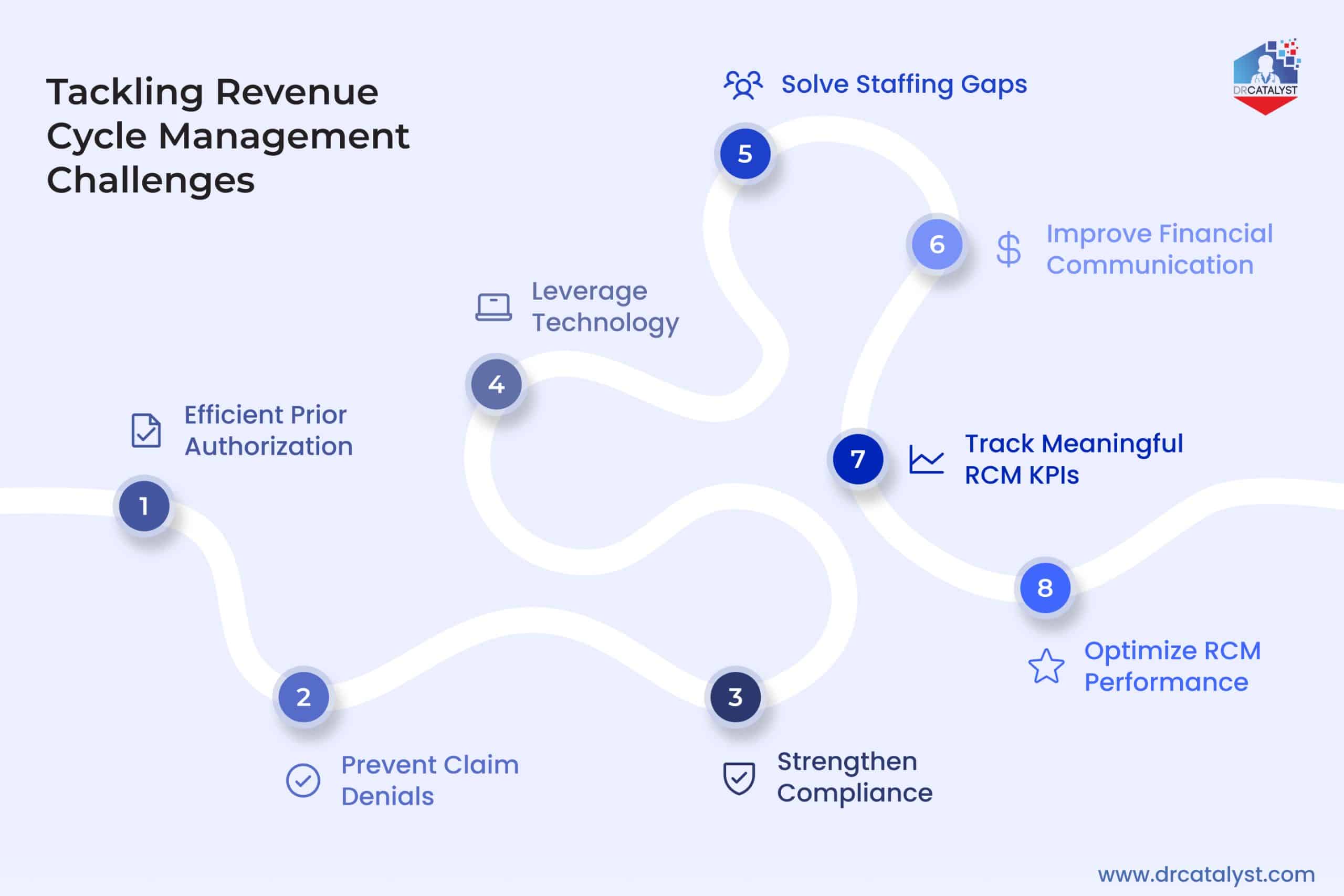
Revenue cycle challenges don’t just slow down payments. They strain staff, increase denials, and create compliance risks. DrCatalyst helps practices take control with proactive strategies, experienced specialists, and systems designed to keep claims moving and revenue flowing. Let’s look at how we overcome these challenges below-
1. Prevent Denials Before They Happen
Our AAPC-certified coding team (CRCs and CPCs) handles specialty-specific coding complexity, while our separate QA team independently reviews claims before they go out. This leads to far fewer denials in the first place. Read more
2. Solve the Staffing Problem Strategically
Our flexible staffing model adapts to what you need:
Virtual Medical Assistants for phones, scheduling, and admin tasks
Virtual Prior Authorization Specialists for proactive authorization management
Virtual Medical Coders (AAPC certified) for coding accuracy
Virtual Credentialing Specialists for payer enrollment management
All virtual staff includes dedicated supervision, daily productivity reports, written SOPs, and a 90-day trial period with zero long-term commitment until you’re confident. Learn why-
3. Efficient Prior Authorization Management
DrCatalyst processes 40,000+ prior authorization tasks monthly across specialties, medications, biologics, procedures, radiology, and DME, with submission, tracking, follow-up, and appeals all handled end-to-end.
4. Improved Patient Financial Communication
Our team handles patient statements and collections in both English and Spanish, manages 208,000+ patient calls monthly, and uses patient-friendly communication practices that preserve the provider-patient relationship while improving collection rates.
5. Build a Compliance Infrastructure That Holds
DrCatalyst is Compliancy Group HIPAA-certified (third-party verified — not self-certified), protected by CrowdStrike 24/7 monitoring and Google Workspace Enterprise security. Our credentialing team manages provider enrollment across all payer networks with proactive expiration alerts 90 days in advance, keeping your practice compliant and continuously billing. Explore:
6. Leverage Technology and Automation
We work with 60+ EHR/PM systems, including Epic, Cerner, athenahealth, eClinicalWorks, NextGen, AdvancedMD, and more, without forced technology changes or workflow disruption. Our unified reporting dashboards aggregate data across all your locations, giving you real-time visibility without logging into multiple systems.
7. Track KPIs That Actually Tell You Something
Your dedicated US-based account manager provides regular billing reports, scheduled performance meetings, and real-time access to the dashboard. No surprises. No black boxes. Just complete transparency into how your revenue cycle is performing. With $59.5M in monthly charges posted, 250+ RCM clients, 27+ years in healthcare, and operations across 44 states, we bring the expertise, transparency, and scalability your practice deserves. Read the complete guide-
Don’t Let RCM Challenges Cost You Another Dollar
Healthcare revenue cycle management challenges are growing, and they’re expensive. But they’re also solvable. The practices that are winning financially in 2026 aren’t those with the best clinical outcomes alone, but they also have airtight revenue cycle operations that capture every dollar they earn, prevent denials before they happen, and recover revenue efficiently when problems arise.
The challenges in revenue cycle management we’ve covered, including claim denials, staffing shortages, coding complexity, prior authorization delays, patient collections, compliance requirements, technology fragmentation, and cybersecurity, all have proven solutions.
The question is how fast you can fix them, and whether you’ll do it alone or with the right partner. DrCatalyst is ready to help. We handle the complex, time-consuming backend work so you can focus on what you do best in delivering exceptional patient care.