

The modern outpatient providers always safeguard the revenue cycle. This begins long before a clinician documents an encounter. It starts at the front desk. Navigating the nuances of patient coverage requires a structured framework. This comprehensive guide serves as an operational roadmap to mastering the verification pipeline, lowering your denial rates, and ensuring clean, predictable reimbursements.
National Health Interview Survey data (2019) were used to examine the association between Medicare eligibility at age 65 and healthcare access, affordability, and financial strain. Their key finding was that Medicare eligibility and enrollment at age 65 were associated with substantially greater improvements in healthcare access and affordability for low-income adults than for higher-income adults, suggesting that expanding Medicare eligibility could reduce health inequities.
What is Eligibility Verification in Medical Billing?
Eligibility verification in medical billing is the process of confirming whether a patient’s insurance coverage is active and determining what services are covered under their plan. This insurance eligibility verification step ensures that healthcare providers understand a patient’s financial responsibility before delivering care. This step is the foundation of a clean claims process and helps prevent costly rejections or denials.
During an insurance eligibility check, practices confirm key details such as:
Active coverage status and effective dates
Covered services and benefit limits
Copay, coinsurance, and deductible amounts
Prior authorization requirements
Network status (in-network vs. out-of-network)
Skipping these steps is risky. Without confirming coverage, providers may perform services that aren’t reimbursed, leading to write-offs and frustrated patients.
The Importance of Eligibility and Benefits Verification Process In Healthcare
The eligibility and benefits verification process directly impacts revenue cycle performance and patient experience. It is highly crucial because it helps to:
1. Reduce Claim Denials
Incorrect or missing insurance details are one of the top reasons for denied claims. A strong insurance verification process ensures clean claim submissions.
2. Improve Cash Flow
Knowing patient responsibilities up front helps practices collect payments faster and reduce outstanding balances.
3. Enhance Patient Experience
Transparent communication about costs builds trust and prevents billing surprises.
4. Supports Accurate Care Planning
Understanding coverage helps providers recommend treatments aligned with patient benefits.
Explore how credentialing impacts approvals for reimbursement in this guide.
Tools and Resources for Efficient Verification
Manual verification involves calling every payer individually, which is no longer sustainable. To scale your practice, you need technology. Modern tools integrate directly with practice management systems to run an insurance eligibility check in real-time. Electronic Data Interchange (EDI) and batch eligibility tools allow you to verify hundreds of patients at once.
However, the most efficient resource is a specialized partner like DrCatalyst, who also complies with the No Surprises Act. By leveraging eligibility and benefits verification services, you offload the manual work to experts for accurate patient cost estimates. For practices looking to improve, Insurance Eligibility and Benefits Verification solutions automate cross-referencing patient data against payer databases, instantly flagging issues before they result in denials. See how DrCatalyst’s Virtual Eligibility Coordination Services can benefit your clinical practice.
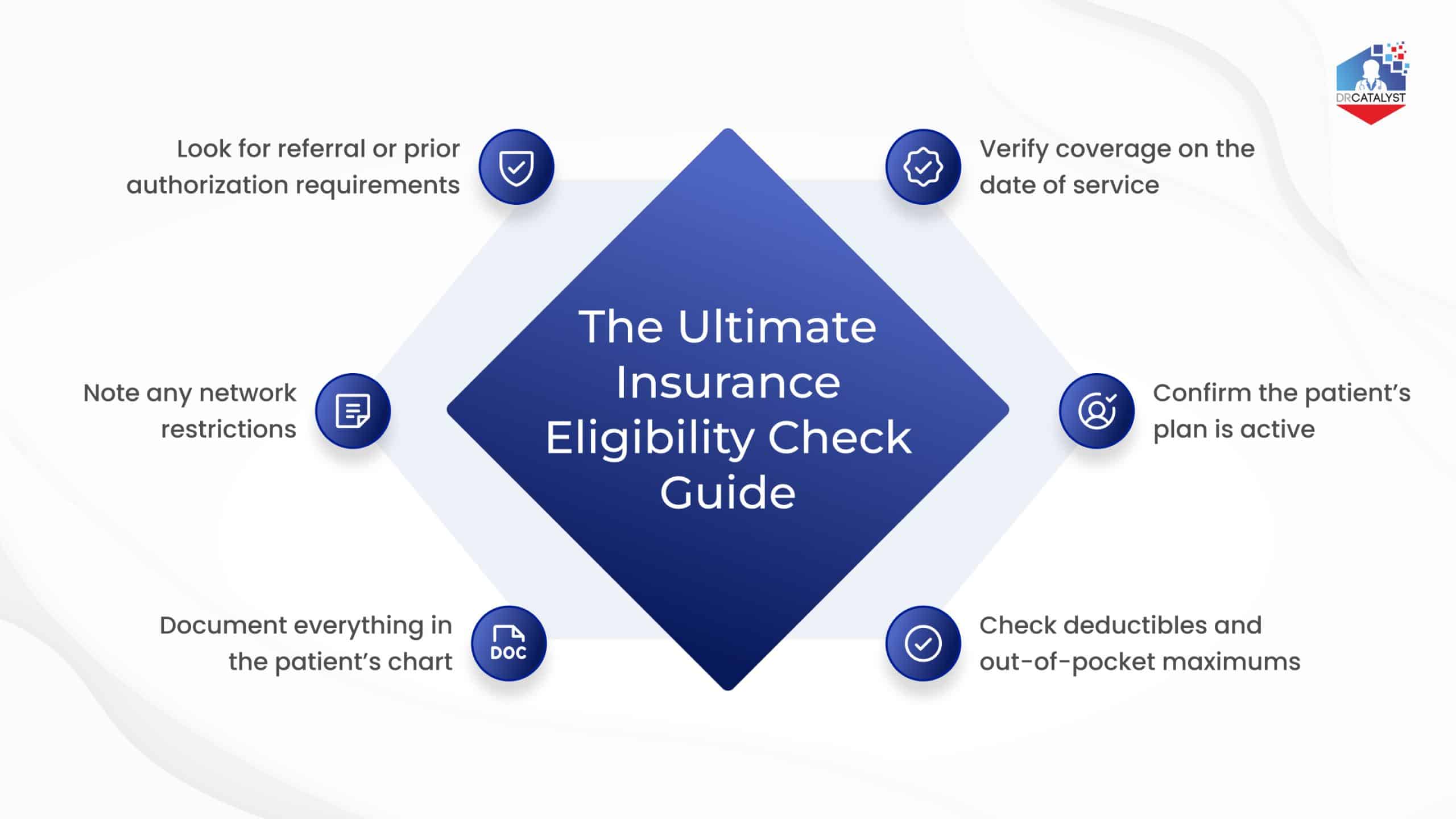
The Ultimate Patient Eligibility Verification Checklist
Use this quick checklist every time:
Verify coverage on the date of service
Confirm the patient’s plan is active
Check deductibles and out-of-pocket maximums
Look for referral or prior authorization requirements
Note any network restrictions
Document everything in the patient’s chart
Make this part of your front desk routine, and you’ll see denials drop significantly. Contact Us to make this a part of your workflow.
Different Methods for Eligibility Verification
Healthcare providers can perform an insurance eligibility check using multiple methods depending on their workflow and resources.
1. Real-Time Electronic Verification
Instant verification through integrated systems is fast and efficient. It helps check insurance eligibility quickly and reduces manual workload.
2. Manual Verification
This step of detailed benefits verification involves
Calling insurance providers
Checking payer portals
Simplifying complex cases
3. Batch Verification
Verifying multiple patients at once is ideal for high-volume practices. At DrCatalyst, we ensure client-specific protocols are followed through structured supervision, qualitative assurance, and adapting our workflow to meet your clinic’s needs.
4. Third-Party Services
Outsourced eligibility and benefits verification services are scalable to accommodate seasonal changes or growth in the practice. Additionally, Drcatalyst’s remote eligibility coordinators check the patient’s prior authorizations to deliver the best results for the practice.
Challenges and Solutions in Verification
Even with the best intentions, the insurance verification process faces significant hurdles. Here are the top challenges and their solutions.
Live Data isn’t always accurate. Many payers offer “basic” coverage but omit details such as transplant benefits or mental health carve-outs.
Solution: Always perform secondary verification for high-cost procedures via a direct payer portal or by phone.
High patient volume and manually checking 50+ patients a day may lead to burnout and human error.
Solution: Automate the insurance eligibility check with human supervision for routine visits and outsource complex verifications.
Insurance companies update plan structures quarterly. This leads to frequent changes to payer rules.
Solution: Partner with experts who continuously update their rule sets. Insurance Approvals rely on up-to-date credentialing and verification data; if your provider credentials are stale, even active benefits won’t pay out.
Speak with a DrCatalyst specialist to build a resilient verification workflow.
Benefits of Outsourcing Eligibility Verification
Many practices are now choosing to outsource eligibility and benefits verification services. Here’s why it makes sense:
Reduces front desk backlog
Improves accuracy with trained specialists
Allows real-time verification at scale
Frees your team to focus on patient care
At DrCatalyst, our eligibility and benefits verification team handles this process with security and accountability as the foundation of providing the service. Learn more about our Eligibility and Benefits Verification services.
To Sum It Up
The eligibility and benefits verification process is a critical foundation of successful medical billing. Its impact ranges from reducing claim denials to improving patient satisfaction, extending across the entire revenue cycle. By combining the right tools, structured workflows, and exceptional support, healthcare providers can transform their insurance verification process into a strategic advantage.
For practices looking to scale efficiently and reduce administrative stress, outsourcing insurance eligibility verification to DrCatalyst offers a practical, results-driven solution.
FAQs
Best practices dictate that you conduct your primary verification sweep 48 to 72 hours before the patient’s scheduled appointment. This proactive window gives your front-office team adequate time to resolve coverage discrepancies, secure missing referral documents, or contact the patient to collect updated insurance information before the patient arrives at the clinic.
Yes. Insurance policies can change, lapse, or terminate overnight due to sudden employer shifts, missed premium payments, or policy re-enrollment cycles. Running a check before every encounter is the only way to safeguard your practice against avoidable rejections.
If an eligibility sweep returns an inactive status, notify the patient immediately upon arrival. Provide them with the opportunity to present an updated insurance card, log in to their payer portal to verify the current policy’s active status, or transition their account to a self-pay model with a clear financial responsibility waiver before care is provided.