


The administrative and financial health of an independent medical practice rests heavily on its revenue cycle. However, with shifting payer rules, complex modifier guidelines, and rapid industry updates, maintaining a zero-error billing process is nearly impossible. Minor administrative errors or mismatched codes can trigger a cascade of delayed payments and revenue loss.
Recent studies suggest that upcoding in ambulatory physician services represents the largest source of billing errors in traditional Medicare, with an estimated $2.38 billion in annual losses. Whether you run a small practice or a large healthcare organization, understanding and implementing regular medical billing audits can significantly improve your financial performance. In this blog of DrCatalyst, we shall elaborate more on these lines.
What is a Medical Billing Audit?
A medical billing audit is a systematic review of your claims, coding practices, documentation, and billing workflows. It identifies errors, inefficiencies, compliance risks, and most importantly, missed revenue opportunities. In simple terms: it’s your practice’s way of asking, “Are we actually getting paid for everything we do?”
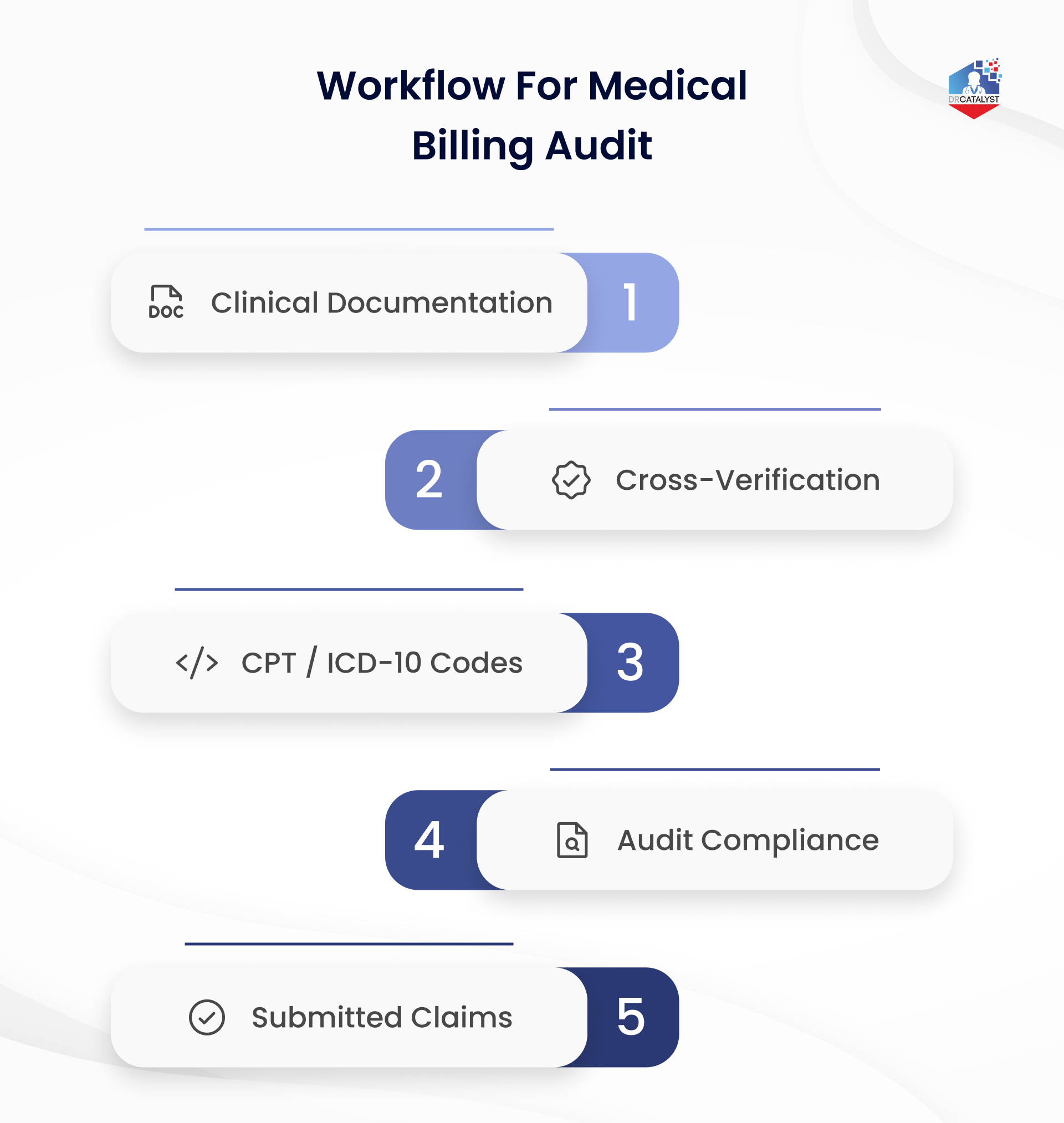
Types of Medical Billing Audits
There are different types of medical billing audits, each serving a specific purpose:
- Internal Audits:
Performed by your own team to catch issues proactively.
- External Audits:
Conducted by independent experts (highly recommended for unbiased results).
- Compliance Audits:
Focused on regulatory adherence and payer rules.
- Focused Audits:
Target high-risk areas, such as frequent denials or high-dollar procedures.
Benefits of a Medical Billing Audit
Implementing regular medical billing audits delivers tangible benefits across your practice:
1. Reduced Claim Denials
By identifying the root causes of denials, you can implement corrective actions and significantly reduce denial rates.
2. Improved Cash Flow
Faster, cleaner claims mean quicker reimbursements and healthier days in accounts receivable (A/R).
3. Enhanced Healthcare Billing Compliance
Stay ahead of ever-changing regulations from CMS, private payers, and HIPAA. Audits reduce your risk of fines, audits, and even exclusion from federal programs.
4. Coding Accuracy
Ensure your coders and providers use the correct ICD-10, CPT, and HCPCS codes to capture all billable services.
5. Staff Training Opportunities
Audit findings can serve as powerful teaching tools to upskill your billing team and providers.
6. Payer Negotiation Leverage
Clean audit trails and low error rates strengthen your position in reimbursement contract negotiations.
Medical Billing Audit Process
Understanding how to do a medical billing audit is key to achieving consistent results. Here’s a simplified process:
Step 1: Define Audit Scope
Decide whether you’re auditing coding, claims, compliance, or the entire revenue cycle.
Step 2: Collect Data
Gather patient records, billing reports, EOBs, and claim data.
Step 3: Review Documentation
Ensure clinical documentation supports billed services.
Step 4: Analyze Coding Accuracy
Verify that CPT, ICD-10, and modifiers are correctly applied.
Step 5: Evaluate Claim Submissions
Check for errors in claim filing, payer requirements, and timelines.
Step 6: Identify Trends
Look for recurring issues such as frequent denials or underpayments.
Step 7: Implement Corrections
Address identified gaps and optimize workflows.
Step 8: Monitor and Improve
Continuous monitoring ensures long-term efficiency.
Regular audits not only improve accuracy but also align your processes with evolving industry standards. Stay updated with the latest insights from medical billing trends.
Medical Billing Audit Checklist for Practices
A medical billing audit checklist ensures you don’t miss critical areas. Use this checklist for your next audit:
| Audit Area | What to Check |
|---|---|
| Patient Demographics | Correct spelling, DOB, insurance ID, group number, and policyholder information |
| Insurance Verification | Active coverage, eligibility on date of service, referral/authorization on file |
| Charge Capture | All billable services documented in the medical record and transferred to the superbill |
| Coding Accuracy | ICD-10 codes support medical necessity; CPT codes match the level of service; modifiers are appropriate |
| Documentation | Complete, legible, signed, and dated notes; medical necessity clearly stated |
| Claim Submission | Timely filing within payer limits; correct claim format (CMS-1500 or UB-04); all required attachments included |
| Payer Policies | Compliance with NCCI edits, LCDs/NCDs, and specific payer medical policies |
| Payment Posting | Accurate posting of contractual adjustments, write-offs, and patient responsibility |
| Denial Management | Root cause analysis of denials; appeal turnaround time |
Why DrCatalyst is Your Ideal Audit Partner
Running a medical practice demands your full attention, leaving very little time to manually audit thousands of line items. Furthermore, building and retaining an experienced, in-house team of certified coders can significantly increase your operational overhead. At DrCatalyst, we take the stress out of your revenue cycle. Our highly trained remote billing specialists understand the nuances of specialty-specific billing, strict payer policies, and changing compliance rules.
We act as a direct extension of your office, checking your claims for errors, working on denials within 3 business days, and keeping your collections moving efficiently. Don’t let staffing shortages drag down your collections. Hire Medical Billers from DrCatalyst’s premier administrative network to secure expert management for your account.
Conclusion
A medical billing audit is not just a compliance exercise; it’s a strategic tool for optimizing your entire revenue cycle. From reducing denials to improving cash flow, audits help practices stay financially healthy and operationally efficient. By implementing regular audits and leveraging trained specialists, healthcare providers can transform their billing processes into a competitive advantage. Optimize your billing process with DrCatalyst and turn your audits into actionable growth strategies.
FAQs
Ideally, perform internal audits monthly and external audits quarterly. High-volume practices may benefit from monthly external audits.
Costs vary based on practice size and scope. Some medical billing services include audits in their package; others charge separately. Read our Medical Billing Services Cost guide for details.
Yes, but it requires expertise in coding, compliance, and payer rules. Many practices outsource to experts for unbiased, thorough reviews.
Internal audits are done in-house for ongoing quality control. External audits are third-party reviews for compliance and identifying blind spots.
By catching underpayments, missed charges, coding errors, and denials before they become revenue losses.