


On Wednesday, a patient calls the clinic. She left Monday’s visit with a new GLP-1 prescription, but the pharmacy still hasn’t filled it because her plan requires prior authorization. So the medical assistant logs into a payer portal. The nurse goes looking for an old lab report. The provider then gets a note asking why the patient didn’t stay on metformin longer.
Most clinics that prescribe these drugs know this routine well. The American Medical Association’s 2025 prior authorization survey puts numbers to it: physicians complete about 40 prior authorizations a week, the work eats up roughly 13 hours of physician and staff time, and 40% of physicians now pay for staff who do nothing but prior authorization.
The AMA figures include all kinds of requests. Still, for clinics with a growing GLP-1 patient base, medication prior authorization often hurts most because it never really stops. Below, we explain why these requests take so long, what the work involves, which Centers for Medicare & Medicaid Services (CMS) rules will and won’t change, and where clinics can find relief. If you’d rather hand off the work, our medication prior authorization services explain how DrCatalyst can help.
Why Prior Authorization for GLP-1 Drugs Takes So Long
Payers have tightened control as demand for GLP-1 drugs has climbed. In Medicare Part D, for example, a 2025 JAMA Network Open study found that about 83% of plans required prior authorization for semaglutide and tirzepatide.
By the third quarter of 2024, that figure had risen sharply from the previous year. Coverage also hinges on why the drug is prescribed. Requests for type 2 diabetes follow one set of rules. Requests for weight management follow different rules, and some plans don’t cover weight-loss drugs at all.
Payers may ask for a qualifying diagnosis, supporting labs, body mass index (BMI) thresholds, related conditions, step therapy history, or proof of a lifestyle program. Two patients on the same drug, with different plans, can face completely different paperwork. Then the calendar. GLP-1 approvals often last only a few months. If no one tracks the renewal date, the patient shows up at the pharmacy for a refill and the whole process starts again.
What the Work Looks Like Day to Day
Filing the request is the easy part. Before that, someone must confirm the patient’s pharmacy benefits, check the formulary and prior authorization criteria for that specific drug, and pull the right chart notes, labs, and prior therapies from the electronic health record (EHR). After filing, someone has to watch for the payer’s response, answer requests for more information, and let the patient and provider know what happened. Many delays trace back to the first step.
When coverage isn’t confirmed up front, problems only surface at the pharmacy counter. Solid eligibility and benefits verification catches those gaps before the prescription ever leaves the office. Pharmacy rejections add another layer to medication prior authorization. The pharmacy calls the clinic, the clinic calls the payer, and the payer asks for a form the clinic thought it already sent. Each round of phone tag can cost a day or two.
The Hidden Staffing Cost
Ask who handles prior authorization for GLP-1 requests in a typical clinic, and the honest answer is usually “whoever has a minute.” Sometimes that’s a nurse. Sometimes it’s a medical assistant between patients, or a front desk employee during a quiet stretch. That arrangement holds up with five requests a week. At fifty, it falls apart. Time spent on hold with a pharmacy benefit manager takes away from rooming patients, returning calls, and supporting providers.
The work is spread across several people; requests get lost. One person files it, another sees the payer’s reply, and nobody follows up. Patients pay for that too. In the same AMA survey, 79% of physicians said patients had abandoned treatment because of prior authorization problems.
Denials, Appeals, and Short Approval Windows
The earlier AMA report found that 32% of physicians say their prior authorization requests are often or always denied. For GLP-1 prior authorization, the usual reasons are missing documentation, an unmet step therapy rule, or a formulary exclusion. Each denial means finding out what went wrong, pulling more records, asking the provider for input, and meeting the appeal deadline.
Sometimes it means scheduling a peer-to-peer review. Clinical decisions belong with the provider, but staff can handle the legwork around an appeal if someone owns it. When nobody owns it, a denied request can sit untouched for weeks.
What CMS Rules Will and Won’t Fix
The CMS Interoperability and Prior Authorization Final Rule (CMS-0057-F) requires certain payers to respond to urgent requests within 72 hours and to standard requests within 7 calendar days. They must provide a specific reason for each denial. That rule leaves out drugs. So for now, GLP-1 and other drug requests sit outside those deadlines. If your clinic is deciding whether to manage this work in-house or turn to remote healthcare prior authorization services, our prior authorization outsourcing guide walks through the trade-offs.
Drugs could be next. In April 2026, CMS published a proposed rule on prior authorization for drugs (CMS-0062-P). It would bring electronic prior authorization to drugs, require Medicaid plans to decide most drug requests within 24 hours, and require payers to explain denials. Several provisions are proposed to take effect on October 1, 2027. An electronic portal still needs complete records, someone to answer the payer, and someone to call the patient.
Practical Ways to Lighten the Load
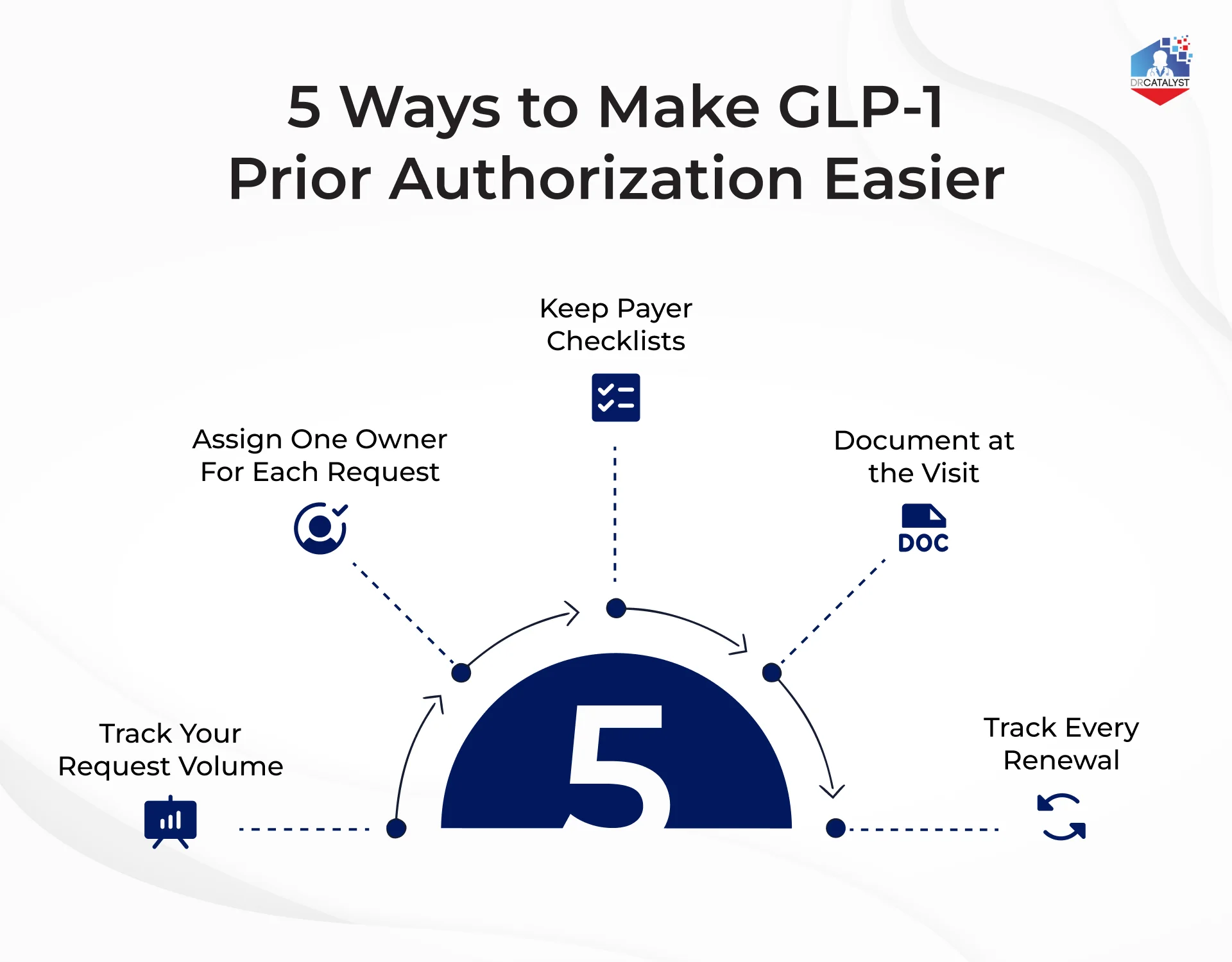
You don’t need to wait for 2027. Start by counting. How many medication prior authorization requests does your clinic handle in a week? How many are pending right now, and how many were denied last month? Most clinics are surprised by the answer. Next, give one owner the work. One person or team handling each request from start to finish removes the “I thought you had it” problem.
Keep a short reference sheet for your top payers that lists their GLP-1 criteria, since formulary prior authorization rules change often and without much notice. Ask providers to document the details payers ask for most, such as diagnosis, weight history, and earlier therapies, at the visit. Put every renewal date on a calendar so approvals don’t lapse between refills.
How DrCatalyst Can Help
DrCatalyst’s healthcare prior authorization services provide clinics with full-time remote specialists who work inside the clinic’s EHR. The team includes 80+ registered pharmacists who help with complex requests by verifying medical necessity and ensuring each submission meets the payer’s clinical criteria. For GLP-1 requests, our specialists review each payer’s formulary and prior authorization criteria, document the diagnosis, labs, and step therapy history for each request, track renewal dates, and handle pharmacy rejections end to end.
The same team manages biologics, infusion therapies, and buy-and-bill drugs, where a denial can leave a clinic paying for medication already on the shelf. Clinics can message their specialist directly for urgent requests and receive daily productivity reports. Every account has 3+ levels of supervision, so if a specialist is out, a supervisor keeps requests moving. DrCatalyst has supported medical practices since 2010 and handles more than 40,000 prior authorization tasks every month.
To Conclude
GLP-1 drugs have turned medication prior authorization into steady, everyday work for many clinics. New CMS rules should speed parts of it up over the next few years, but someone will still need to gather records, follow up with payers, and catch renewals before they expire. The clinics that handle it best treat prior authorization as its own job, not a task squeezed between patients. If GLP-1 requests are stretching your team thin, talk to DrCatalyst about your volume and current workflow.
FAQs
They’re expensive, and coverage depends on whether the drug is prescribed for diabetes or weight management. Prior authorization for GLP-1 drugs lets the payer confirm the patient meets its criteria before covering the prescription.
It’s approval a payer requires before covering a formulary drug. The prescriber must show the patient meets set criteria, such as a qualifying diagnosis or prior therapies.
It can take anywhere from a day to several weeks. Missing records, requests for more information, and appeals all add time.
Not yet. The current final rule (CMS-0057-F) excludes drugs. A proposed rule (CMS-0062-P) would add drugs, with several provisions proposed for October 1, 2027.
Yes. Healthcare prior authorization services like DrCatalyst provide remote specialists who manage requests inside the clinic’s EHR, while providers keep control of clinical decisions.