


Practices don’t lose revenue in one dramatic moment. It slips away little by little: a claim sent with the wrong code, a denial nobody had time to appeal, a patient balance that ages past 90 days. By year-end, those small gaps can seriously hit the bottom line. Billing mistakes also add up nationally. According to the Centers for Medicare & Medicaid Services (CMS), Medicare made an estimated $28.83 billion in improper fee-for-service payments in fiscal year 2025. Most often, insufficient documentation that didn’t support the claim caused it.
This is where revenue cycle management (RCM) companies come in. An RCM company takes over some or all of the work involved in turning patient visits into payments. If you’re new to how that process works, our guide to the steps of RCM is a good place to start. Below, we cover why RCM matters, ten revenue cycle management companies worth knowing, and how to pick the right fit for your practice.
Why RCM Services Matter for Your Practice
Payers are denying more claims, and the rules keep changing. In its review of 2024 data, KFF found that HealthCare.gov insurers denied about 19% of in-network claims. Fewer than 1% of those denials were appealed. For a practice, every denial that goes unworked is money left on the table, and catching those denials is a big part of what revenue cycle management companies do. Denials are only one piece of the puzzle. Coding updates, credentialing, eligibility checks, and patient collections all compete for your staff’s time.
Prior authorization adds to the pressure. In the American Medical Association’s (AMA) 2025 survey, physicians reported completing about 40 prior authorizations a week, taking roughly 13 hours of physician and staff time. That’s why many practices now hand the work to a revenue cycle management service provider rather than stretching their own team thinner.
Hiring in-house isn’t cheap either. According to the U.S. Bureau of Labor Statistics, medical records specialists earned a median of $51,140 a year in May 2025, before benefits, training, and software. For many groups, one experienced RCM service provider costs less than building a full billing department. Smaller clinics often feel this the most. If you run a practice with one or two providers, talk to us about why it can be a smart move to outsource your RCM.
Top 10 RCM Companies for Healthcare Practices
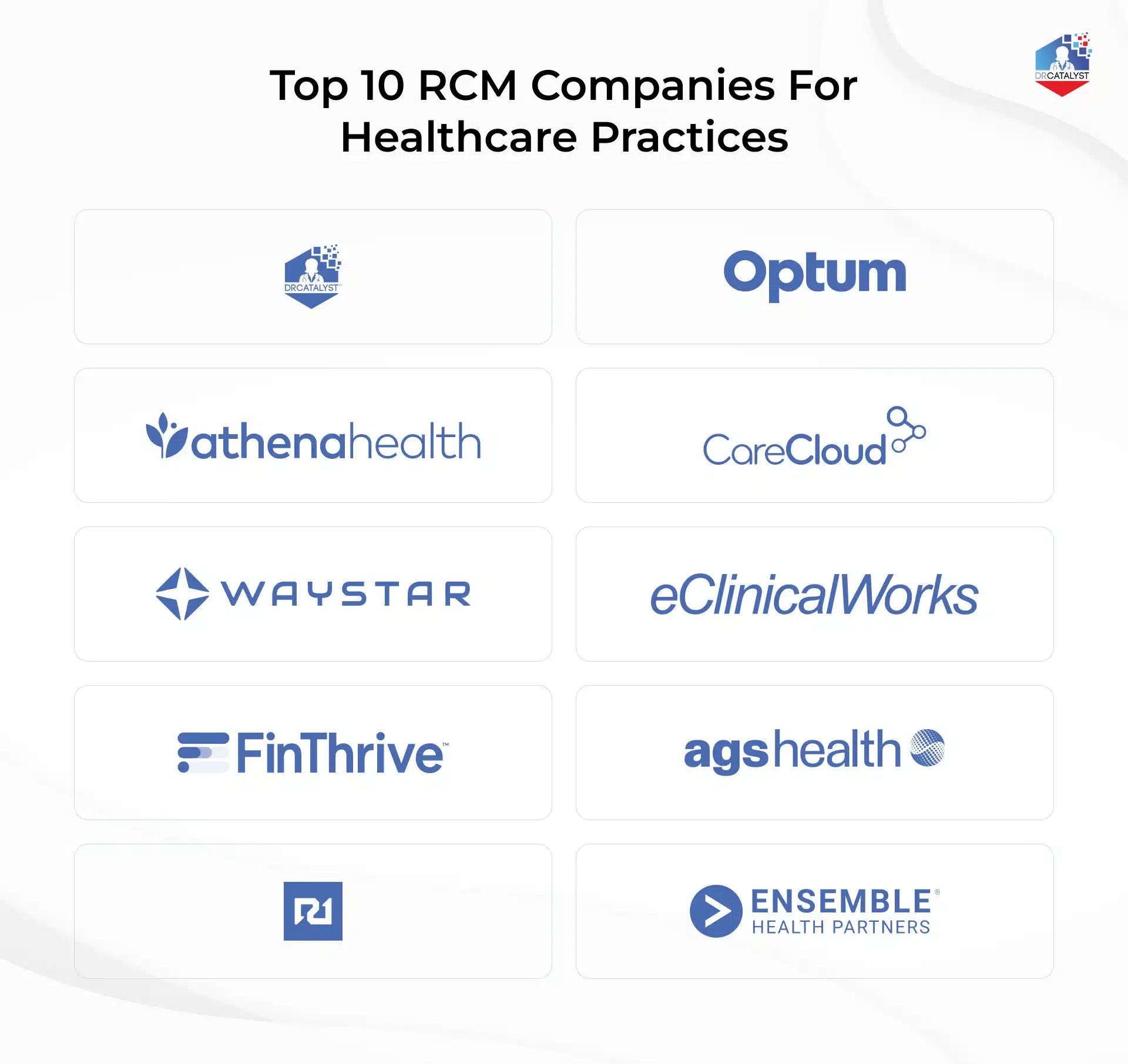
No single choice is best for every practice. Some RCM companies focus on large health systems, while others are built for independent and specialty practices. Here are ten well-known revenue cycle management companies, including several top end-to-end RCM managed service providers, along with who each one serves best.
1. DrCatalyst
DrCatalyst offers end-to-end RCM for practices of all sizes, with remote billing teams that work directly inside your existing electronic health record (EHR). Each client gets a dedicated account manager, regular reporting, and multiple levels of supervision. DrCatalyst’s RCM services are a strong fit for independent and specialty practices that want to avoid switching software, protocols, or workflows.
2. R1 RCM
R1 RCM is one of the largest revenue cycle management companies in the country. It provides end-to-end RCM for hospitals, health systems, and physician groups, and is one of the most recognized names among large health systems.
3. Optum
Optum, part of UnitedHealth Group, offers billing, coding, and analytics services through its revenue cycle business. It mainly serves large hospitals and health systems and also owns Change Healthcare’s claims technology.
4. Ensemble Health Partners
Ensemble is a revenue cycle management company focused on end-to-end services for hospitals and health systems. Large organizations looking to outsource their entire revenue cycle often consider Ensemble alongside R1 and Optum.
5. Waystar
Waystar is a cloud-based platform, not a full-service billing team. It automates eligibility checks, claims management, denial prevention, and patient payments. Waystar works with a wide range of EHRs.
6. athenahealth
athenahealth combines cloud-based practice management, EHR, and billing tools. Its RCM services are popular with small and mid-sized ambulatory practices that want billing built into their EHR.
7. FinThrive
FinThrive offers revenue cycle software for health systems, including claims management, denial management, and pricing transparency tools. It suits organizations that want strong revenue-cycle analytics.
8. AGS Health
AGS Health provides revenue cycle services, including coding, billing, and accounts receivable (A/R) follow-up. It is supported by its own technology platform. AGS Health works with health systems and physician groups.
9. CareCloud
CareCloud combines cloud-based RCM, EHR, and practice management. Its billing tools focus on claims scrubbing, denial resolution, and patient collections. CareCloud serves independent practices and medical groups.
10. eClinicalWorks
eClinicalWorks pairs its EHR with RCM services for ambulatory practices. It’s a fit for practices that already use eClinicalWorks and want billing handled within the same system.
How to Choose the Right Revenue Cycle Management Company
A good partner should fit the way your practice already works. As you compare options, ask a few practical questions.
Do they work in your EHR? Switching software is costly and disruptive. Many top end-to-end RCM managed service providers can work within your current system.
Do they know your specialty? Mental health, allergy, and orthopedic billing all follow different rules. Ask how many specialties in your practice they can work with!
How do they report results? You should see clear monthly numbers, such as clean claim rate, denial rate, days in A/R, and collections.
Are they ready for new rules? The CMS Interoperability and Prior Authorization Final Rule sets new decision timelines for certain payers, so your partner should understand what’s changing.
What does the contract look like? Look for clear pricing, no surprise fees, and a reasonable exit clause. For more guidance, see our guide on choosing the right RCM partner.
How DrCatalyst Helps Practices Improve RCM
DrCatalyst is a revenue cycle management company that has been benefiting medical practices since 2010. Instead of asking you to change systems, our remote billing teams work within your EHR and follow your workflows. As a revenue cycle management service provider, we handle charge entry, claims scrubbing and submission, payment posting, denial management, A/R follow-up, and patient statements. We post charges and payments within 24 to 48 business hours, and we work denials within 48 to 72 business hours.
Our RCM clients see an average 18% increase in revenue. We also specialize in specialties with unique billing needs. For example, our mental health billing and RCM services cover the payer rules and session-based coding behavioral health practices handle every day. Every client gets a dedicated account manager, regular meetings, and reports that show exactly where your revenue stands. Ready to see the difference?
To Summarize
The right RCM company can cut denials, speed up payments, and free your staff to focus on patients. The best fit depends on your size, specialty, and EHR. Large health systems often lean toward full-service firms like R1 or Ensemble, while independent and specialty practices usually do better with a partner that works inside their current system and knows their billing rules. Take time to compare a few revenue cycle management companies, ask for clear reporting, and check how they handle your specialty.
If you’d like a partner that works the way you do, we can help.
FAQs
A revenue cycle management company manages the steps that turn patient visits into payments, including eligibility checks, coding, claims, payment posting, denials, and patient billing.
Compare how each revenue cycle management company works with your EHR, how well it knows your specialty, how it reports results, and what its contract includes.
No. Some focus on large health systems, but many RCM companies, including DrCatalyst, serve small and mid-sized practices.
Medical billing focuses on preparing and submitting claims. A revenue cycle management service covers the whole financial process, including eligibility, coding, denials, A/R, and patient collections.
Pricing varies by provider and practice. Some charge a percentage of collections, while others charge a set monthly fee or per staff member. Ask for a written quote based on your claim volume.